
-
![Jean Gorin]()
Spactio-temporal composition no. 136, 1976
100 x 100 x 16 cm
-
![Jean Gorin]()
Multivisual Spatio-temporal Composition No. 121, 1975
Vinyl/wood, 100 x 100 x 15 cm
-
Composition No. 30, 1958
Oil on wood, 50 x 38 cm
-
Conquest of Space No. 3: Spatiotemporal Rhythm, 1957
Oil on wood, 143 x 143 x 11 cm (100 x 100 cm)
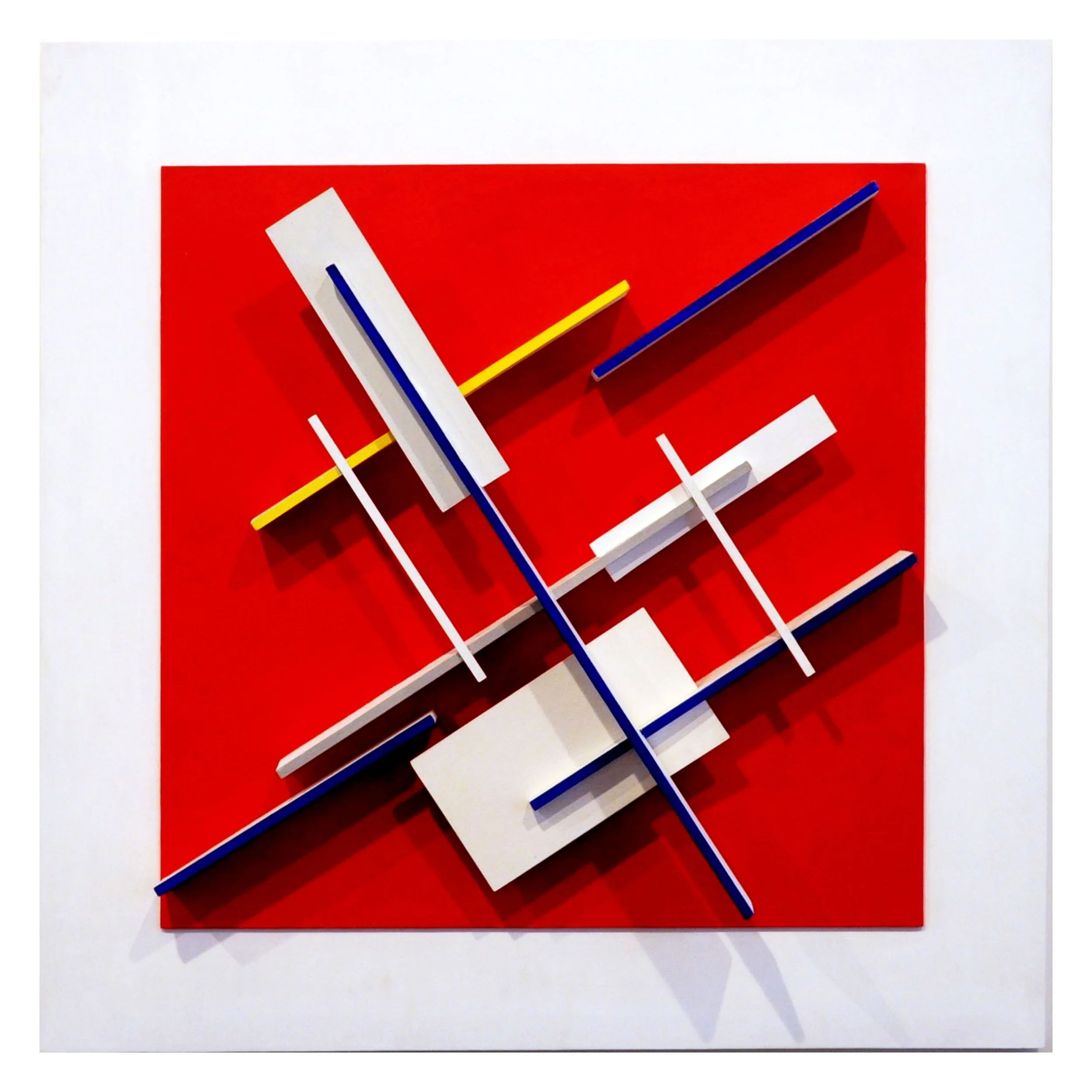
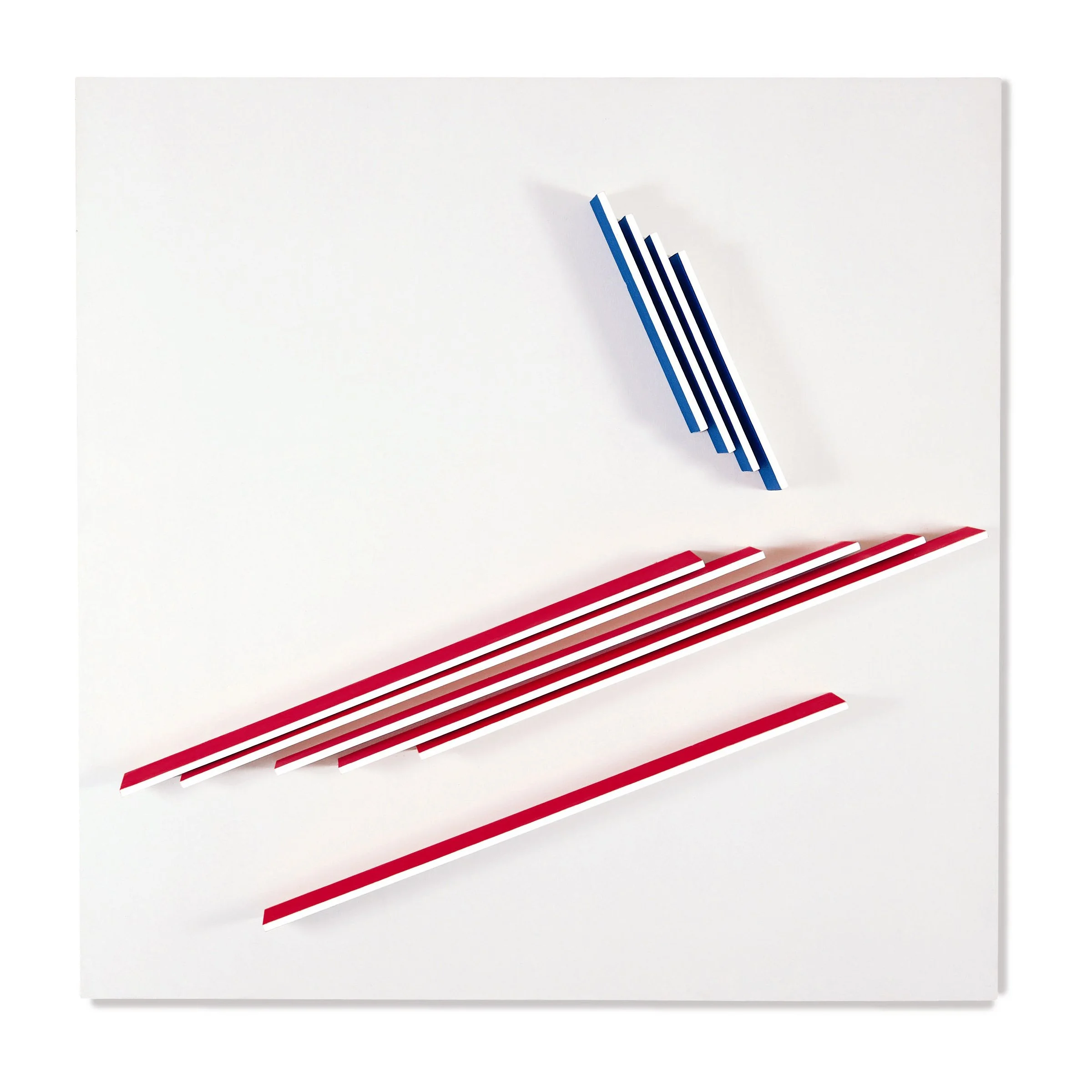


© Nantes Métropole - art museum - Photo: B.
« In Neoplastic compositions, the permanent balance of the individual and the universal, the subjective and the objective, the static and the dynamic, matter and spirit is expressed through the constant opposition of its fundamental elements. »
JEAN GORIN
After studying at the Académie de la Grande-Chaumière in Paris between 1915 and 1917, Jean Gorin continued his training at the École des Beaux-Arts in Nantes from 1919 to 1922. He then settled in Nort-sur-Erdre, in the Loire-Atlantique region, where he lived until 1937. There, working in solitude but aware of the artistic dynamics of his time, he focused his research on Cubism and Purism. These movements led him to prioritize a meticulous construction of his work, setting aside concerns with literal representation. By moving away from representing the "silent life" of objects, his works are imbued with a vitality of their own, discernible to an attentive observer. This restrained yet palpable vitality results from the intensity with which Gorin refined and clarified his pictorial language. It was during this period, between 1926 and 1927, that a pivotal encounter with Mondrian took place. Gorin initially adopted the formalism of Neo-Plasticism, favoring the exclusive use of straight lines and right angles formed by the intersection of vertical and horizontal lines. However, he later reintroduced circles and diagonals into his compositions. Michel Seuphor has observed that it was Mondrian's moral stance, rather than his doctrine, that influenced the future direction of Gorin's work. Apart from a brief period of adherence to Neo-Plasticism, Gorin essentially retained a limited chromatic palette of the three primary colors, black, and white.
Gorin was also deeply influenced by the Neo-Plasticists' interest in transcending the painting and expanding it to encompass the overall plastic organization of architectural space. This desire to push the dematerialization of the artwork further led Gorin, in 1931, to introduce the third dimension into his compositions. He replaced the black bars structuring the colored fields of Neo-Plastic canvases with a subtle interplay of light and shadow, created by incising the surface into shallow reliefs.
In the "flat reliefs" of the 1930s, he limited himself to offsetting parallel planes in relation to the background of the composition. Here, color, applied to the surface, and relief, in negative space, acted as negative elements. But just after the Second World War, Gorin began to integrate increasingly prominent relief elements into his compositions, forming a "positive" relief. It was in 1945-1946 that he incorporated planes perpendicular to the background and created his first outdoor spatial constructions: consisting of black steel squares and colored panels. In front of the canvas, an area of increasing structural complexity was constructed, animated by the dynamic interplay of shifting, overlapping shadows. Moreover, color was no longer confined to surfaces parallel to the background but also occupied those perpendicular to it, interacting through reflection rather than direct application.
Gorin's compositions powerfully illustrate the contrast between the aspiration for forms of pure harmony and the deconstruction of space stubbornly favored by an opposing force. This latter force, though operating almost automatically, remains tangible and carries within it a potential for disruption. By fully embracing Mondrian's legacy, Gorin does not merely honor the approach initiated by his predecessor; he actively contributes to the consolidation and evolution of geometric abstract art with profound generosity and conviction. He combines an austere technique, perfectly suited to his art, with a finely balanced sensibility, thus offering a body of work imbued with an almost mathematical rigor. His art is rooted in an aesthetic of volume that explores depth and strives for the synthesis of an architecture born from the selective refinement of painting and sculpture. Gorin enriches the tranquility and stillness of Mondrian's Neo-Plasticism with a dimension of deliberate dynamism, manifest in the surfaces and volumes that evolve in accordance with the functional architecture. In his paintings, the arrangement of colors, distributed in lines and placed on relief planes, profoundly alters their chromatic properties. The unwavering nature of the system upon which it rests and the grandeur that emanates from it are unfailingly impressive. The visual power of Gorin's works stems not only from intrinsic inspiration but also from a deliberate aesthetic pursuit that permeates each composition.
Gorin's objective, in his own words, was to "plastically architect the internal space in harmony with the external space." This ideal represents the quintessence of his artistic research, achieving a fullness rarely attained by other forms of expression. His experiments with the sculptural use of color culminated in 1970 with the design of the "Plastic Structure of the Spatial House." In addition to his work with reliefs, Gorin also created several large-scale spatial structures: in 1955 for the city of Rome, in 1957 for Mexico City, and in 1968 for the University Institute of Technology in Nancy, marking his commitment to the creation of monumental sculptural works.
“This art, perfectly stripped down and which some will undoubtedly judge cold and devoid of feeling, in fact stems from the most generous thought. A part of intuition is preserved at the source of each work, even if it is deliberately concealed beneath a geometric appearance. Profound contradictions that reveal both the artist's asceticism and the complexity of art: what can arise from an effort to reconcile divergent aspirations, geometric principle and the blossoming of sensitivity, abstraction and the desire to serve life. And the man's discretion should not obscure the audacity, the obstinacy, and the nobility of his approach.”
Marianne Le Pommeré
Works in museums and public collections
National Center for Contemporary Art, Paris
Museum of Modern Art of the City of Paris, Paris
Museum of Fine Arts, Bordeaux
Museum of Art and Industry, Saint-Etienne
Museum of Painting and Sculpture, Grenoble
Progressive Museum, Basel
Stedelijk Museum, Amsterdam
Walter Art Center, Minneapolis
Selection of the main exhibitions
1989, Galerie Schlégl, Zürich, Switzerland
1969, Retrospective, National Center for Contemporary Art, Paris, France
1965, Retrospective, Museum of Fine Arts, Nantes, France
1960, Retrospective, Museum of Walloon Art, Liège, Belgium
1957, First solo exhibition, Galerie Colette Allendy, Paris
1928, First exhibition with the STUCA group, Ronchin (suburb of Lille), Art Nouveau workshop