
-
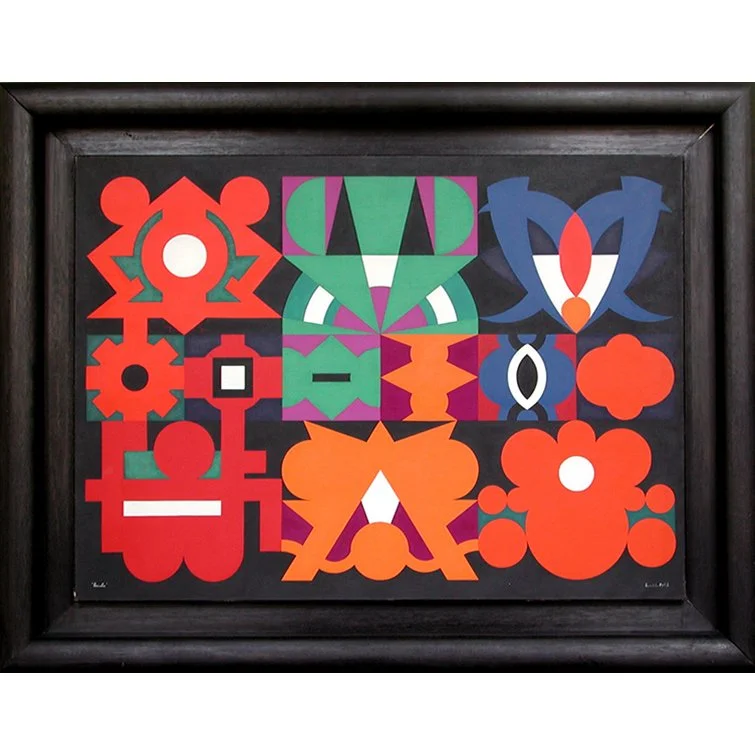
![Auguste Herbin]()
Mouth, 1943
oil on canvas, 73 x 100 cm
-
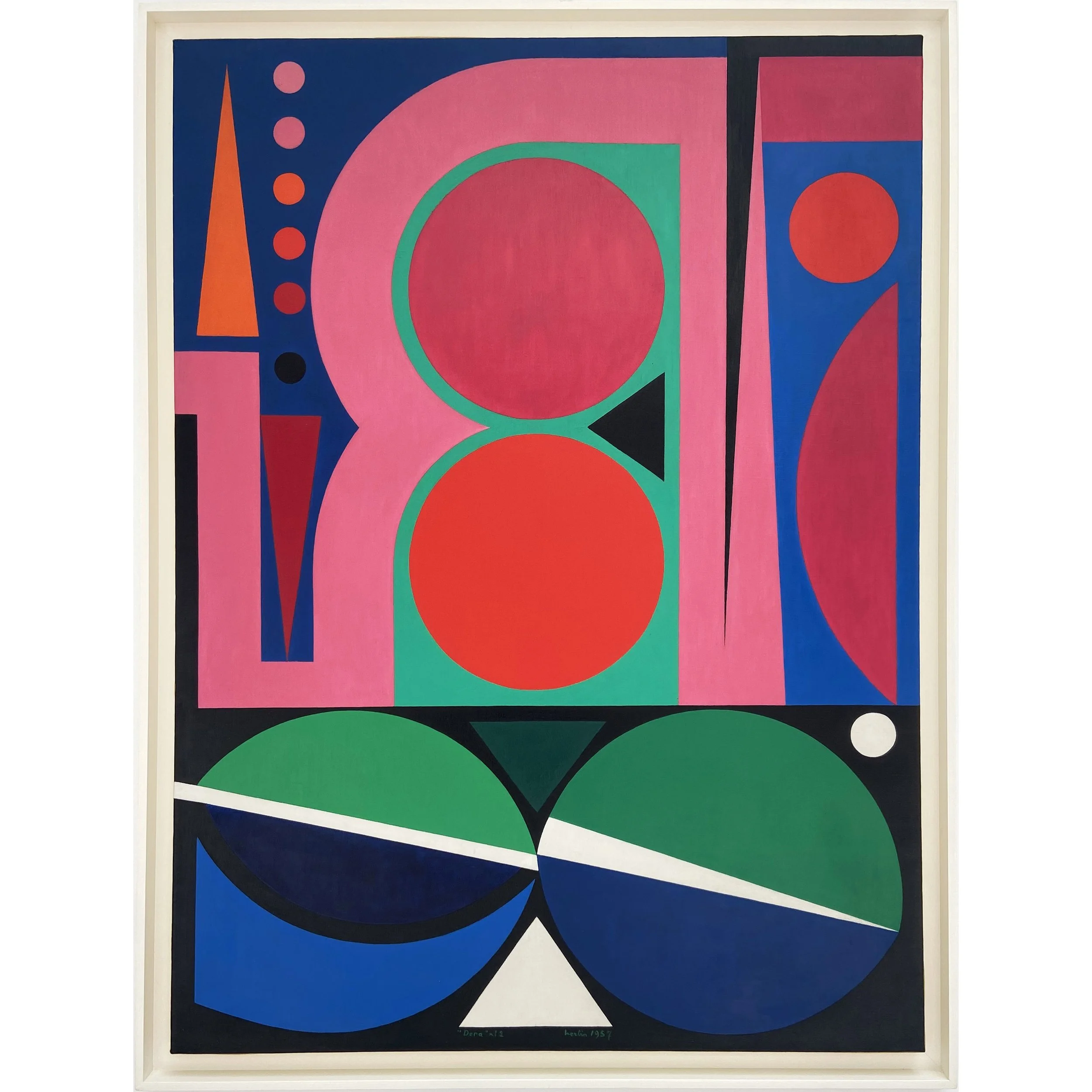
![Auguste Herbin]()
Dora II, 1957
oil on canvas, 130 x 97 cm
-
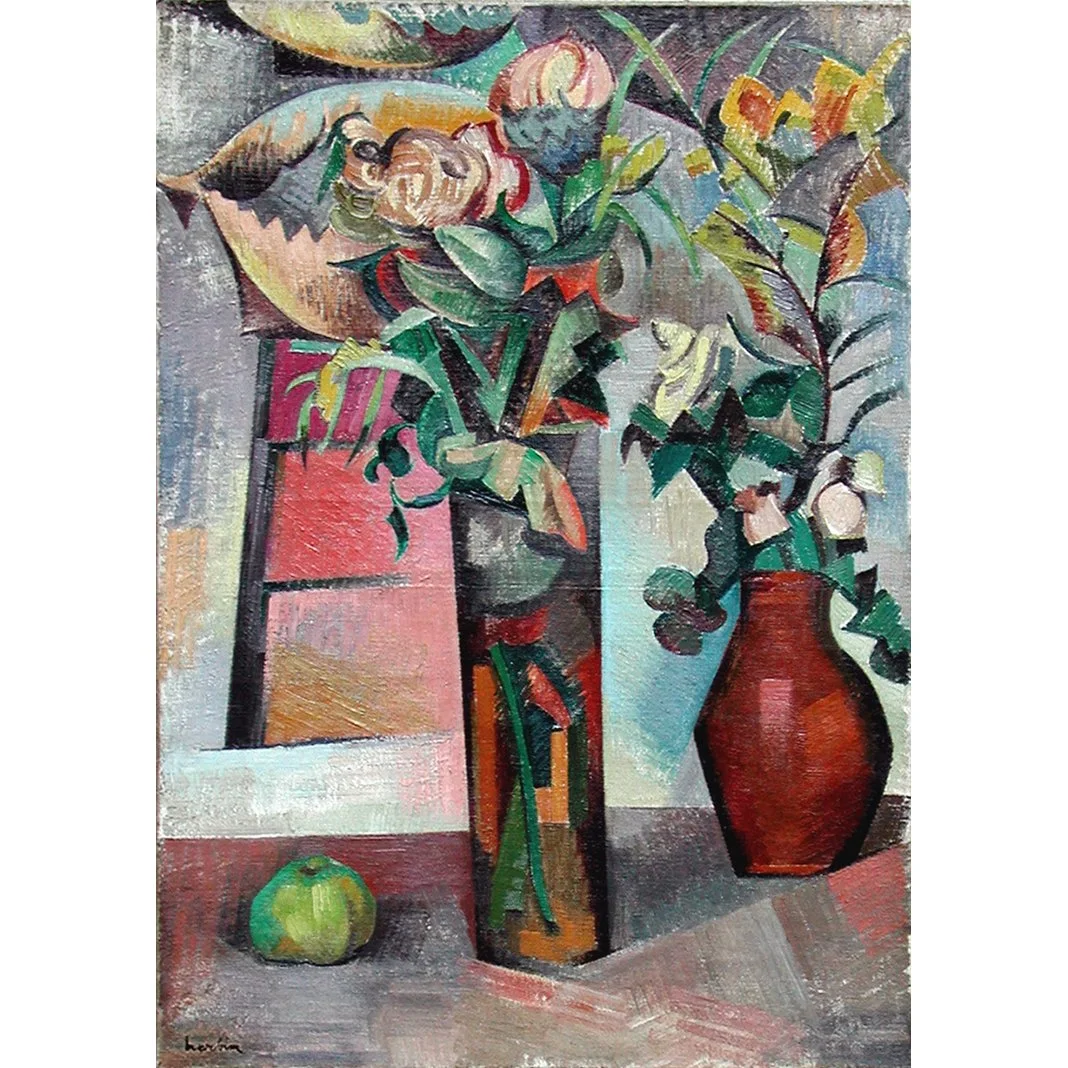
![Auguste Herbin]()
Still life bouquet of flowers, 1911
oil on canvas, 64.9 x 46.1 cm
-
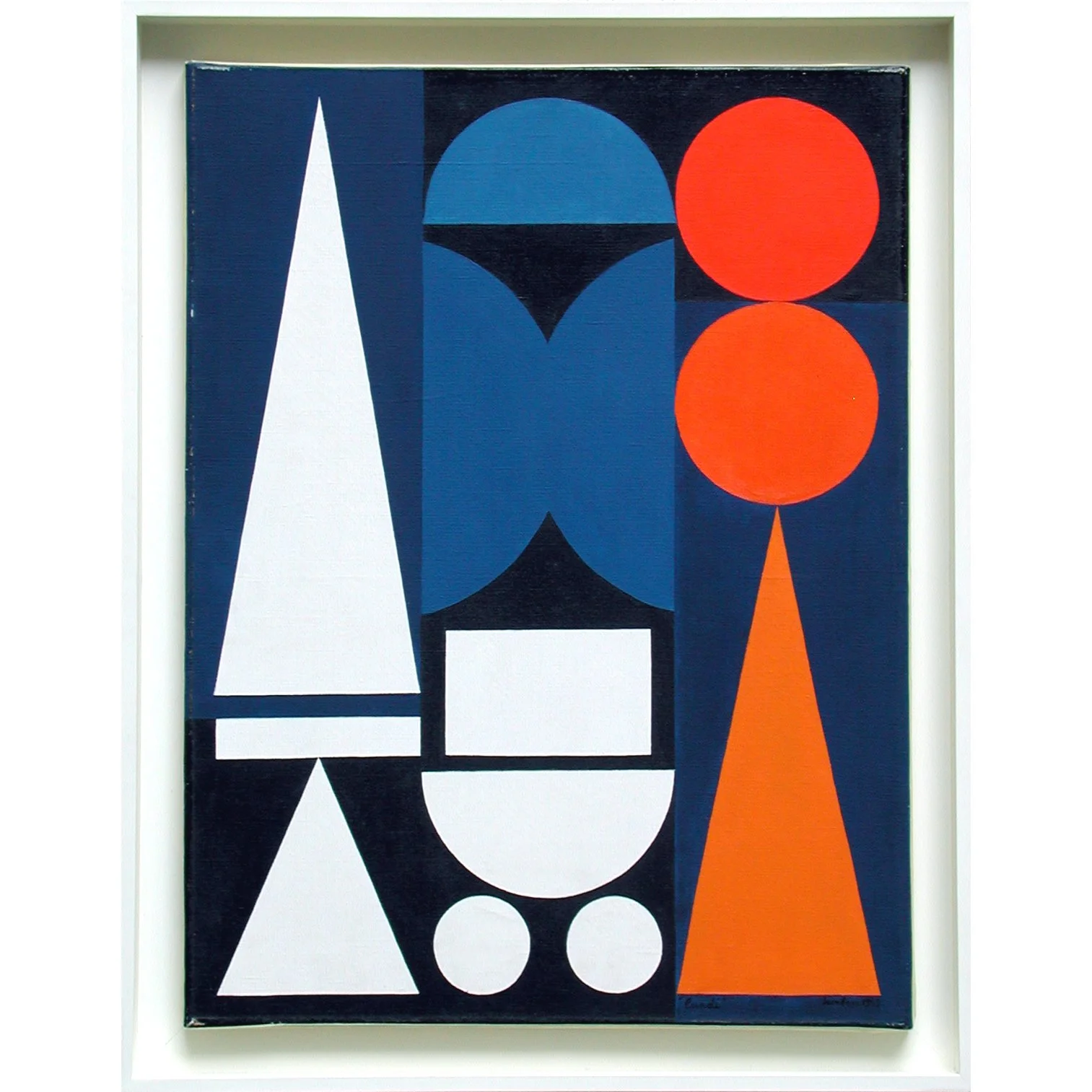
![Auguste Herbin]()
Monday, 1949
oil on canvas, 61 x 46 cm

Herbin, Stockholm 1951
« Let us repeat tirelessly that this is about the reality of being, the reality of a work conceived directly and absolutely by being, with the only means of being, a non-figurative, non-objective work that progressively enriches being, which is of the highest importance for human becoming. »
« The foundations of his “Plastic Alphabet,” as much scientific as esoteric, follow in the footsteps of both Goethe and Rimbaud. It allows him to develop his compositions from the words of his chosen vocabulary. Night (1953), Wine (1951), Friday the 2nd (1954), Perfume 2 (1954): the titles of his compositions testify to the diversity of his approaches but do not convey the effect produced by the combination of form and color, the expressive and rhythmic quality that emanates from the whole, nor the monumental scale that emerges. Auguste Herbin's art is, at this moment, masterful. »
AUGUSTE HERBIN
Born in 1882 in Quiévy, died in 1960 in Paris.
Auguste Herbin is one of the rare artists who not only left their mark on the history of abstract art but also on 20th-century modernism. The son of weavers, Herbin began working at the age of 12. His dedication to municipal drawing classes earned him a scholarship that allowed him to enroll at the École des Beaux-Arts in Lille. However, at the end of the 1901 academic year, he decided to leave the Beaux-Arts and settle in Paris. Herbin continued his artistic explorations in the wake of Cézanne, whom he considered his mentor, as well as Van Gogh. His early 20th-century still-life compositions retain a texture reminiscent of Cézanne, but Herbin's technique is more dynamic, with strong contrasts and colors at their most intense.
It is fascinating to note that rounded forms, subdivided into geometric patterns, are already present in his figurative works. This intuitive sense of geometry, perceptible as early as 1901, would leave a lasting mark on Herbin's work, as he constantly sought a geometric ideal to structure his forms and colors. In 1909, Herbin took up residence at the Bateau-Lavoir, occupying a studio adjacent to Pablo Picasso's. However, his approach to Cubism differed from that of Braque and Picasso. Initially, Herbin rejected the axiom of achromaticism, vigorously preserving vivid and contrasting colors in his work. Moreover, his graphic style employed entirely abstract geometric forms, which served no figurative purpose. Between 1918 and 1920, the majority of Herbin's creations flirted with abstraction. However, Herbin never forgot the teachings of Fauvism. In his work, color acted spontaneously, dissolving form. Thus, after having been influenced by Impressionism, Fauvism, and Cubism, he arrived at abstraction in the 1920s, a period from which he began to theorize his own artistic vocabulary. In 1920 and 1921, the artist first explored the complexities of mural painting. He created frescoes and attempted to integrate painted works and sculptures into architecture, the pivot and fusion of the arts. He also created sculptures in painted wood as well as 'sculpta-paintings,' a type of three-dimensional painting.
Around 1928, the aesthetic based on geometric, rectangular, and rectilinear forms was gradually replaced by a more organic and asymmetrical style. Industrial motifs gave way to those inspired by nature. Between 1930 and 1933, twisted, coiled, and undulating patterns began to appear. Herbin's stylistic line is a continuous flow without beginning or end. It is fluid and flexible like wool. This undulating and coiled line evokes the frenetic movement of a dancing maenad. In 1938, Auguste Herbin anticipated the notion of cosmic art. His circular forms evoke celestial bodies traveling on a circular trajectory. Celestial bodies moving around their orbits suddenly collide and shatter into a thousand pieces. The painter, like a demiurge, escapes the constraints of terrestrial gravity. His field of expression becomes cosmic space.
His abstract language gradually became more refined, revolving around his theory based on a correspondence between forms and colors. His research in this area culminated in his "Plastic Alphabet," created in 1943 and published as a treatise in 1949 in his book "Non-Figurative Non-Objective Art." His technique consisted of arbitrarily associating geometric shapes, colors, and tones with each letter. Acting like actual letters of an alphabet, these plastic elements were linked to one another around various concepts: a name, a musical note, a day of the week, or a philosophical concept. In this way, Herbin continued to develop the idea introduced by Goethe and popularized by Rudolf Steiner, which posits the existence of esoteric correspondences between letters, sounds, forms, and colors. It is the artist's responsibility to make the mysteries of the cosmic order perceptible to our senses. The exploitation of pure geometric forms, such as the square, the triangle, the circle, the semicircle, as well as the use of primary colors, offers the painter an infinite field of experimentation and creation through his intuition.
Co-founder of the Abstraction-Création association in 1931 with Georges Vantongerloo, Auguste Herbin remained a key figure in the post-war abstract art scene and a true mentor to other artists, including Victor Vasarely, Georges Folmer, Aurélie Nemours, Jean Dewasne, Geneviève Claisse, Olle Baertling, and Jean Leppien. Imbued with a synesthetic spirituality, Auguste Herbin's art is based on purely abstract thought, where each form and color is a silent statement. And that is what makes it so beautiful.
Works in museums and public collections
MNAM Center Georges Pompidou, Paris
Museum of Modern Art of the City of Paris, Paris
Museum of Grenoble, Grenoble
MoMA New York, USA
Selection of the main exhibitions
2025, Lenbachhaus Museum, Munich
2024, Montmartre Museum, Paris
2009, Museum im Kulturspeicher, Würzburg, Germany
2007, Museums of the Castle of the Dukes of Wurtemberg, Montbéliard
2005, Mondriaanhuis, Amersfoort, Netherlands
2003, Kunstmuseum Lentos, Linz, Austria
2002, Mondriaanhuis, Amersfoort, Netherlands
2001, London Royal Academy of Art, England
Selection of prints available in the shop


Editions Lahumière 1981 – Exhibition poster
Screen printing
95 x 72 cm
←Auguste Herbin | ←Prints | ←Store