
-
![Georges Folmer]()
Vertical with white lines 1956
Mixed media on canvas, 81 x 60 cm
-
![Georges Folmer]()
Composition 1962
Mixed media on hardboard, 63 x 100 cm
-
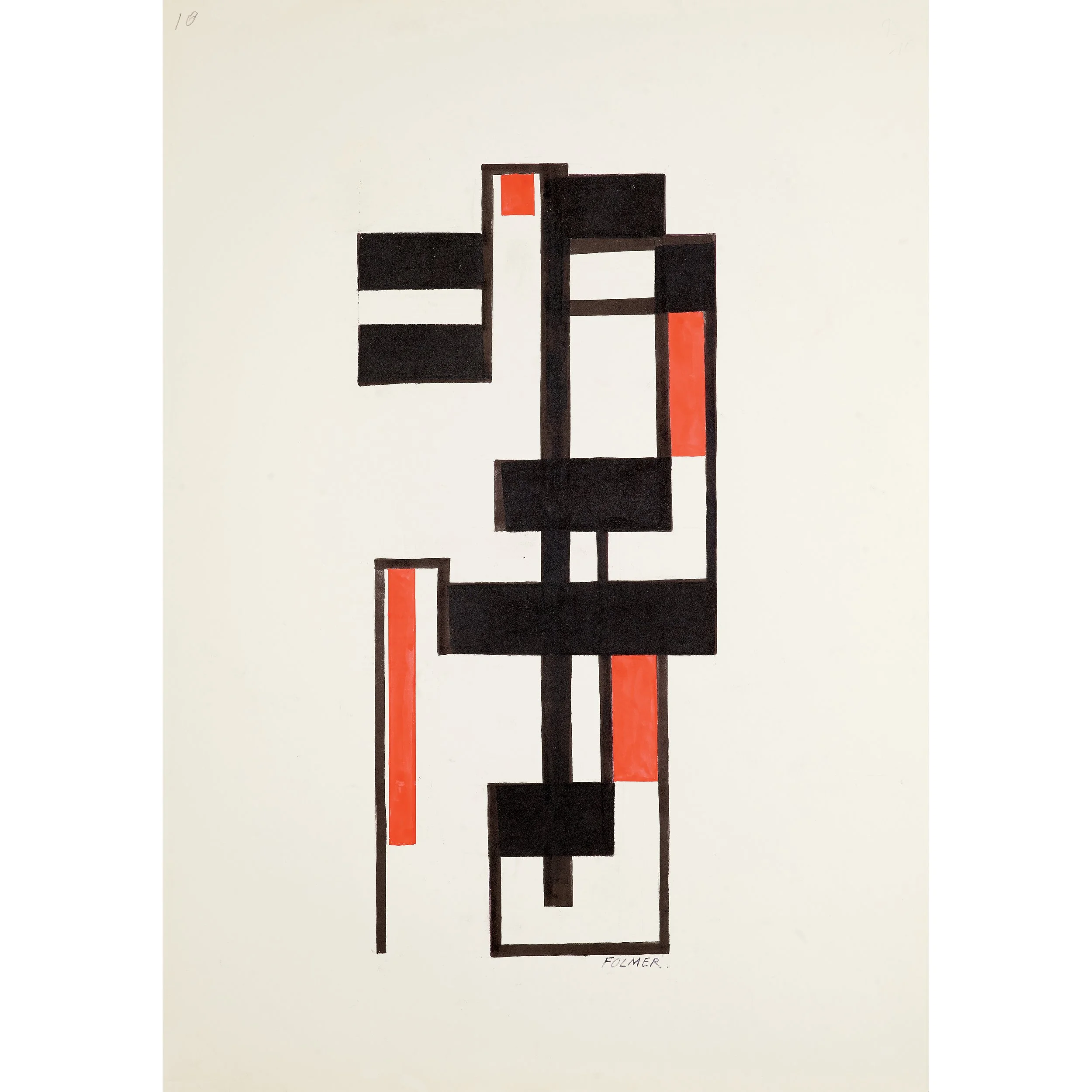
![Georges Folmer]()
Untitled, 1968
Ink and gouache on bristol board, 81 x 60 cm
-
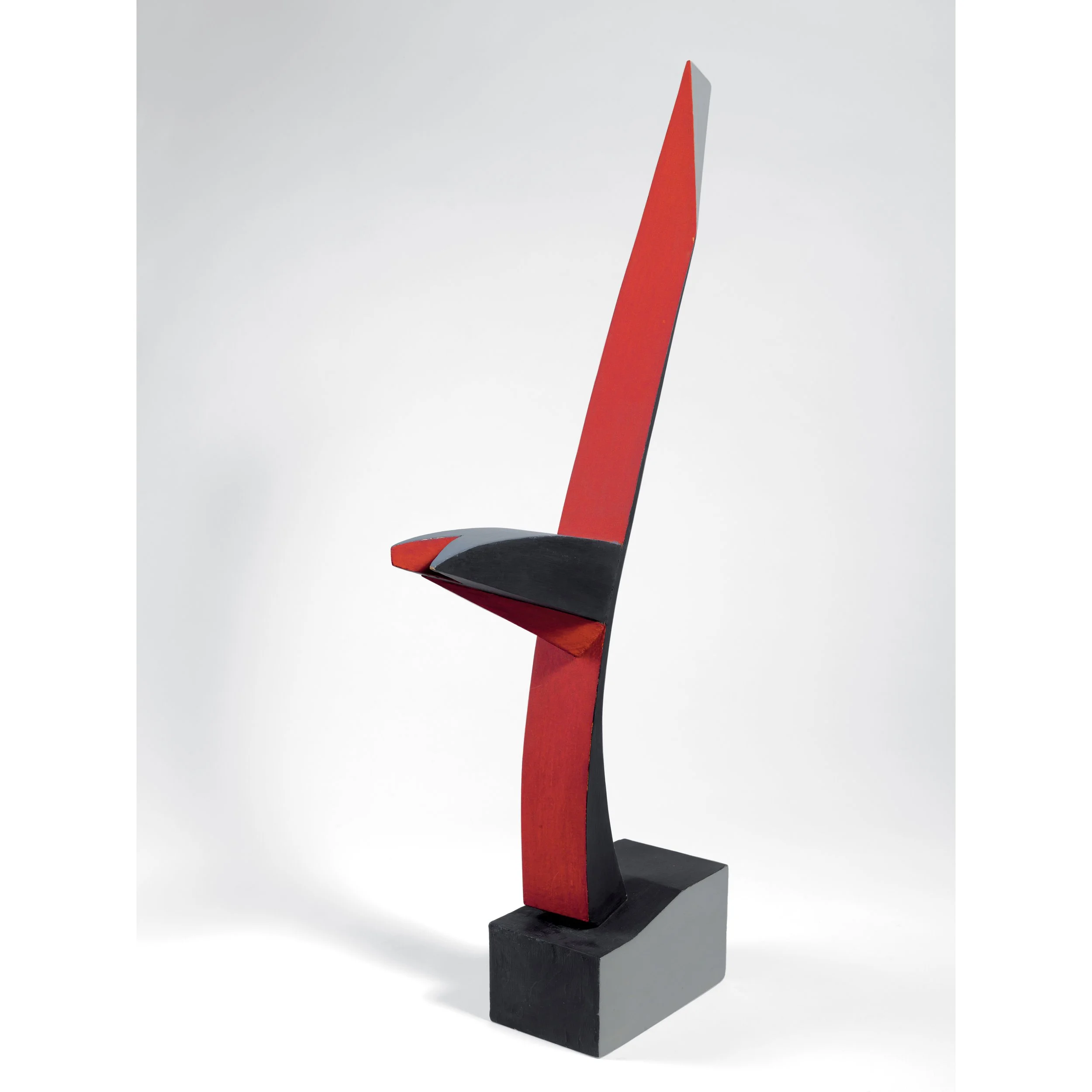
![Georges Folmer]()
Polychrome wood, ca. 1952
Oil on wood, 71 x 17 x 29 cm
-
![Georges Folmer]()
Untitled, 1949
Watercolor wash on paper, 18x24cm



GEORGES FOLMER
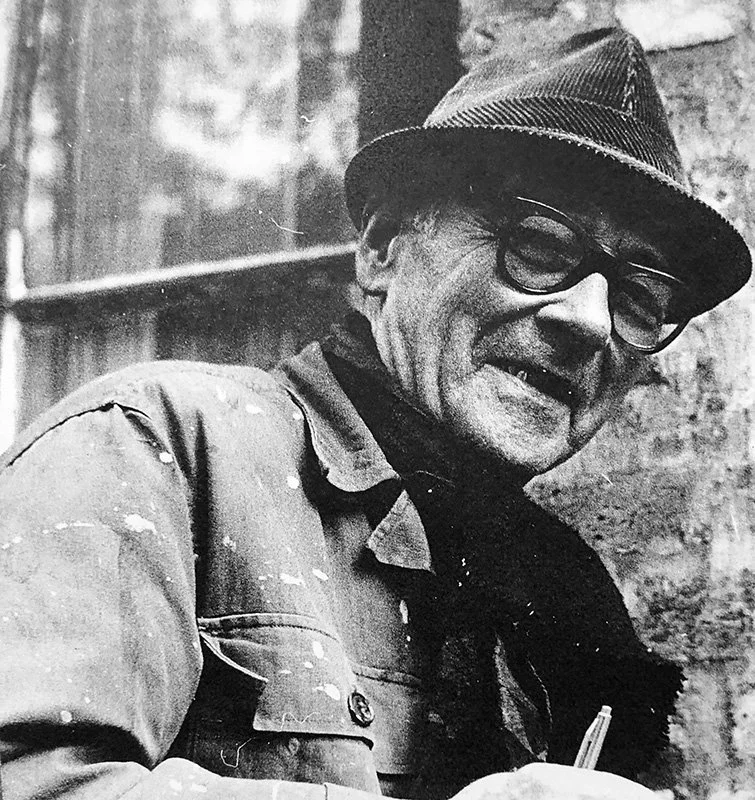
Born in 1895 and died in 1977.
Born in 1895 in Nancy, a center of Art Nouveau, Folmer trained in the disciplines of drawing and applied arts techniques before joining the fine arts school in his city, which complemented a multidisciplinary education.
In 1919, he came into contact with the Nabi painter and set designer Henri-Gabriel Ibels, who hired him to create costumes for his theatrical workshop. He frequented avant-garde circles, including Maurice Denis and Paul Sérusier, who exerted a significant influence on his early paintings, which evolved from Impressionism to a Nabi style through a stylization of forms outlined in black. This simplification foreshadowed a Cubist approach, stemming from his early attempts to deconstruct forms and multiply viewpoints: small still lifes.
In 1926, his meeting with Félix del Marle proved decisive, setting his artistic path firmly in motion, a path resolutely oriented towards the study of the theories of Mondrian, Van Doesburg, and Vantongerlo. The subjects of his Cubist canvases were inspired by the world of the circus: harlequins, trapeze artists. By accentuating the geometric character of his compositions, he achieved the elimination of the subject.
Following his meeting with Auguste Herbin, he joined the activists of Abstraction-Création, became friends with Domela, Jean Gorin and adopted geometric abstraction by continuing the analysis of Mondrian's writings which convinced him of the necessity of pure forms.
In 1935, Folmer settled in La Ruche. His studio was located at Coin des Princes. He left it in 1968 after thirty-three years. This year was pivotal for the painter: he participated in the first Mural Art Exhibition in Paris, alongside Gleizes, Lhote, Kandinsky, and Gorin.
He produced his first abstract drawings in pencil, sanguine, charcoal, and ink, and experimented with new media such as striated plaster and eggshell. In 1937, the City of Paris commissioned him to create a monumental panel for the International Exposition of Arts and Techniques: Jupiter Throwing Lightning, a figurative interlude in a period when Folmer was absorbing Mondrian's Neo-Plastic theories.
In parallel, since 1934 he has been pursuing research on the Golden Ratio and polyhedra. Guided by a studio neighbor, the mathematician and painter Dimitri Viner, he delves deeper into the mathematical secrets of this knowledge, which he applies in his painting.
In 1939 he participated in the international exhibition of abstraction at the Charpentier gallery, which foreshadowed the Salon des Réalités Nouvelles. Closer ties were forged between Folmer, Gorin, Béothy, Del Marle and Servanes.
1941-1942: his abstract maturity is reached with his ink monotypes and polychrome woodcuts. Harmonic Symphony (1942), acquired by the MNAM in Paris, makes open references to the golden ratio.
1945: Creation of the Salon des Réalités Nouvelles
Folmer exhibited at the 2nd Salon in 1946. He actively participated in meetings organized by Félix Del Marle, which brought together the core group of constructivists within the Réalités Nouvelles movement. Driven by the desire to integrate the visual arts into daily life and the architectural environment, the Espace group was formed with Gorin and Béothy (1949)
1950: "Salle Espace" at the Salon des Réalités Nouvelles
Folmer is in charge of setting up the Espace room under the aegis of Del Marle and Herbin.
His first solo exhibition was at the Colette Allendy Gallery. He presented his spatial constructions, which characterize his artistic language: construction, balance, harmony, and rigor. In a few years, rhythm and light would fuse geometric abstraction with poetic abstraction in paintings whose titles would borrow from Mallarmé's verses.
1951 Manifesto of the Espace group created by André Bloc, of which Folmer became an active member alongside, among others, Sonia Delaunay, Fernand Léger, Poliakoff, Gropius, Leo Breuer, Arp, Aurélie Nemours…
Folmer exhibits his ink monotypes at Art Témoin in Paris. His constructed art is based on the relationships between form/color/surface.
Herbin appointed him head of the Geometric Section of the Salon des Réalités Nouvelles. This tenacious builder, according to Michel Seuphor, who considered him one of the Salon's moral pillars, remained the only geometrician on the committee following Herbin's resignation. In 1957, he was appointed secretary general of the Salon des Réalités Nouvelles.
In 1961, Folmer founded the Mesure group, "Experimental Group for Formal Plastic Research," which he chaired, with Jean Gorin as vice-president. The group presented exhibitions in Germany and in Paris, at the Hautefeuille gallery.
Folmer diversified his compositions by introducing ovoid shapes and curves. In 1963-1964 he worked on mobiles and roto-bodies, which he exhibited at the Cazenave Gallery in Paris. Roger V. Gindertaël wrote the preface.
With the Mesure group having disbanded, its work in favor of a synthesis of the arts continued to gain traction. Exhibitions were organized, but following his departure from La Ruche, Folmer settled in Germany in 1968.
Final exhibitions in Strasbourg and in 1972 his jubilee was organised at the Salon des Réalités Nouvelles.
In his small workshop in Neumühl, he continues to work on mosaic projects, revisiting his readings of Nietzsche, Tolstoy, Dostoevsky, Gorky.
He died in 1977 and was buried in the village cemetery.
Lydia Harambourg
Art historian - Correspondent for the Institute of Fine Arts