
-
![Félix Del Marle]()
Untitled, 1950 (design for a stained glass window)
Gouache, ink on paper, 48 x 30 cm
-
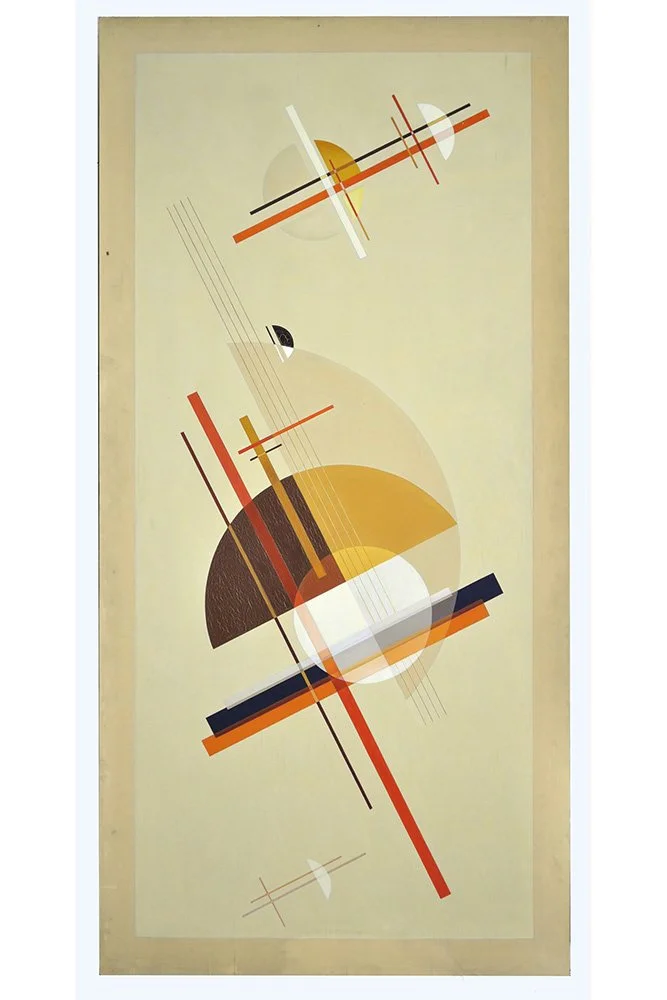
![Félix Del Marle]()
Composition Circa 1948
Oil on wood, 208.5 x 102.5 cm
-
![Félix Del Marle]()
Finale - study for "Musicalism" 1925
Mixed media on paper, 65 x 35.5 cm
-
![Félix Del Marle]()
Untitled, 1947-48
Ink and gouache on paper, 47 x 29 cm



FELIX DEL MARLE
Born in 1889, lived and died in 1952.
Félix Del Marle is a protean artist, one of the few representatives of French Futurism, although this Italian movement was launched by Marinetti in Paris.
In 1912, he settled in Paris, where he met Apollinaire and became friends with Gino Severini, sharing his studio for a time. That same year, he contributed to the Futurist manifestos by writing the Futurist Manifesto Against Montmartre. His work from this period emphasizes the themes of transportation, speed, and syncopated images of urban life, in an aesthetic still very close to Cubism. Like Severini (North-South, 1913, Galleria di Turino), he gave particular importance to the metro, a symbol of modernity. In Montparnasse Metro Station, he depicts the North-South line, which opened between 1910 and 1912, connecting Montmartre and Montparnasse, then perceived as more modern. Signs and wayfinding blend with advertisements and travelers engrossed in their newspapers. Another work from this period depicts the Orsay (or Orléans) station through a dynamic interweaving of metal girders and colorful shapes.
In the 1920s, Del Marle distanced himself from Futurism and moved closer to the German group Simplicissimus and to František Kupka. In 1925, he founded the group and journal Vouloir, which was both regionalist and moderately avant-garde. That same year, he gave a lecture on Henri Valensi, founder of Musicalism, a movement exploring the connections between painting and music.
From 1926 onwards, Vouloir and Del Marle gravitated towards the De Stijl and neo-plasticism. He approached Mondrian to publish articles in the magazine and visited him in his Parisian studio. That same year, he traveled to the Netherlands with César Domela and met the architects Gerrit Rietveld and J.J.P. Oud.
Subsequently, he completed several architectural projects, including the L'Esthétique Moderne in Lille and Léonce Rosenberg's apartment in Paris. In 1928, he founded the STUCA group in Lille (with Gorin, Domela, Mondrian, etc.), aiming for a new synthesis between art and industry, in a dynamic parallel to the spirit of the Bauhaus, which he had visited in 1926.