
-
![Victor Vasarely]()
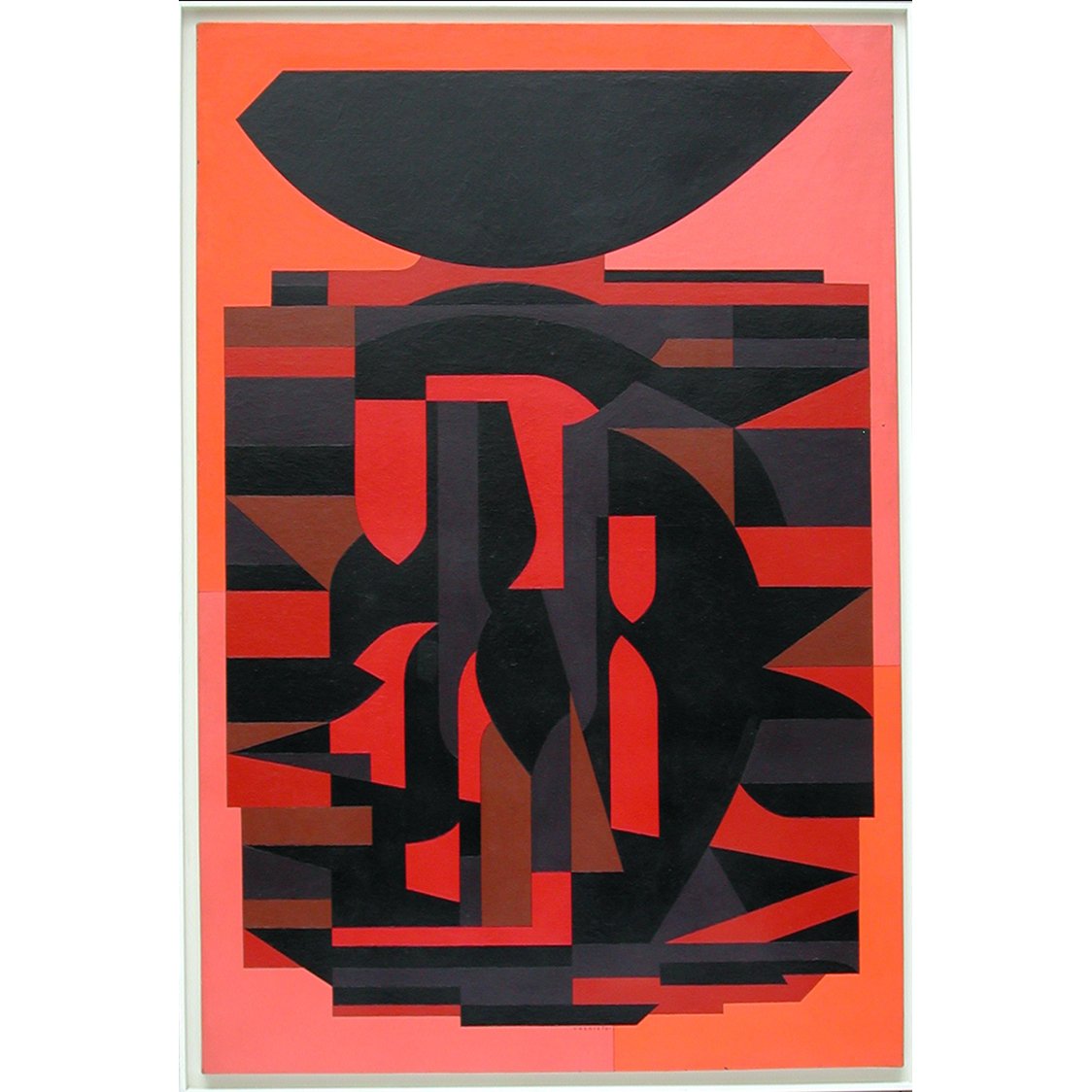
Siris II, 1952-58
Oil on canvas, 195 x 130 cm
-
![Victor Vasarely]()
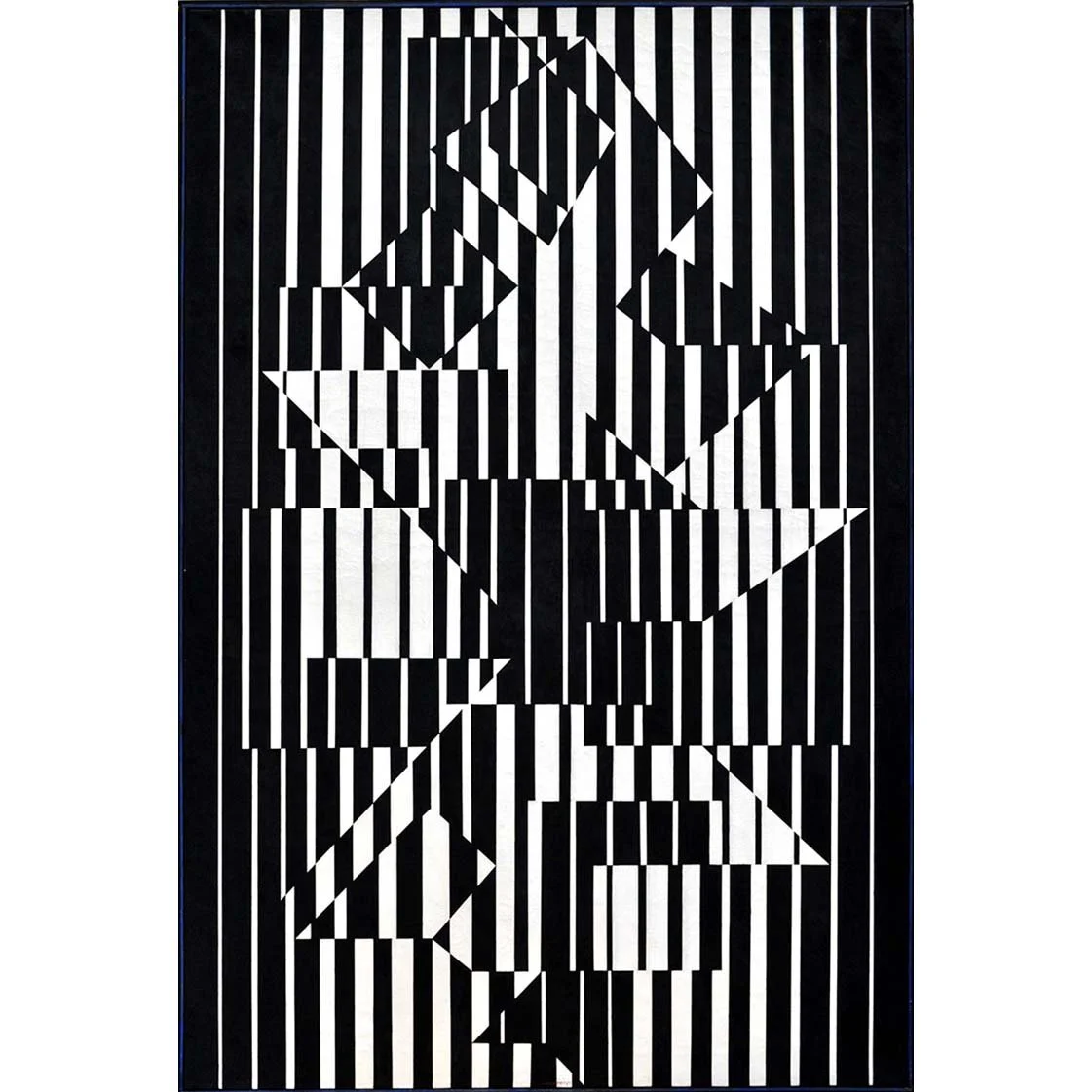
Elbrus, 1956
Oil on canvas, 195 x 130 cm
-
![Victor Vasarely]()
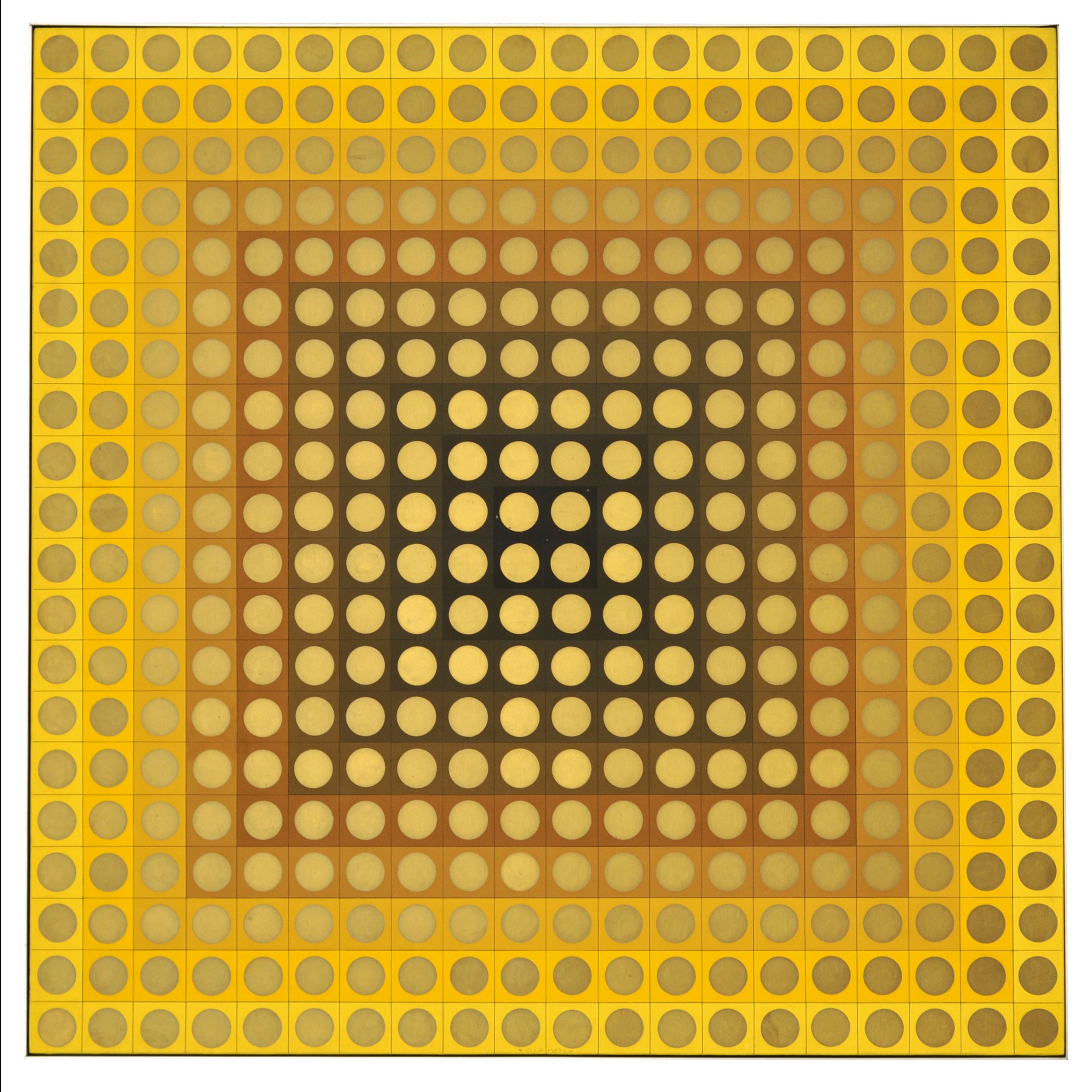
Ilava, 1956
Oil on canvas, 195 x 130 cm
-
![Victor Vasarely]()
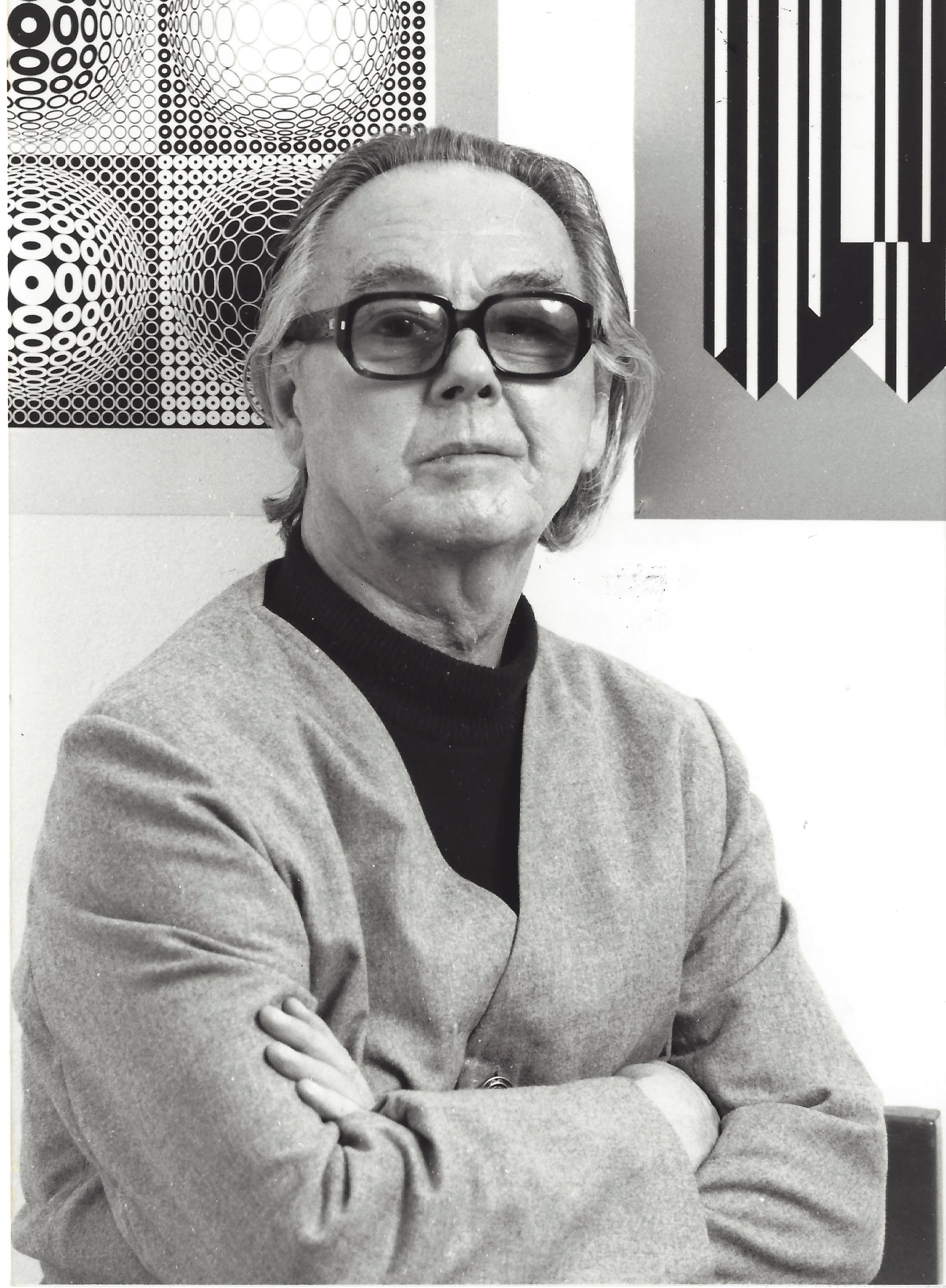
Taller, 1965
acrylic on canvas, 65 × 65 cm

« My plastic units—my circles, my squares, my multicolored diamonds—are stars, atoms, cells, molecules, but also fine grains of sand, pebbles, foliage, flowers. I am much closer to nature than the painter who executes a landscape, because I am within it, I connect with it at the level of its organization, the arrangement of its elements. »
VICTOR VASARELY
Born in 1906 in Pécs, Austria-Hungary, died in 1997 in Paris.
Victor Vasarely, the father of Op Art, was born in 1906 in Pécs, Hungary. He was a self-taught artist who received no formal training until he enrolled at the Műhely, the "Bauhaus of Budapest," in 1929. Upon graduating, he dedicated himself to restoring the social function of art. The following year, in 1930, he moved to Paris, where he earned a living in printing, notably creating posters for pharmaceutical advertising. During his early years in Paris, Vasarely produced his first optical works, primarily geometric designs intended for printing on fabric.
Although introduced to the principles of geometric abstraction during his year of study at the Műhely Academy, Vasarely did not fully commit to abstract painting until the 1950s. This period saw the emergence of his fascination with the cosmos, interstellar space, and utopian visions of extraterrestrial worlds. From 1947-1948 onward, Vasarely was deeply captivated by the idea of the fusion of forms in nature and by their perception and mental formation. He developed a remarkable capacity for abstraction, convinced that forms—shadows, light, plants, celestial bodies—possess their own existence and dynamism. An optical stimulus emerged in his art after the "Belle-Isle" period (1947-1954), which was followed by the "Denfert" period (1938-1951/58) and the "Gordes-Cristal" period (1948-1960). Devoting himself to the search for pure composition, Victor Vasarely believed he had achieved it with the union of color and form. However, he would overcome the difficulty of distinguishing between the sign and the symbol of forms, especially from 1955 onward, when he developed the "Black-White" period (1951-1963), which, through its binary radicalism of colors, allowed him to capture the abstract within geometric forms. From 1955, Vasarely's research led him to increasingly use simple geometric shapes (squares, circles, ovals, rhombuses), which would form what he called "plastic units.".
These binary units form the basis of his "plastic alphabet." Examining the components of this alphabet, we find that Vasarely essentially bases it on six colors: red, blue, green, yellow, violet, and gray, including twelve to fifteen shades for each color (the lightest being numbered 1, and the darkest, between 12 and 15). He occasionally introduces mixtures of other colors, as well as gold and silver. Vasarely uses these colors on a square support, within which various geometric shapes such as the square, triangle, circle, rhombus, or ellipse are arranged. Like a musical composition, Vasarely allows the inner resonances of his plastic units to manifest themselves.
Vasarely's abstraction cannot be understood without considering his perspective: he perceived his era as an expansion, an increase, and even a proliferation of the visual. In his art, marked by his research in optics, human perception and its relationship to the universe became the central theme. Geometric forms and colors emerged as the new language of modern man. The act of seeing is not a passive contemplation of the work; the gaze constantly attempts to grasp its totality, and with each unsuccessful attempt, it generates new perceptible units. We witness a redefinition of the spatial experience of painting. The decomposition of form, from which space is transformed into energy, is not confined to rigid formalism. Vasarely fashions a dynamic and stimulating universe, playing on convexity and concavity, as well as on the richness of spatial tensions. Within this unique project, Vasarely, although attached to constructivist aesthetics, also manages to achieve a stylistic counter-attack, in other words a subversion: he distorts the literalness of geometric forms and resorts to various illusionistic techniques to generate a kind of mannerism in his geometric abstraction.
Vasarely's goal was always to reconcile art and life. Architecture held a crucial place in his thinking, as he aspired to nothing less than a revolution in art, not only in its visual form but also in its architectural form, as evidenced by the profound integration of his sculptures into architectural spaces. Within this framework, he extended his artistic language to architectural projects centered around the "polychrome city of happiness." He thus participated in the construction of several architectural projects, including the University of Caracas in 1954 with architect Carlos Raúl Villanueva, the Faculty of Science on the Jussieu campus in 1967, the Montparnasse train station in 1971, and the façade of the RTL radio station in the same year. In addition, he created spaces dedicated to his own work such as the Vasarely Museum at Château de Gordes (1970), the Vasarely Foundation (1976) in Aix-en-Provence and the Vasarely Museum in his birthplace in Pécs (1976) and, finally, the Vasarely Museum at Zichy Castle in Budapest (1987).
Abstraction in Victor Vasarely's work is rooted in a vision that permeates his entire oeuvre: "The modern artist will no longer paint the green leaf hanging from the tree: he will ask himself where nature's chlorophyll comes from. And suddenly, he takes flight into the complex structures of space-time," he said. This awareness of nature led Vasarely to focus not on the appearance of objects, but on their very essence, their particles. Consequently, Vasarely invites the viewer not to observe life from a distance, but to immerse themselves in the perception of its plastic elements, whether through architectural or sculptural works, creating each time a spatial expansion of forms through the interplay of other plastic components. He constructs his works on a perpetual tension, using unusual viewpoints and complexly composed repetitions—in other words, everything less familiar to the viewer—encouraging them to reflect on how perception works. Nature remains ever-present in Vasarely's work; he never truly departs from it, but it is transformed. It becomes a source of inspiration drawn from the genesis of the Universe. Vasarely draws inspiration from the very genesis of the Universe; his elements may always bear witness to a mimesis , but this mimesis, as Philippe Junod writes, "acquires a cosmic dimension by aiming at the genesis of the world." Thus, nothing is pre-existing: every moment is an exploration; we are all newborns.
Works in museums and public collections
Ludwig Museum, Cologne, Germany
MNAM Center Pompidou, Paris, France
Museum of Grenoble, France
Vasarely Foundation, Aix-en-Provence, France
MoMA New York, United States
Museum Ritter, Waldenbusch, Germany
Museum im Kulturspeicher, Wurzburg, Germany
Selection of the main exhibitions
2019, Vasarely. Sharing Forms, Centre Pompidou, Paris, France
2010, Messmer Foundation, Riegel, Germany
2009, Stattgalerie Klagenfurt, Austria
2008 Milan Triennale, Italy
2007, Columbus Museum of Art, Ohio, USA • 2006, Kunstmuseum Zürich, Switzerland
1998, Vasarely – Geometry, Abstraktion, Rhythmus. Die Fünfziger Jahre, Ulmer Museum, Ulm, Germany
1992, Retrospective, Kunstforum Vienna, Austria
1979, The Optic Art of Vasarely, Phoenix Art Museum, Phoenix, Arizona, United States
1966, L'Unite Plastique, Musée des Arts Décoratifs, Paris, France
1965, The Responsive Eye, Museum of Modern Art, New York, United States
1944, Galerie Denise René, Paris, France
Selection of prints available in the shop


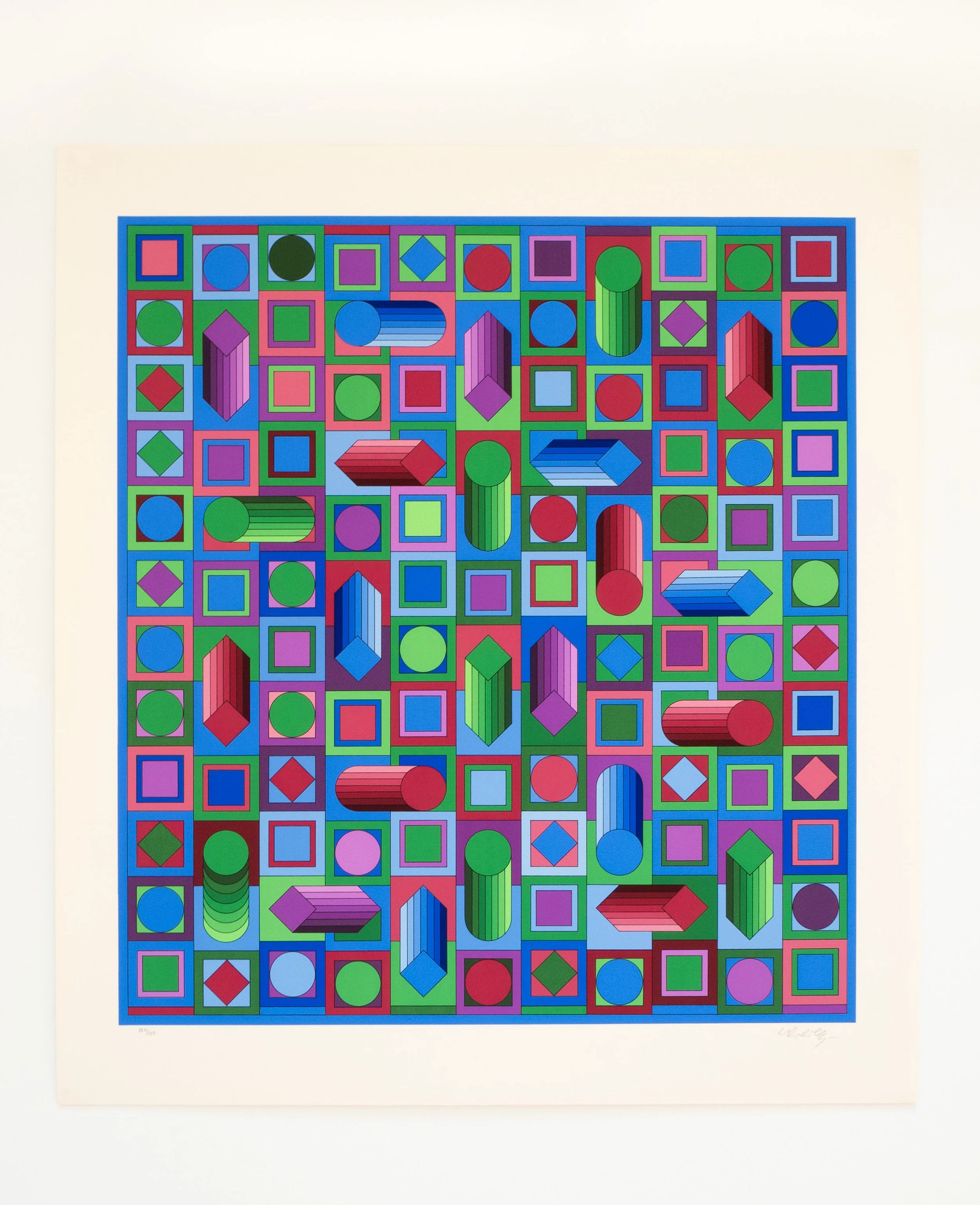


Editions Fall 1978 – Original poster on bristol
Unsigned, unnumbered
Offset - 95 x 68 cm – Bénavides 1270
←Victor Vasarely | ←Prints | ←Store