
-
![Andreas Brandt]()
Weiss-Gelb, 1977
Oil on canvas, 81 x 135 cm
-
![Andreas Brandt]()
Black with Gray, 1987
oil on canvas, 165 x 100 cm
-
![Andreas Brandt]()
Blau-Rot, 1978
oil on canvas, 81 x 135 cm
-
![Andreas Brandt]()
Schwarz-Rot, 1985
Oil on canvas, 81 x 135 cm


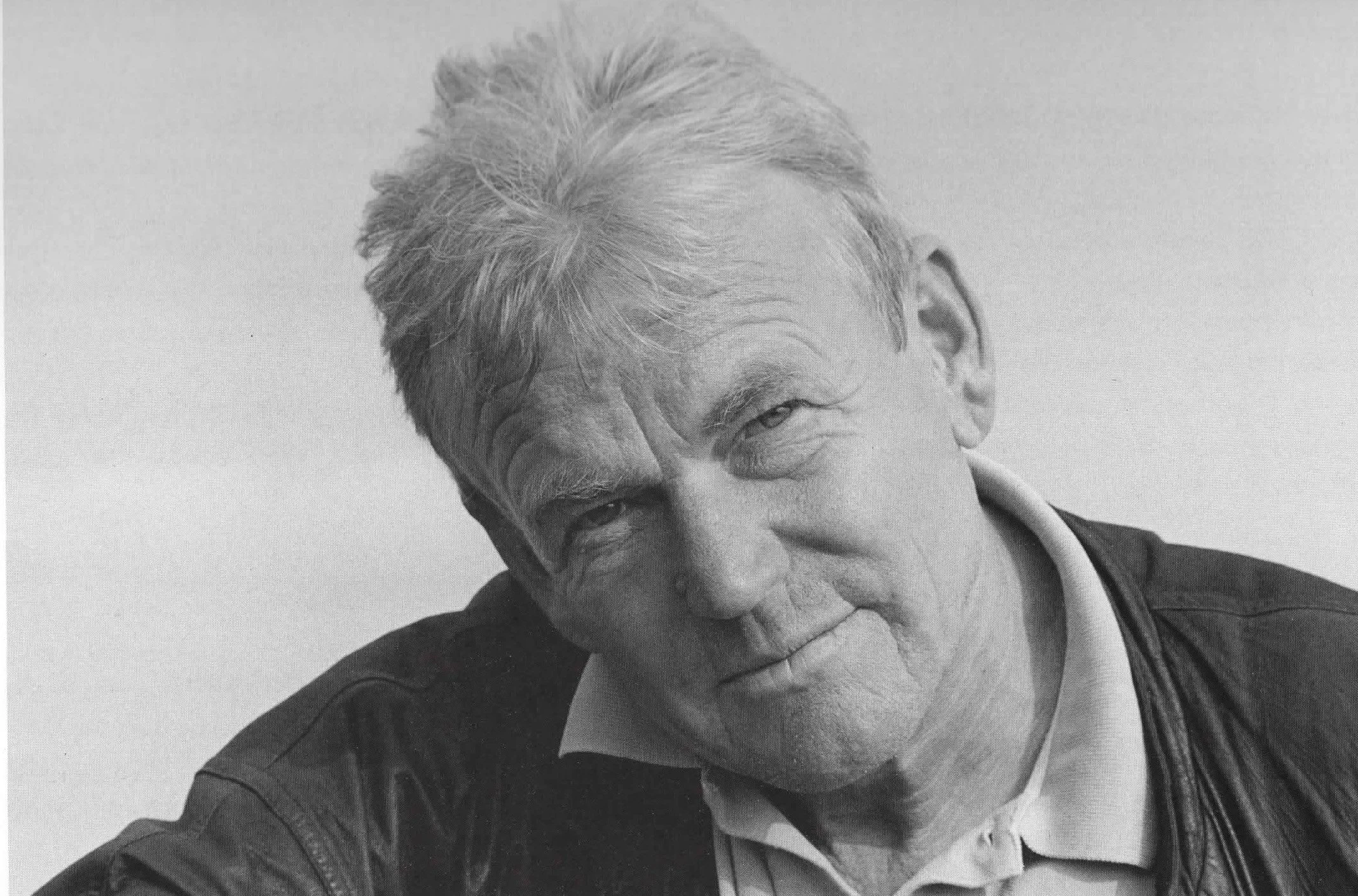
© David Brandt
« We can only talk about the method. »
ANDREAS BRANDT
Born in 1935 in Halle an der Salle, Germany and died in Germany in 2016.
Andreas Brandt was one of the most ascetic representatives of German Concrete Art, known for his consistent use of straight lines and bands of equal width against monochrome backgrounds. After studying biology at the University of Halle in 1954, he moved to West Berlin where he completed his studies at the Berlin Academy of Fine Arts in 1961. In 1970, he gave a lecture as a guest speaker at the HfbK Berlin. A member of the German Artists' Association (Deutscher Künstlerbund), he participated in their annual exhibitions eight times between 1966 and 1980. Andreas Brandt then pursued a career as an independent painter and was a professor of textile design at the Hamburg University of Fine Arts from 1982 to 2001. In his artistic development, Andreas Brandt took into account the requirement stated by Gottfried Benn: "If you remove the adjectives, what you want to say will become clearer." What the poet, whom Brandt greatly admired, recognized as a necessity of his Expressionist generation—namely, "the omission of qualitative adjectives that take up a lot of space"—is perhaps even truer for constructive pictorial thought. For when the painting does not refer to a known representation and has no narrative content, the artistic product is the content of information, and its observation, with the aim of maximum perceptibility, should not be obscured by an interpretation of meaning. This observation also applies to the works of Andreas Brandt.
Inspired by American modernist painters such as Barnett Newman and Ad Reinhardt, Brandt developed a unique pictorial language early in his career, emphasizing the essential elements for organizing the image's space. He experimented with the systematic arrangement of bands of intense black or gray on a white background, alternating between landscape and portrait formats. In the late 1960s, Brandt abandoned the representation of external reality to develop a highly personal conceptual imagery, characterized by a harmonious and precise systematic structure and a limited color palette. Initially, he worked exclusively with vertical bands in landscape format before incorporating horizontal lines and portrait formats. His work is distinguished not only by its meticulously structured bands and subtle interplay of colors, but also by a tranquil poetics and a sense of space evoking a vast expanse. For Brandt, working on a canvas is therefore a process requiring concentration, sublimation of emotions and a certain meditative lightness.
By restricting himself to straight lines and bands of equal width against monochrome backgrounds, Brandt was considered one of the most radical concrete painters. He was interested in the balance of surfaces and the relationship of colors, creating an unexpected spatiality and elements that seem to vibrate for many viewers. As one moves in front of a work, the impression of color changes, like sound propagating through space. Thus, the structure appears to be set in visual motion. Despite its frame, the surface of Brandt's work opens up through a succession of harmonies, rhythms, and movements. He used pictorial means to combine rational compositional methods with rhythm and sonority, sometimes creating the impression of listening to a Bach étude. His main objective was to create "the picture as picture with the means of the picture," as he explained in 1970 in a publication by the Diogenes Gallery in Berlin. Looking at a work by Brandt, one gropes for the transition from inside to outside and from outside to inside, even though there is no longer any outside or inside. In looking, one tries to understand what is nonetheless real but unavailable.
Works in museums and public collections
Josef Albers Museum, Bottrop, Germany
Berlinische Gallerie, Berlin, Germany
Hamburger Kunsthalle, Germany
Selection of the main exhibitions
2004, Andreas Brandt – Minimale Farbklänge, Arithmeum, Bonn, Germany
2004, Minimalism and after III, Daimler Chrysler Contemporary, Berlin, Germany
2003, Einhalt und Vielfalt, Kunsthalle, Halle, Germany
2001, Arithmeum, Bonn, Germany
994, ACP Viviane Ehrli Galerie, Zurich, Switzerland
•1990, Paris, Gilbert Brownstone et Cie, Paris, France
1986, Galerie Teufel, Köln, Germany
1980, Christel Gallery, Stockholm, Sweden
1975, Galerie Wentzel, Hamburg, Germany
1970, Diogenes Gallery, Berlin, Germany
Selection of prints available in the shop
Signed and numbered silkscreen print
Edition /200
format 27.5 x 20.5 cm
←Andreas Brandt | ←Prints | Small Format Prints | ←Store