
Vision and rigor
Jean Dewasne, Jean Gorin, Auguste Herbin & Victor Vasarely
From January 18 to February 29, 2020
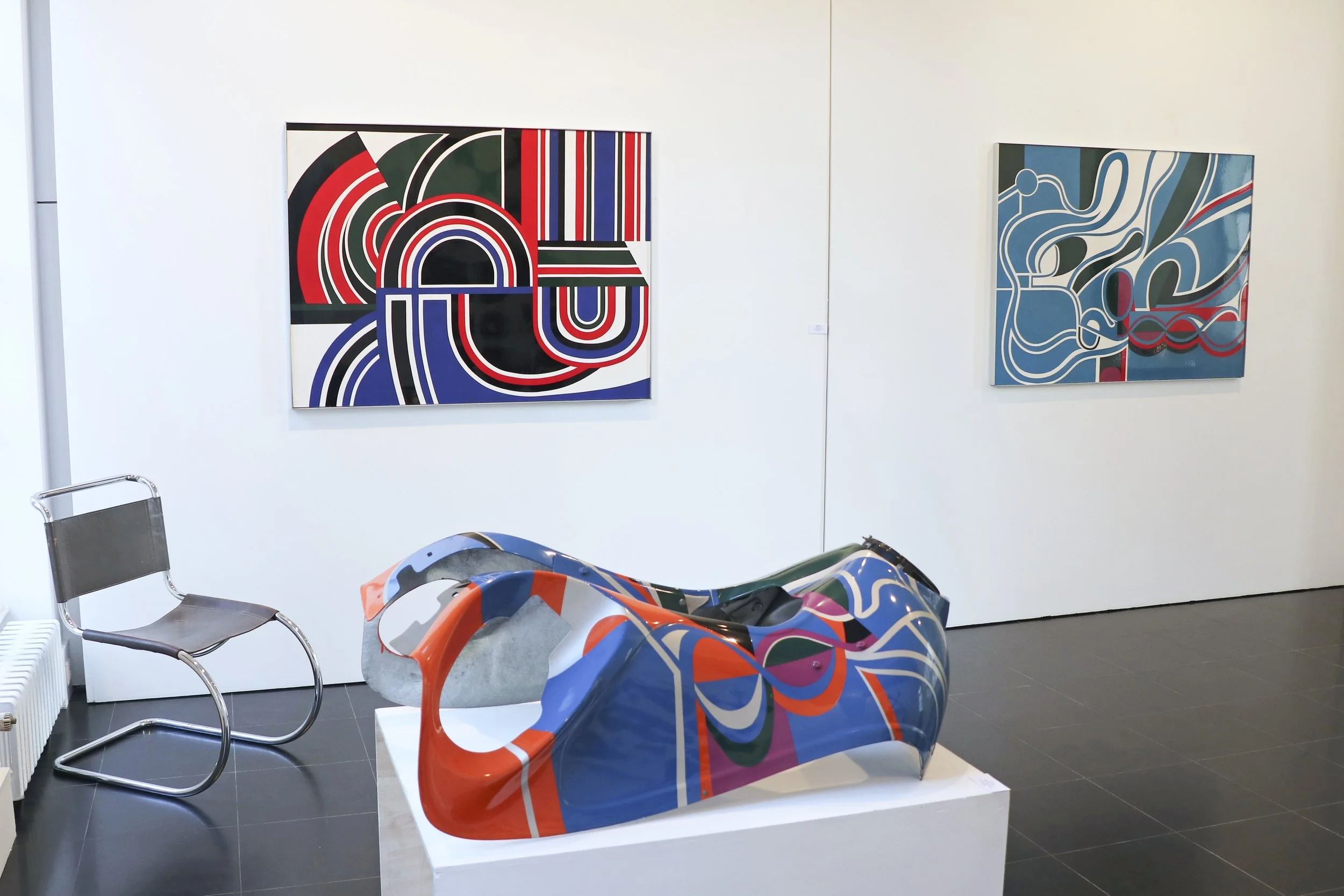
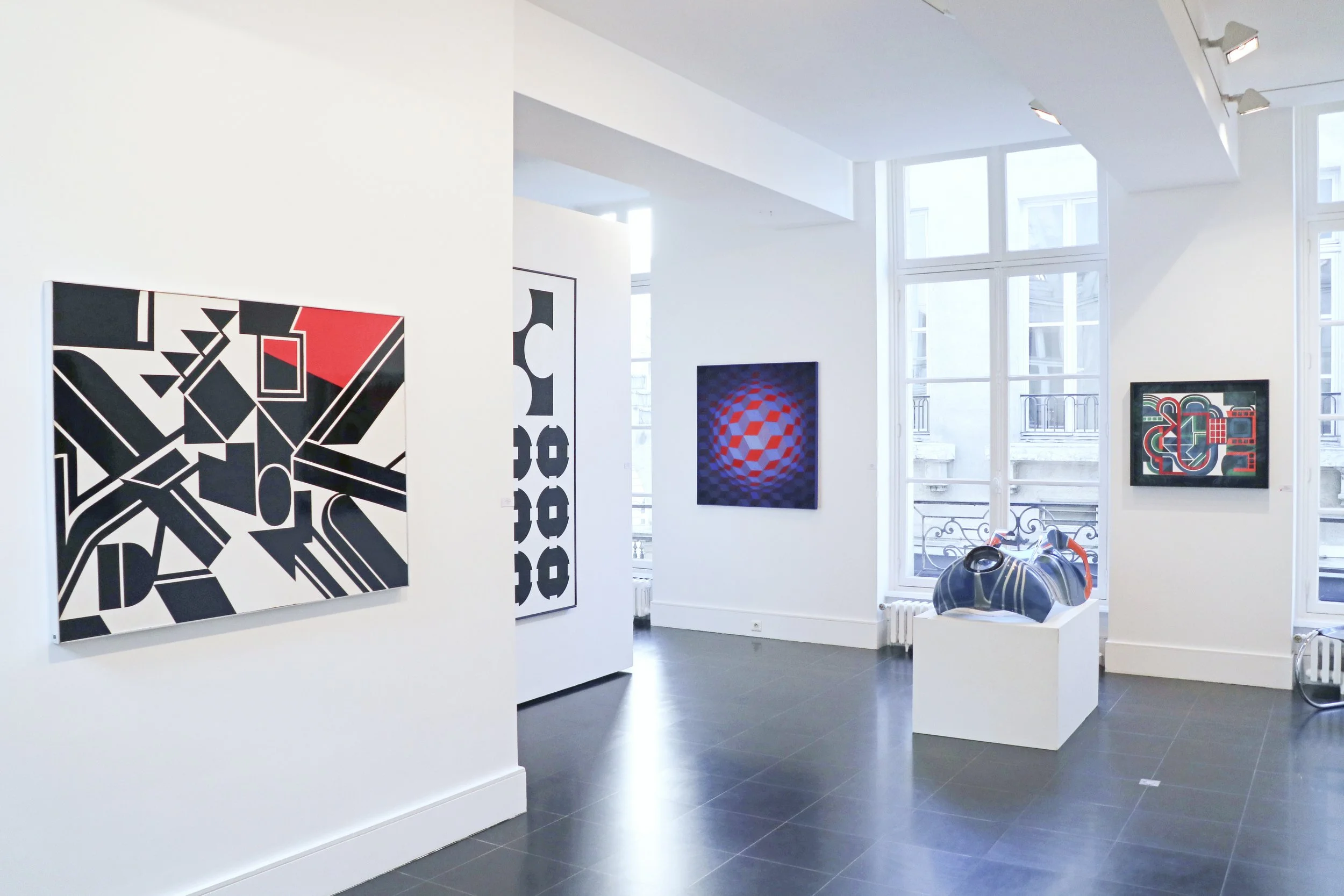
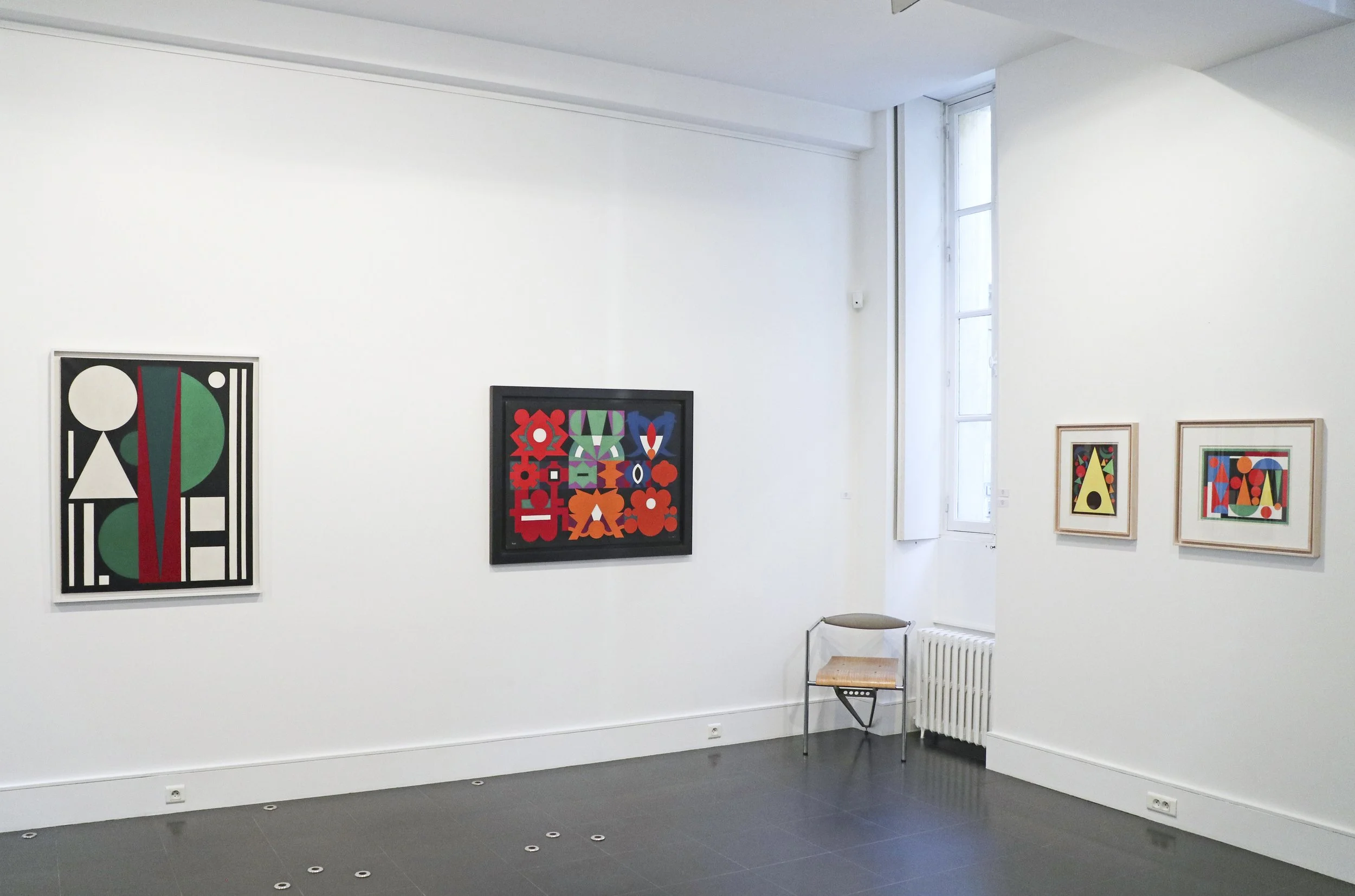
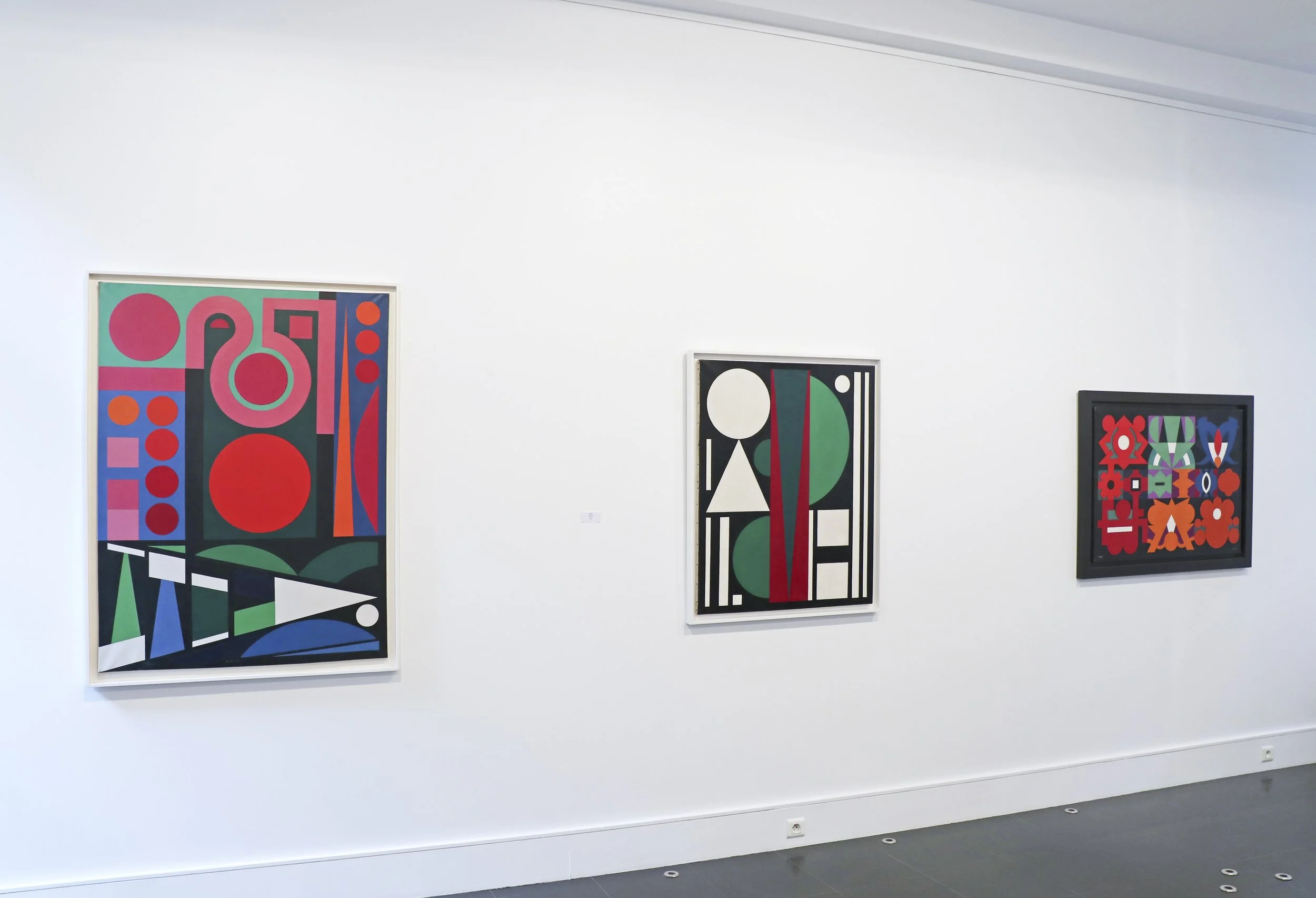
In the 1960s, Anne and Jean-Claude Lahumière, then publishers, met Jean Dewasne and produced his first editions; this encounter proved decisive in their decision to return to the art world, particularly focused on geometric abstraction. It seems to me that among the artists they collected with admirable passion, Auguste Herbin, Jean Gorin, Victor Vasarely, and Jean Dewasne stand out for a particular affinity: these men were visionaries, assiduously concerned with giving social meaning to their work. They were convinced that a visual environment constructed with a rational mind could contribute to moving humanity toward a more equitable order. Consequently, their working method was inspired to a high degree by transparency and logical rigor. The rigor of their pictorial language is the result of a universal aspiration. Hence the title of the exhibition: "Vision and Rigor." The simultaneous presence of the selected works within the exhibition invites us to make cross-comparisons which can give a particular colour to the very perception of each of the works.
The works on display date from roughly three decades: from 1945 to 1975. These artists are separated by more than a generation. Herbin was born in 1882, Gorin in 1899, Vasarely in 1906, and Dewasne in 1921: they therefore did not share the same historical experiences. And yet their pictorial language is quite comparable. At the beginning of the period under consideration, in 1945, they were all committed to non-figurative painting, which at that time was not an obvious choice. Herbin had just developed his "plastic alphabet," and the young Dewasne chose him as his mentor. As for Jean Gorin, from the early 1930s onward, he had begun creating reliefs and sculptures according to the principles of Neo-Plasticism. Encouraged in this endeavor by Mondrian, like a solitary star, he traversed events organized around non-figurative art without deviating from his chosen path. During the 1930s, he met Herbin in the ABSTRACTION-CREATION association, where they both held positions of responsibility. They also frequented the "group of revolutionary artists," with whom Gorin had traveled to Moscow in 1932 to experience the realities of the Soviet utopia. Despite the convergence of these two artists' convictions and commitments, no reciprocal influence on their artistic output is observable.
Victor Vasarely, a Hungarian artist who emigrated to Paris as early as 1932, brought to the turbulent atmosphere of postwar Paris his highly advanced training acquired in Budapest at the "Mühély," an art school founded by Sandor Bortnyk, modeled on the Bauhaus, where he himself had been a student. His pictorial language was still tentative, as documented in the 1946 exhibition at Denise René's gallery. He subsequently received a powerful impetus from his encounter with the work of Herbin. In 1952, Dewasne published a monograph dedicated to Vasarely. The encounters and exchanges of information among these four artists were linked to their participation in the activities of the "Salon des Réalités Nouvelles," the "Espace" group, and the exhibitions at the Denise René gallery.
Jean Dewasne rapidly increased his prestige and influence thanks to his exceptional organizational skills. In 1950, he and Edgard Pillet founded the Atelier d'Art Abstrait (Atelier of Abstract Art) in Paris, where he taught painting techniques based on the principles of dialectical materialism. He advocated abandoning traditional painting and proposed using industrial pigments on supports such as hardboard. Furthermore, he called for large urban spaces to be made available for the public display of his works. Jean Dewasne's career is marked by monumental paintings, beginning with "The Apotheosis of Marat" in 1950, "The Long March" in 1969, and culminating in the gigantic paintings executed in the final years of his life for the Grande Arche in Paris-La-Défense. With his "Antisculptures," Dewasne made a significant contribution to the evolution of visual language, developing his topological reflections on convex and concave spaces.
In the early 1950s, Herbin's art was at its peak: his works displayed a clarity of thought and a serene harmony that made him the undisputed master of "cold abstraction." He had succeeded in elevating non-figurative art to a widely respected, almost classical, position. The younger generation respected him, read and discussed his writings, and entrusted him with the role of champion of the legitimacy of non-figurative art. Several of his admirers, such as Baertling and Jacobsen, promoted his name and works in their native countries of Sweden and Denmark, as well as in Belgium and the Netherlands. In Germany, Herbin was known thanks to his participation in the first two editions of Documenta.
Meanwhile, in the shadow of Herbin's success in abstract art, a radical, highly technical, and pragmatic movement was taking shape. Among the key figures in this trend were Dewasne and Vasarely. After arriving in France in 1932, Vasarely had worked successfully as an entrepreneur, founding an advertising agency. It wasn't until 1946 that he decided to embark on a career as a painter. At the age of forty, he began the slow process of developing a personal style in this field. His previous work had given him an understanding of the effects that create "optical illusions," and he knew how to construct structures that provoke perceptual instability, which he sought to translate into his art. For a time, he reduced his works to black and white to intensify the kinetic effects of the structures. In 1955, he organized the exhibition "Le Mouvement" (The Movement) at Denise René's gallery and published his "Yellow Manifesto." The influence of this exhibition was enormous; it can be said to be at the origin of either "kinetic art" or "op art," which would develop throughout the 1960s. We were witnessing the transfer of results from science, particularly "Gestalt psychology," to the field of visual art and the dissemination of mechanical and electrical procedures.
But the truly profound revolution stemmed from the method of production and distribution of artworks that Vasarely proposed and put into practice in the following years. While Dewasne's visionary quality was expressed in his demand for access to large public spaces, Vasarely's lay in his ability to anticipate the arrival of a new category of consumers in the art world, a new public that needed to be accommodated with mass production and distribution. He therefore organized his Parisian studio to produce works anonymously, mechanically, easily memorable and recognizable. Qualities that Andy Warhol would later also put into practice at the Factory. In Vasarely's work, the concept is conceived like a musical score; after 1960, almost all of his works are characterized by an orthogonal grid into which squares or circles, prepared beforehand in large quantities, can be placed. In the execution, there are no personal traces; As for size, it can vary from the dimensions of a traditional painting intended for personal use, to integration into architecture, urban projects, and even "global folklore." Vasarely's name is also linked to the multiplied art object—the "multiple"—and to the distribution of "kits" that welcome the user as a participant in the creative process.
While these events and movements unfolded, Jean Gorin silently pursued his own path, faithful to his neo-plasticist credo. His lifelong dream: to transform his reliefs and sculptures into architecture, houses, neighborhoods, cities. If there is any reason to speak of UTOPIA, it is certainly the case for Gorin's work: his creations are here, before our eyes; but their place is nowhere.
We have thus far discussed the visionary aspects of these four artists. What can be said about the rigor they bring to the execution of their ideas? Rigor is measured by the degree of adherence to a constructive rule, declared by the artist as the basis of their work. In Gorin's case, adherence to an ideological system—Mondrian's Neo-Plasticism—was total and consistent, but always carried out with sufficient creative input to avoid the trap of dogmatism.
As for Auguste Herbin, in 1943 he provided his observers with a rule of interpretation with his "plastic alphabet," which he rigorously applied to the execution of his paintings. Jean Dewasne set himself the objective of introducing new materials and unprecedented methods. He formulated very early on the requirement to subject artistic work to objective data, to the laws of science, in order to create large-scale works whose use could only be public and therefore collective. This attitude of Jean Dewasne towards scientific thought also brings him closer to Victor Vasarely, who was inspired by the same sources, who speaks of corpuscles and waves, of quanta and topology at the basis of his "plastic units".
In conclusion to these observations, we therefore see two pairs emerging in the exhibition: Herbin and Gorin as inventors of an autonomous pictorial language, but faithful to the tradition of personal and manual execution; Vasarely and Dewasne as artist-engineers, willing to delegate the execution of their projects to external parties, or even to machines.
Hans Jörg Glattfelder, November 2019