

Sensitive geometries
Jean Deyrolle, Emile Gilioli, Jean Leppien, Alberto Magnelli
From March 13 to September 25, 2020
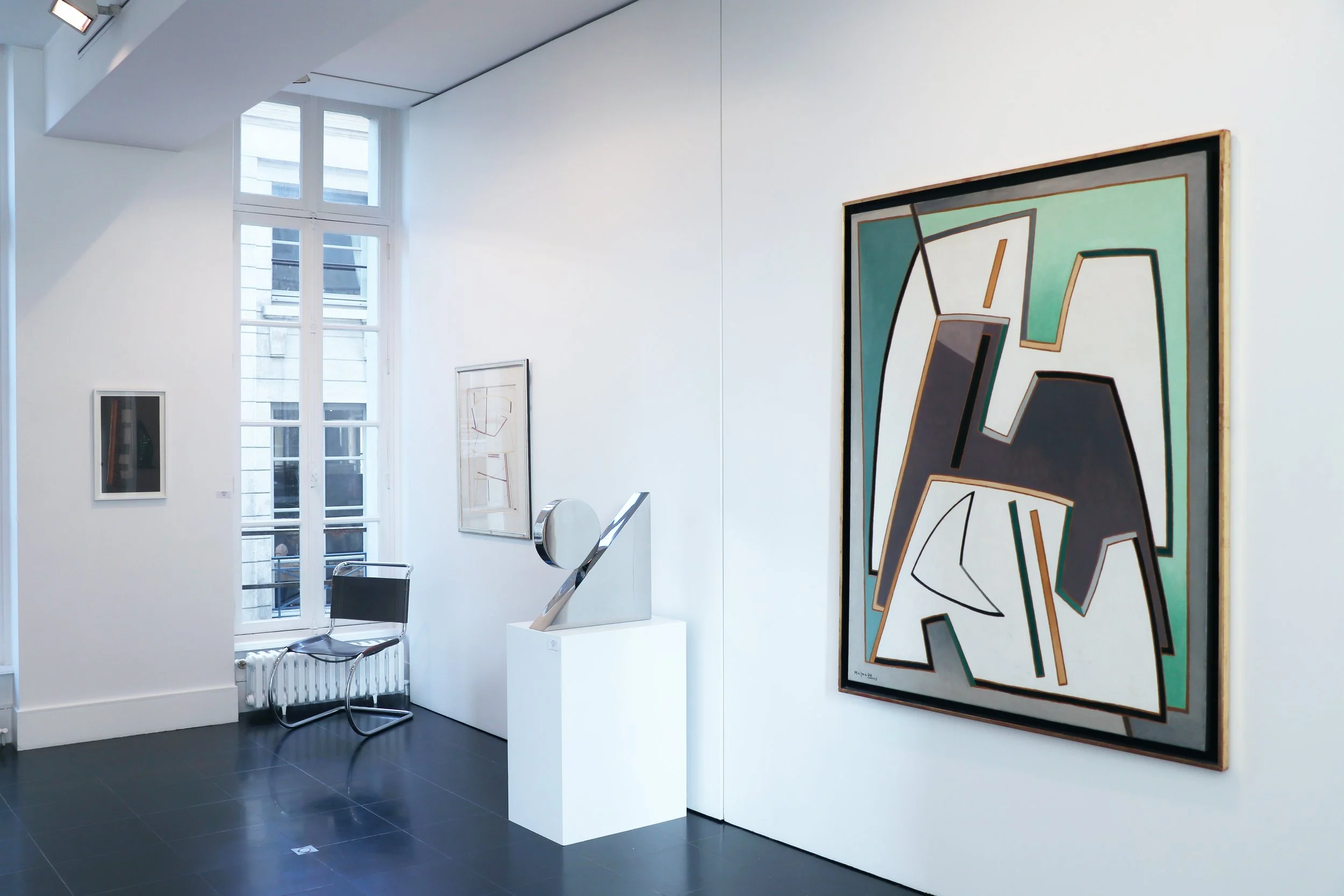
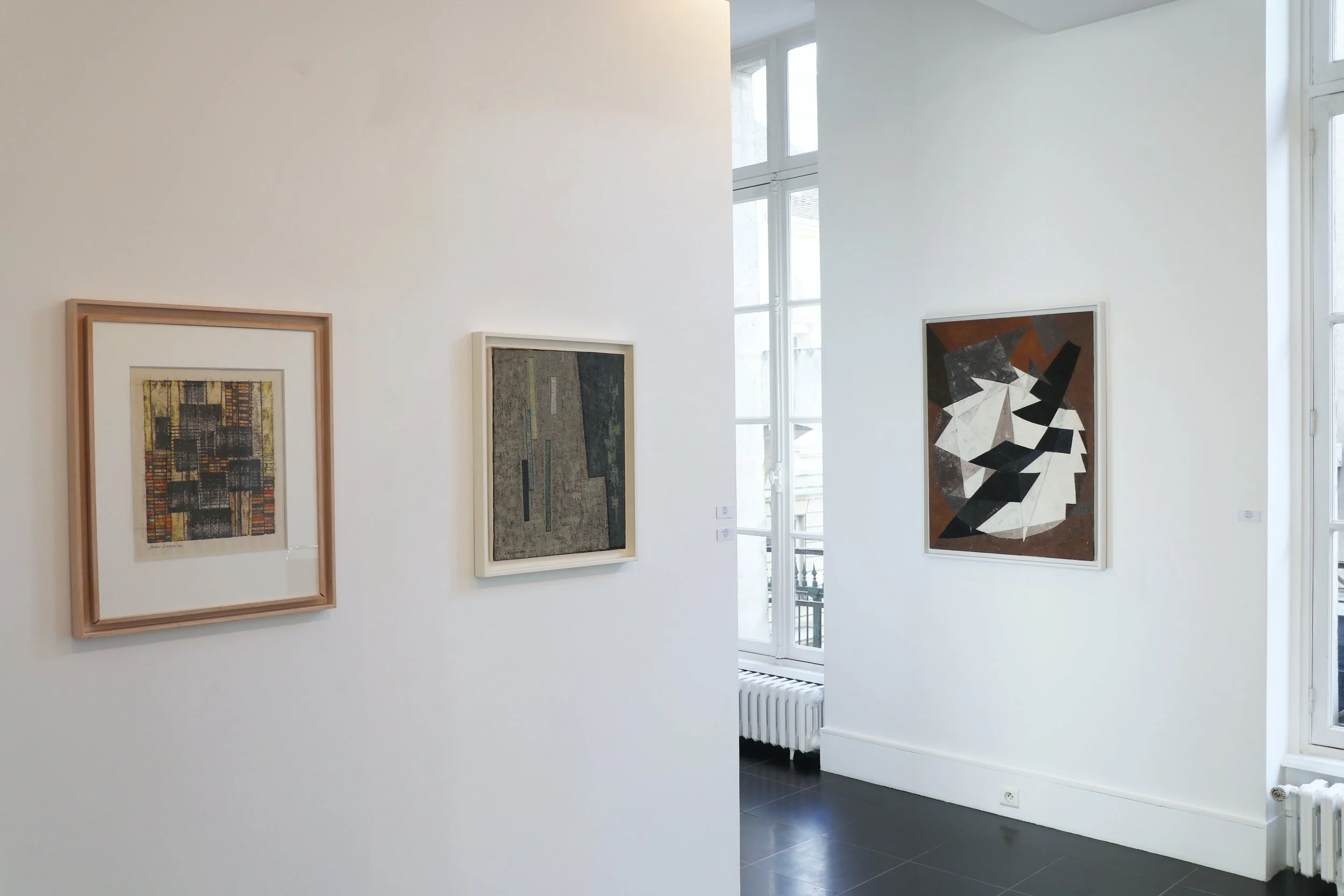
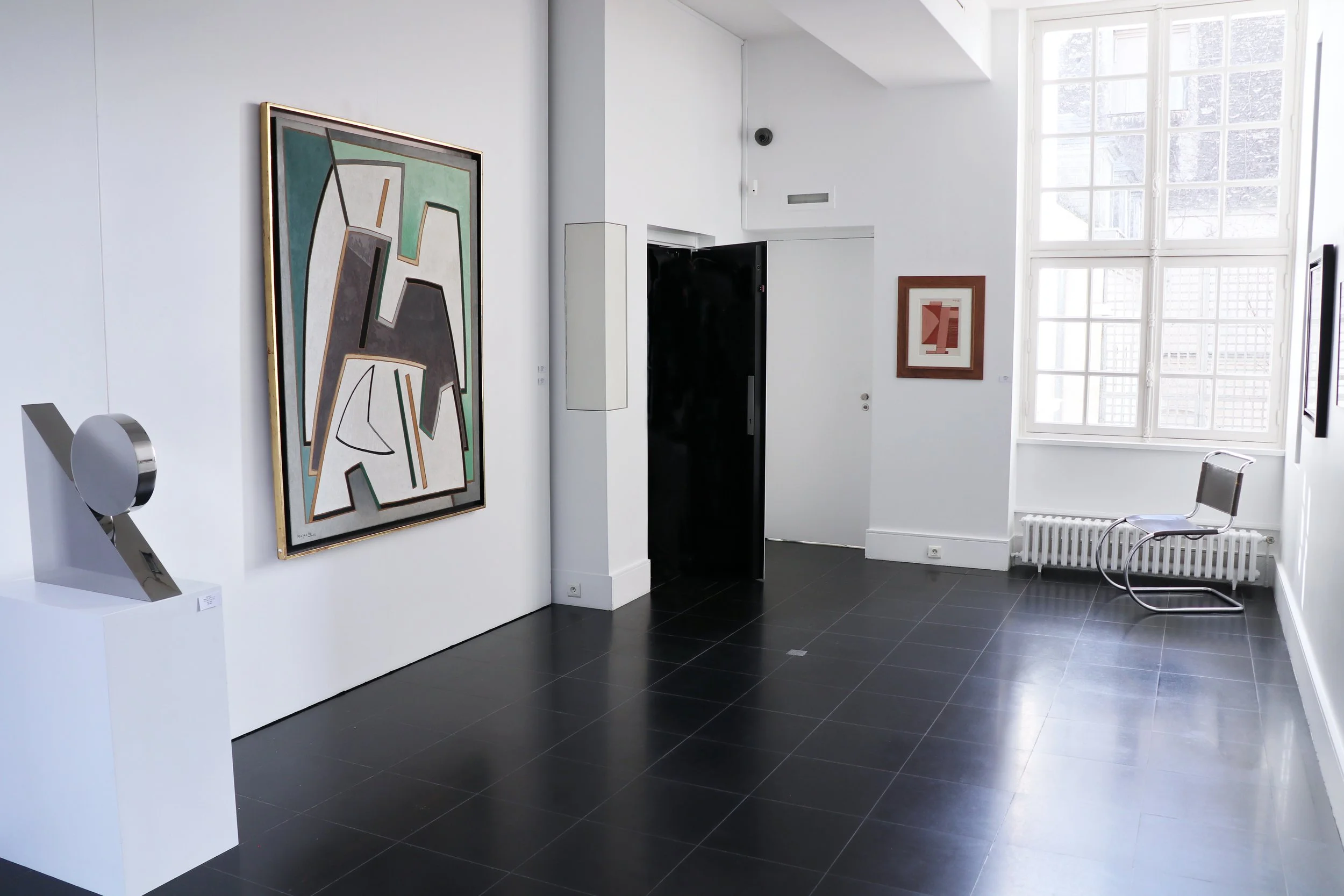
Alberto Magnelli (1888-1971), Jean Leppien (1910-1991), Jean Deyrolle (1911-1967), and Emile Gilioli (1911-1977), brought together by the Lahumière Gallery for the exhibition "Sensitive Geometries," are representative of the revival of geometric abstraction in post-World War II France. Born between the late 19th and early 20th centuries, of German, Italian, or French origin, these artists were not always at the same stage of development in their work, as the war had been a period synonymous with exile, imprisonment, isolation, and great hardship. In the optimistic climate of Reconstruction, Magnelli, Leppien, Deyrolle, and Gilioli experienced a resurgence of vitality in their work, forged strong friendships, and frequently exhibited together in Parisian galleries and salons. They didn't always find themselves in the capital, sometimes preferring the peace and tranquility of Provence, where some would eventually settle permanently, such as Magnelli in Grasse, Leppien in Roquebrune, or Deyrolle in Gordes. The works brought together for this exhibition demonstrate how the light, color, landscapes, and architecture of the South contributed to the renewal of their creative output.
For Magnelli, the eldest of the four artists, the post-war period marked the culmination of nearly forty years of career spent between his native Italy and his adopted country, France. "Rich in its own internal and silent geometry," according to art critic Achille Bonito Oliva, Magnelli's painting seeks a state of rhythmic equilibrium where clearly defined forms, often outlined in black, shift from acute angles to arcs, as in Varied Forms, 1958. The matte finish of the colors, applied with respect for the picture plane, evokes the art of fresco painting, so dear to the artist, a Florentine by birth and a great admirer of Piero della Francesca. Bathing his paintings in a delicate light, he establishes particularly refined color relationships, based on the use of muted tones such as brown, ochre, bistre, and blue-gray. Magnelli thus counterbalanced the rigorous architecture of his paintings' compositions with the sensuality of his colors and the fluidity of his forms. This geometric sensibility appealed to young artists who, seeking to break free from overly rigid pictorial construction, were able to turn towards more informal stylistic principles.
Jean Deyrolle, who embraced abstraction in 1944, particularly appreciated Magnelli's sense of rhythmic plasticity in his painting. The 1953 painting, Malon, painted during the summer in Gordes, is representative of his early abstract period, where geometric forms are interlocked, defining large areas of color. These alternate between warm and cool tones, creating a gentle harmony, in keeping with his use of tempera, a technique Magnelli had introduced him to. The work Oreus, 1966, executed during a period of artistic maturity, testifies to his methodical yet sensitive approach to painting: the central motif of the broken circle, echoed throughout, creates an impression of spatial vibration in the canvas. Oblique fissures, traversing the pictorial field, contribute to a fragmented effect, softened nonetheless by the application of paint with a palette knife, in fluid and rhythmic strokes, lending an expressive force that also stems from the painter's physical engagement. For Deyrolle, the sensuality of the work arises from both the brushstroke and the gesture. It is in this union between a rigorous abstract language and a pictorial sensitivity awakened by contact with nature, particularly that of the South of France, that the artist has established his distinctive style.
In Jean Leppien's work, we find this desire to avoid overly rigid formal order through a fluid deployment of lines. His conception of painting, inherited from Kandinsky, whose teachings he followed at the Bauhaus in 1930, consists of "translating a state of mind or a state of spirit into pure forms and colors." Indeed, the untitled composition 6/49 LIII from 1949 results from the dynamic articulation of large curved lines whose interpenetration delineates areas of color within the strict two dimensions of the pictorial field. The use of a smooth and precise technique contributes to the harmony of the composition, whose melodious character expresses the artist's sensitivity. This poetic approach to painting would later manifest itself in the adoption of a richer paint layer and warm tones, lending a luminous and sensual presence to the work. In the paintings of this period, Jean Leppien reconciles geometry and materiality by greatly simplifying the elements of the composition, reduced to essential signs such as the circle or forms derived from the rectangle of the untitled work 5/61 XIII of 1961.
The sculptor Émile Gilioli, who turned to abstraction after the war, a period during which he formed close friendships with figures such as Deyrolle, Dewasne, and Poliakoff, also sought to achieve a balance between rigor and sensuality in his work: “I would like my sculpture to be like an overripe fruit bursting with sap… I would like to imbue my statues with a true radiance of matter. It is three-dimensional sculpture, static, dynamic, and cosmic, that I would like to create,” Gilioli declared in 1946. His evident interest in the work of Brancusi led him to a highly refined abstraction where the perfection of volumes and the sharp precision of lines are achieved through absolute mastery of materials and polishing techniques. Light, reflecting generously on the gilded surface of the bronze, fluidly underscores the transition from curve to angle, from dense volumes to smooth planes, as seen in *Cut Flower*, ca. 1960. The work Vitesse 1976 revisits two themes dear to the artist: the oblique line, illustrating the conquest of space, and the sphere, symbolizing the sun. Gilioli's sculptures, through their pure and elemental form, and their sensual and luminous presence, transcend all anecdotal detail to reach the universal.
The exhibition "Sensitive Geometries" illustrates how Alberto Magnelli, Jean Leppien, Jean Deyrolle, and Emile Gilioli drew new inspiration for their work from the mild, luminous climate of the South. Their works, with their earthy colors and shimmering textures animated by a soft, delicate light, offer perfect testimony to this.
Domitille d'Orgeval