
Bauduin - Stempfel
Disturbance
From May 17 to June 30, 2018
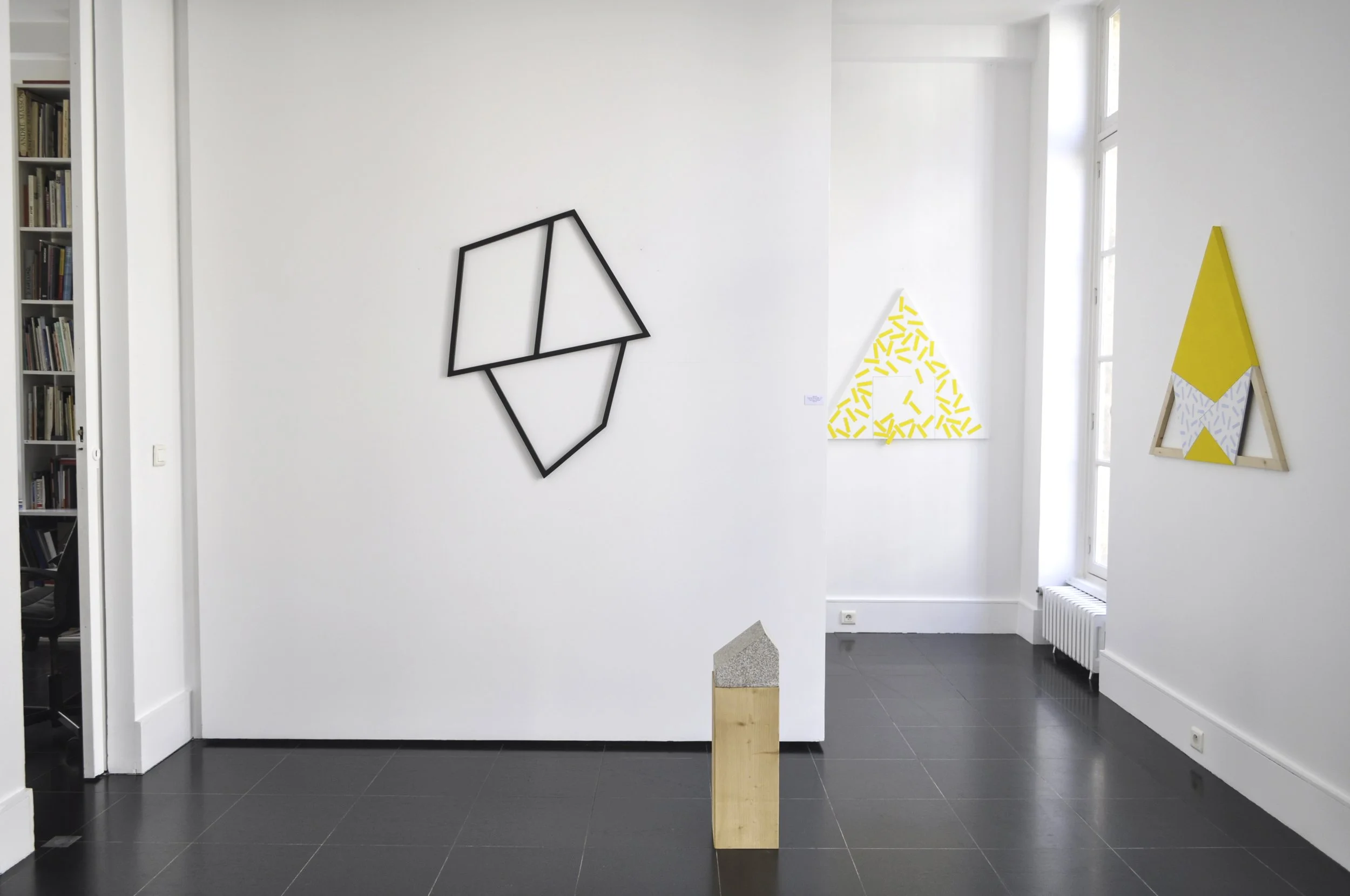
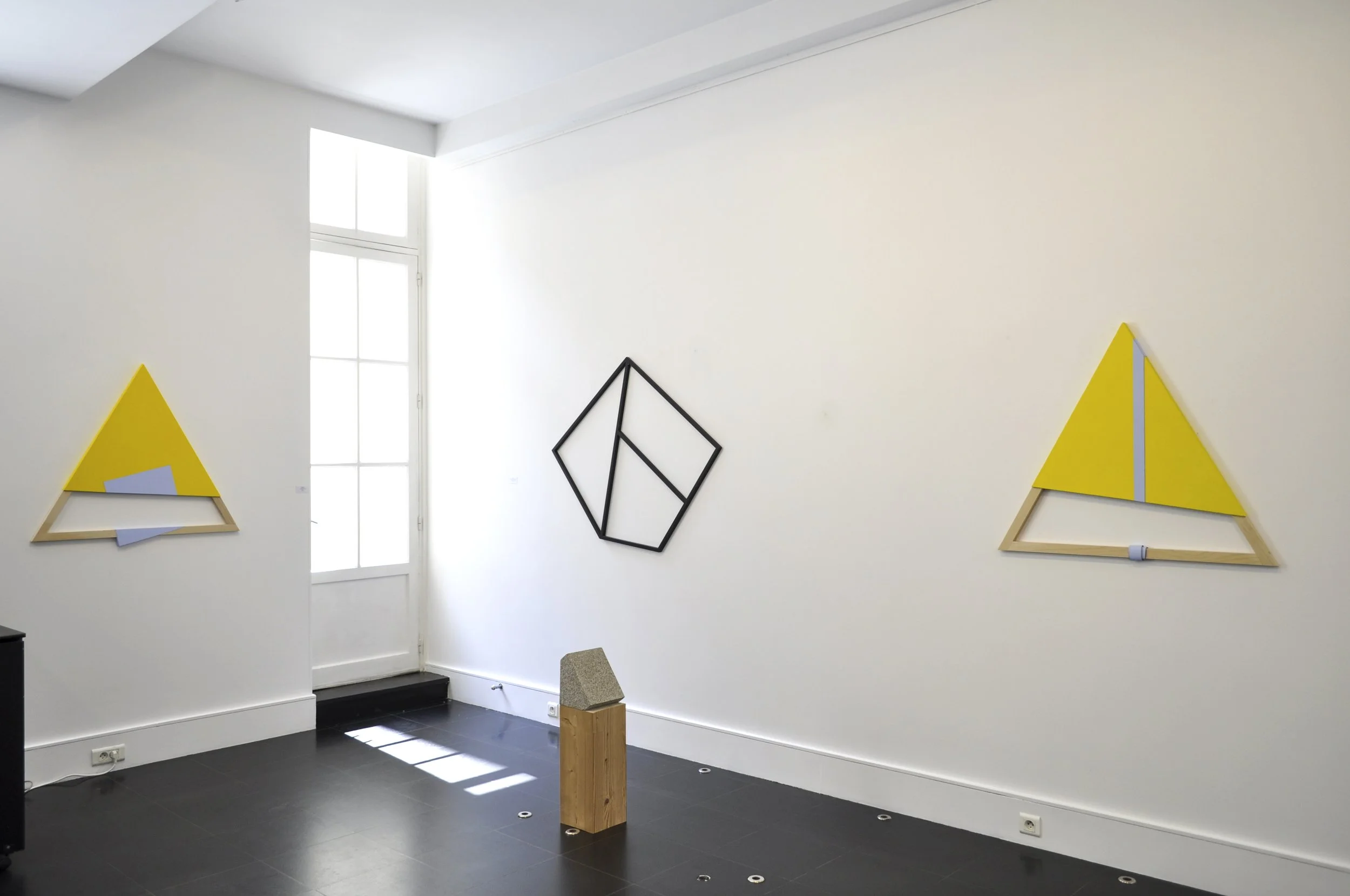
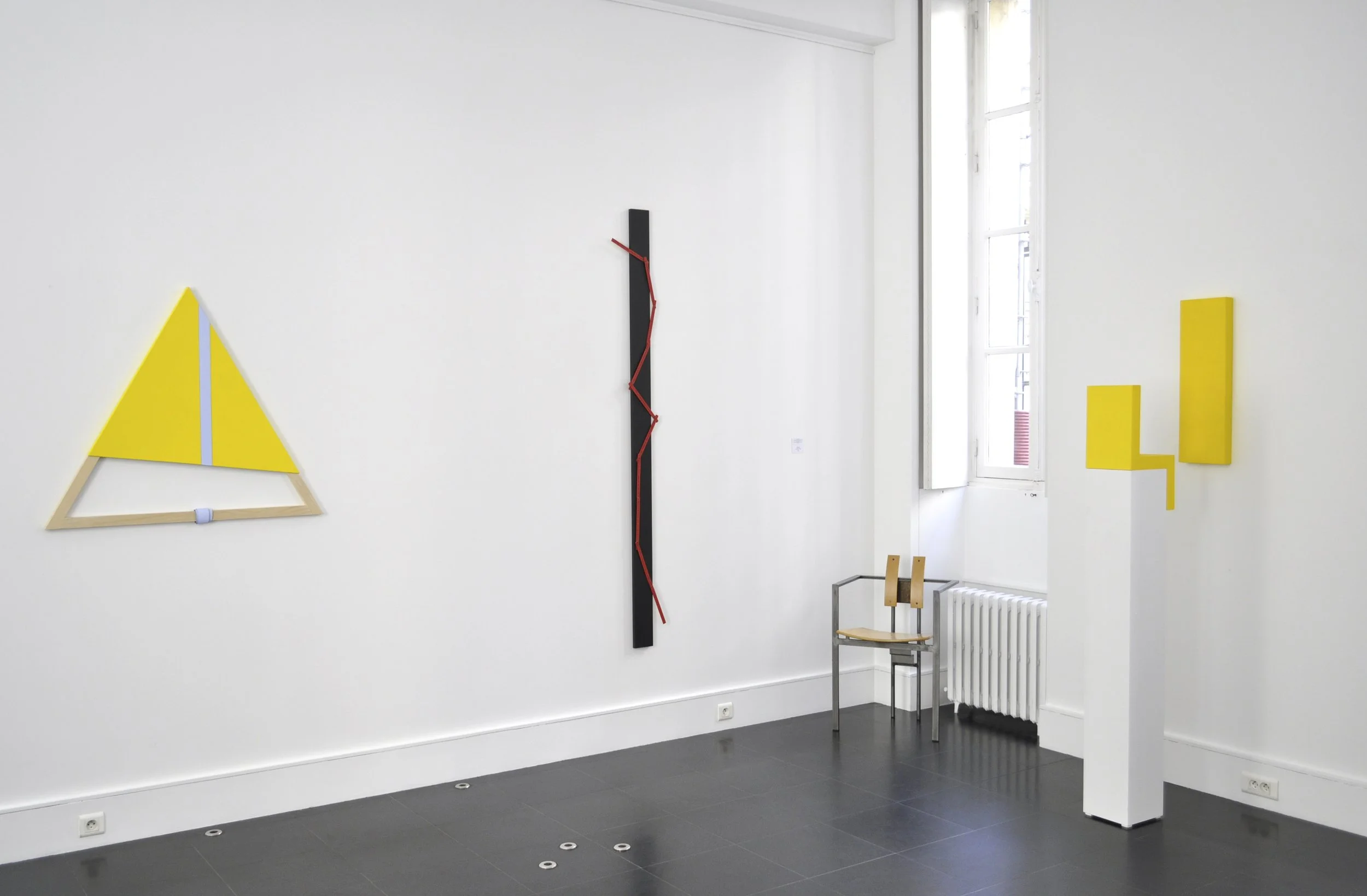
Stempfel and Bauduin, brought together for the exhibition "Troublement," infuse the walls of the Lahumière gallery with a quirky sense of humor. While they both belong to rather distinct aesthetic universes, their works, which display a shared taste for irony and excess, are animated by a similar critical spirit towards geometry.
Characterized by great singularity and formal restraint, Bauduin's work defies any attempt at strict definition and lies at the crossroads of Minimal, Conceptual, and Land Art. At the heart of his approach lies the need to distance himself from geometric abstraction in order to move towards a new artistic practice that he called "Déposer" (Deposing) in 1975. With this key word, which underpins his entire body of work, Bauduin means "creating a void to eliminate all opposition, erasing all duality between appearance and essence on the surface of things." His "depositions," which can take place in nature, on a monument, or on a document, employ subtle and unexpected formal and intellectual juxtapositions, prompting the viewer to question. This is the case with the megaliths, apprehended through old postcards, which Bauduin has repurposed by "depositioning" a square of glass, here simply drawn in front of giant stone blocks and alongside figures from the period standing beside them to provide scale. The glass square, when physically "depositioned" in nature, is a reflective medium that establishes a dialectic of the visible and the invisible, as well as a very particular relationship to time, place, and history, without ever imposing a particular viewpoint. The series on "The Dwellings" also corresponds to a work on sites of memory. Here, the dwelling is evoked in its simplest, even archaic, form by a granite block culminating in a gabled summit. Its relief outline, depicted on the wall, presents the viewer with an abstract transposition of spatial reality. As for the "Earth Drawings," scale models of actions carried out outdoors or embodiments of future projects, their refined and minimalist nature evokes the microcosm of Zen gardens in which the artist has made numerous interventions in Japan. They also evoke the meaning that the word "geometry" holds for Bauduin, a word which, in its primary sense, refers to the notions of earth and measurement that are so dear to him. Some of the artist's works engage the viewer more directly, such as the "Hollowed Frames" series (2012-2013), which, stripped of their canvases, open onto the wall: covered with rambling words, they infuse Bauduin's work with a poetic sensibility and a touch of the absurd, reminiscent of Duchamp. One of the hollowed-out frames, pierced by a folding ruler in place of the canvas, perfectly captures the tone of this art, which, with a finely calibrated modesty, oscillates between measure and excess.
In a different vein, but not without a spiritual affinity, André Stempfel has also distanced himself from geometric orthodoxy by introducing humor into his work and demonstrating his taste for the unexpected. One is immediately struck by the exclusive use of "Senegal" yellow, whose luminous energy radiates beyond the canvas. This monochrome palette, like Klein's, became his signature, even if he occasionally allowed himself a few deviations by sparingly adding a few centimeters of blue and white. Exploring the limits of the traditional canvas seems to be one of Stempfel's main objectives, and with tireless imagination, he constantly reinvents the staging of his paintings, often conceived sequentially. Here, he manipulates the canvas, which is interrupted midway to reveal part of the stretcher; there, he detaches it from its support to reveal the reverse side, which is covered, not without a touch of insolence, with polka dots. Furthermore, Stempfel displays a marked inclination to break free from the two-dimensional plane and explore the surrounding space: examples abound, from the colorful band extending beyond the canvas to the square decorated with a checkerboard pattern that, striving to escape the canvas, seems on the verge of toppling over. This idea of painting grappling with the laws of gravity, so prevalent in Stempfel's work, is also evident in his sculpture, particularly in the way he animates pedestals by playing with their inevitable descent to the ground. The artist's playful and disruptive geometry is fully realized in the series of folded and rolled paintings where, this time, the artwork appears to have gained its autonomy by freeing itself from the wall. There is a jubilant aspect to observing Stempfel's geometric variations, which constantly attempt to escape their own fate in order to push the limits of their existence even further.
Domitille d'Orgeval