
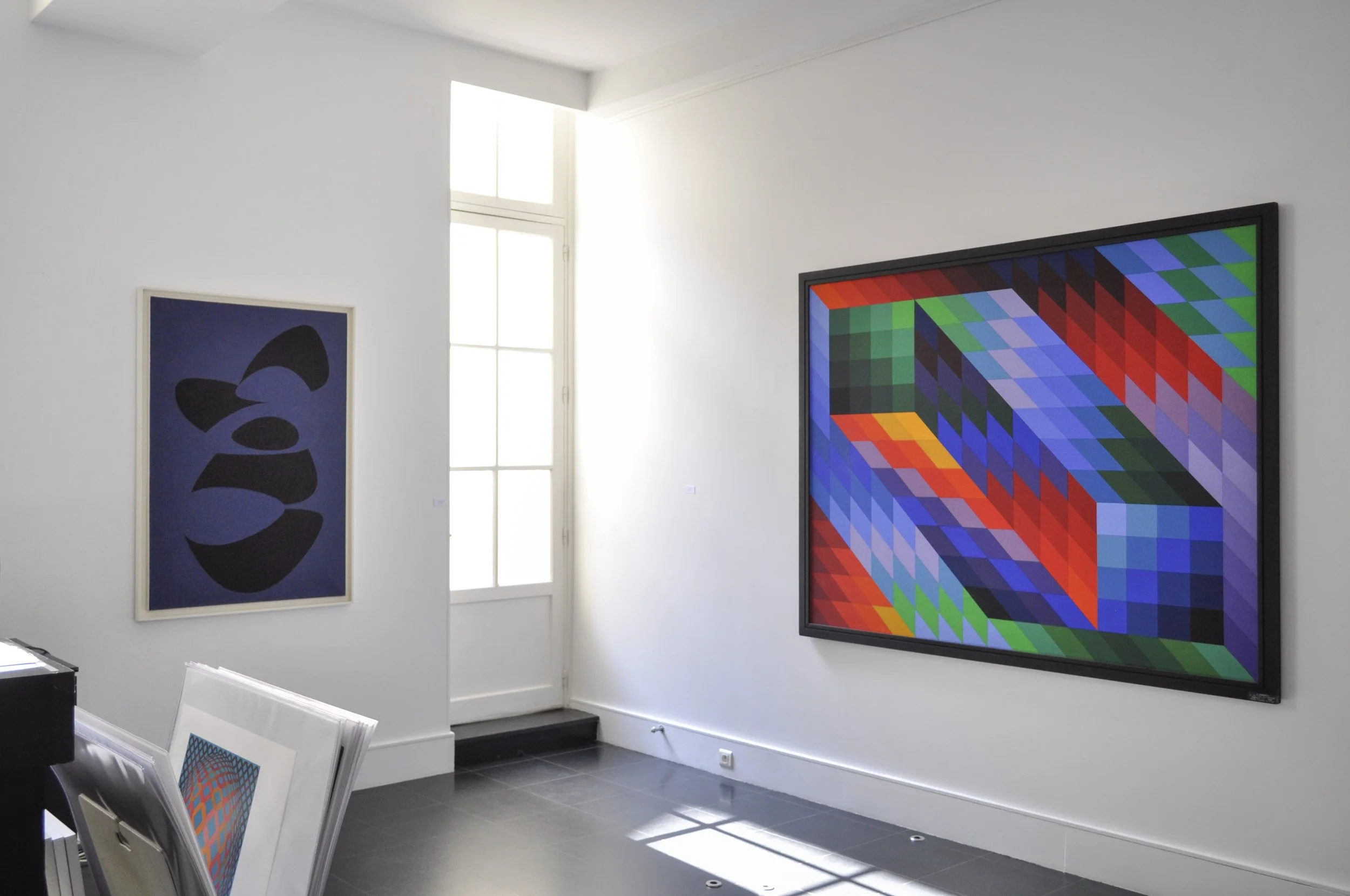
Vasarely's Worlds
From March 9 to April 27, 2019
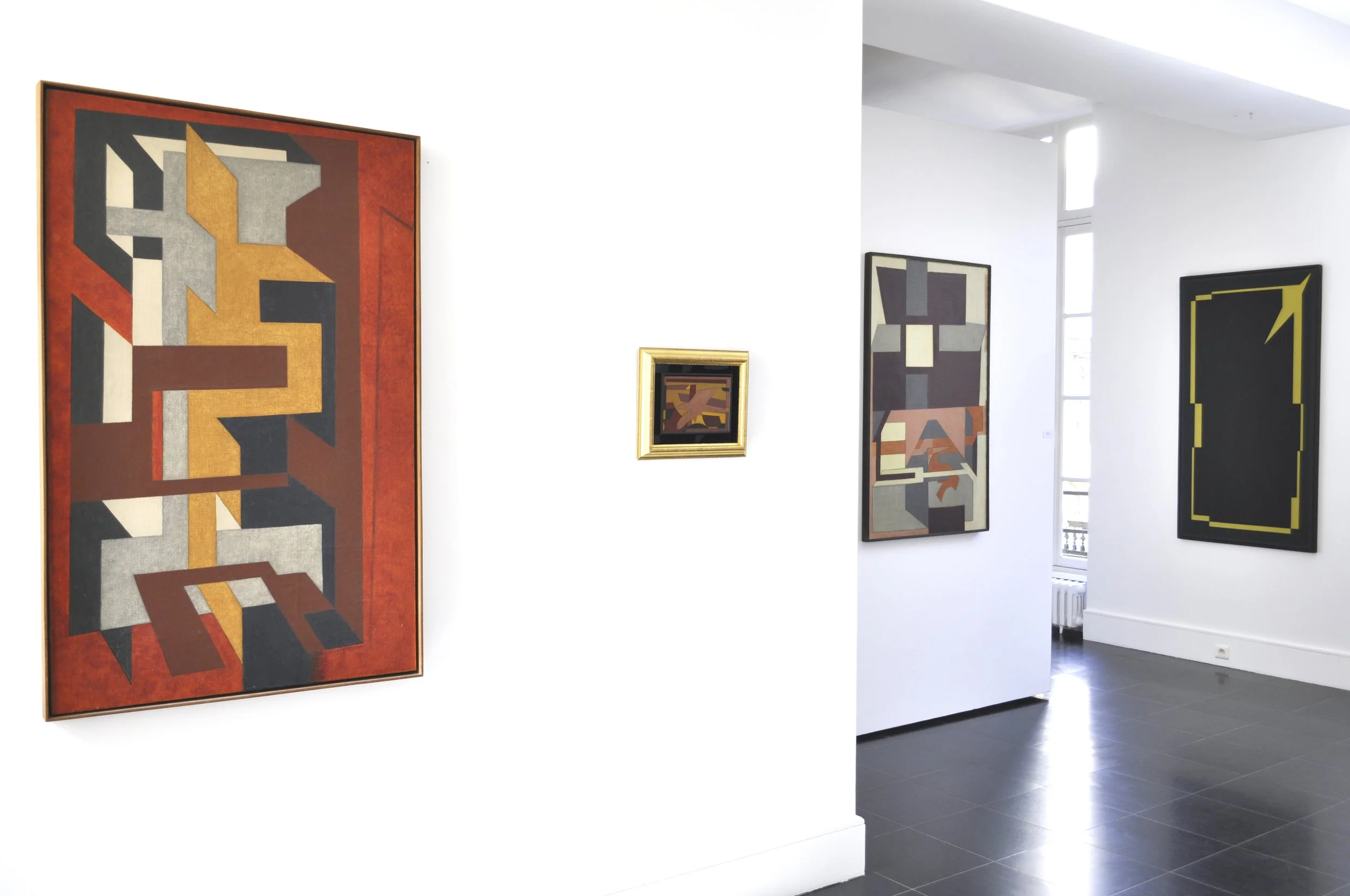
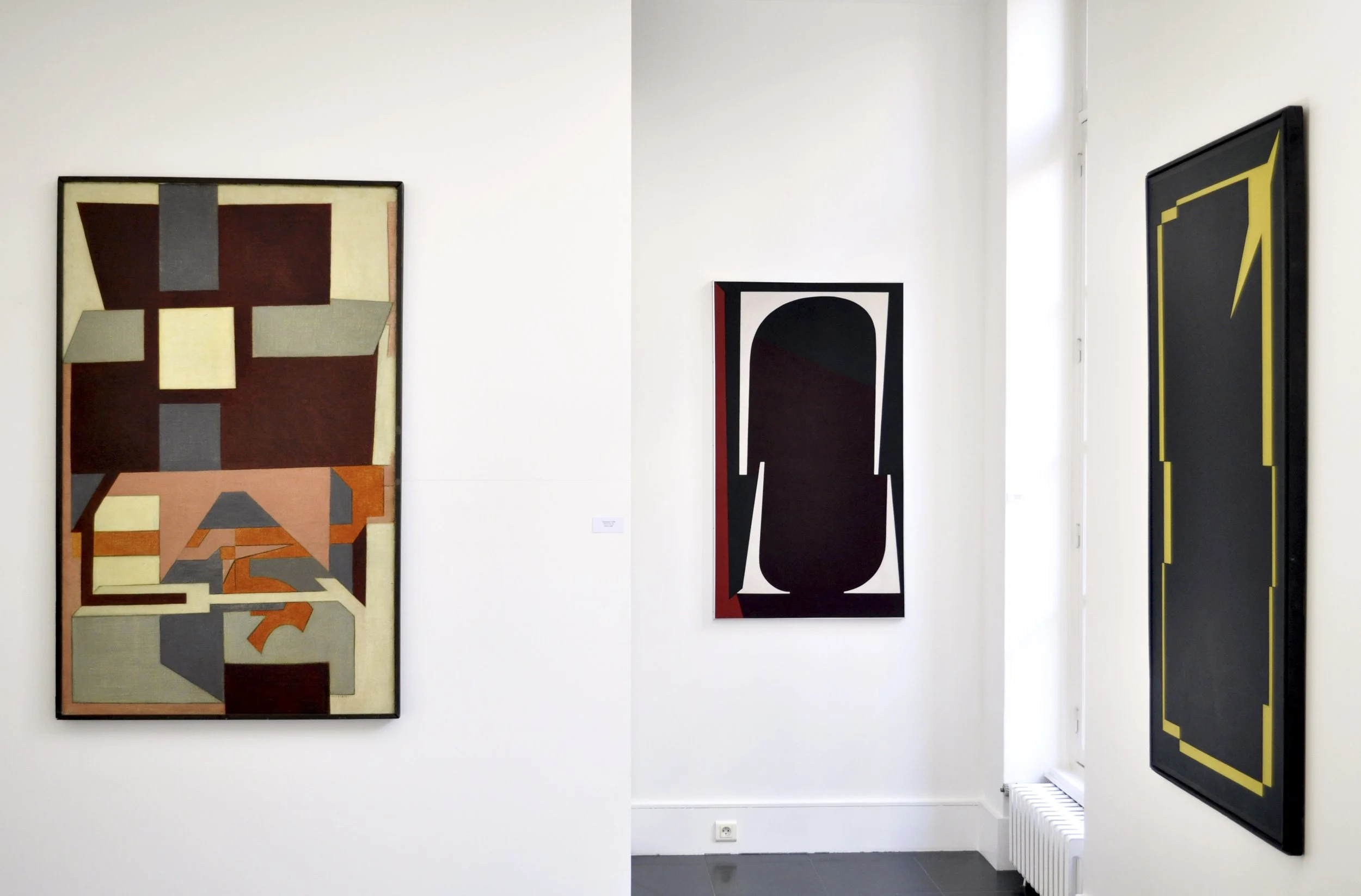
Vasarely's worlds are manifold, as are the diverse visual experiences that inspire them. Their common thread is that they all begin with observation. Only the scale varies: for Vasarely, abstraction is simply the result of his gaze adjusting to different levels of reality. In 1945, he created a series of collages from cut-out microphotographs. One of the keys to his abstraction lies here: it is less about severing ties with nature than about seeking new forms within what he calls his "internal geometry." The world of the cell and that of the crystal then presented themselves to him.
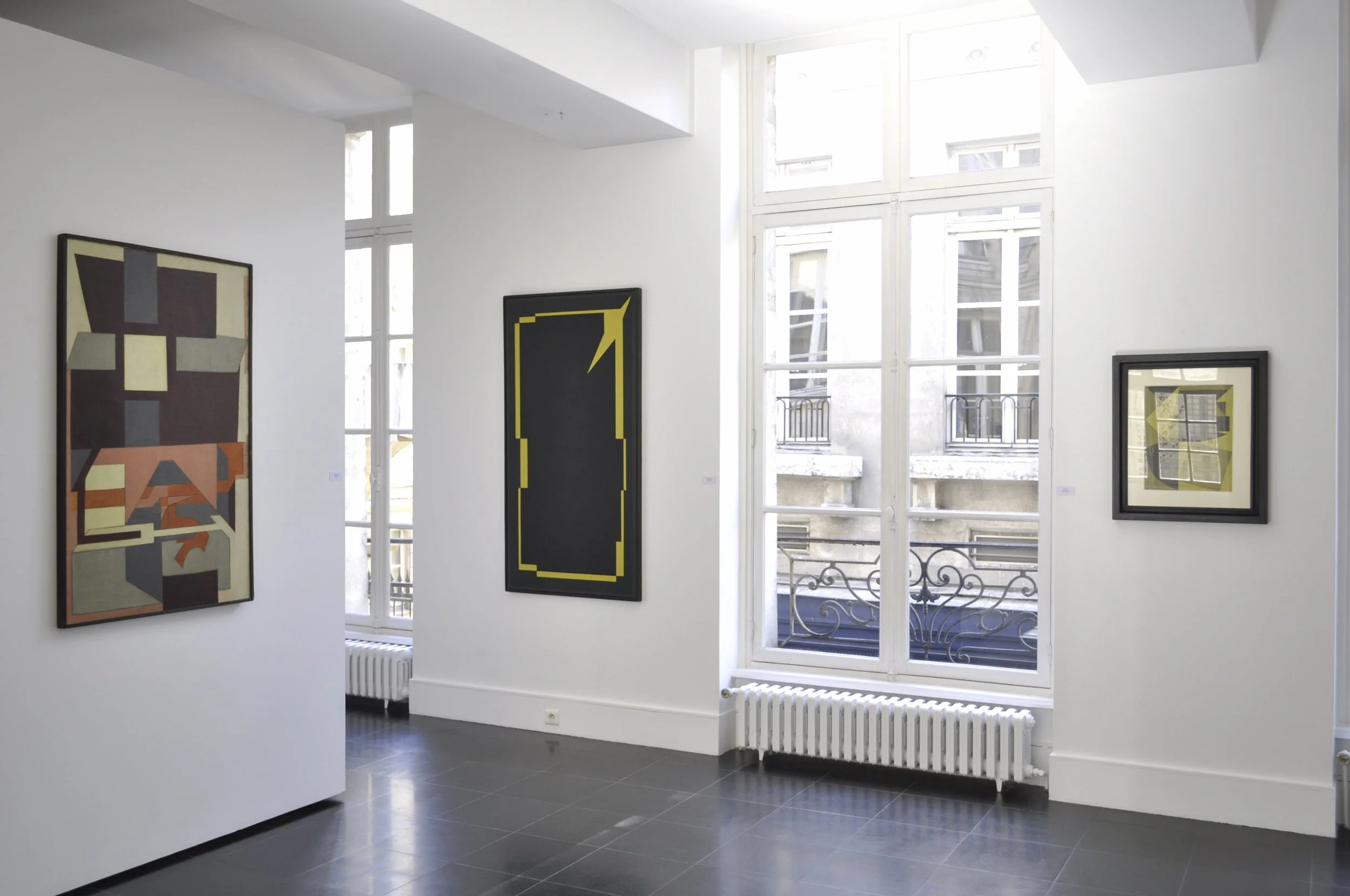
The cell is the biomorphism of the works in the Belle-Isle series; the crystal is the Cubist arrangement of sharp planes in the Gordes series. Added to this are the layered forms of the Denfert series, derived from the cracks in the Paris metro's wall tiles and elevated by the painter to the dimensions of geological landscapes, punctuated by the great synclines contrasting with anticlines (Tabriz, 1950-1954). For, with Vasarely, scale is constantly shifting. With the monumental Elbrus (1956), named after the Iranian peak, the crystalline arrangement refers back to its primordial environment: rock, mineral. The crystal also becomes architectural when the artist confronts the angular geometry of the village of Gordes, in the Luberon, which he discovered in the late 1940s. Sénanque (1948) or Santorini (1950), but also Yamada (1948), base their perceptual ambiguities on a play of false symmetries and sketched repetitions. Stone and glass, tumbled in the waves of Belle-Île, take on the forms given to them by the great forces of nature, thus expressing "the secret connection that exists between places and objects, between the different elements, between the planets." Like the nested ellipses of Longsor (1950-1952), the works in this series also echo the "single swirling medium" from which all beings and things are said to originate. The pebble sets Vasarely on the path of cosmic reverie.
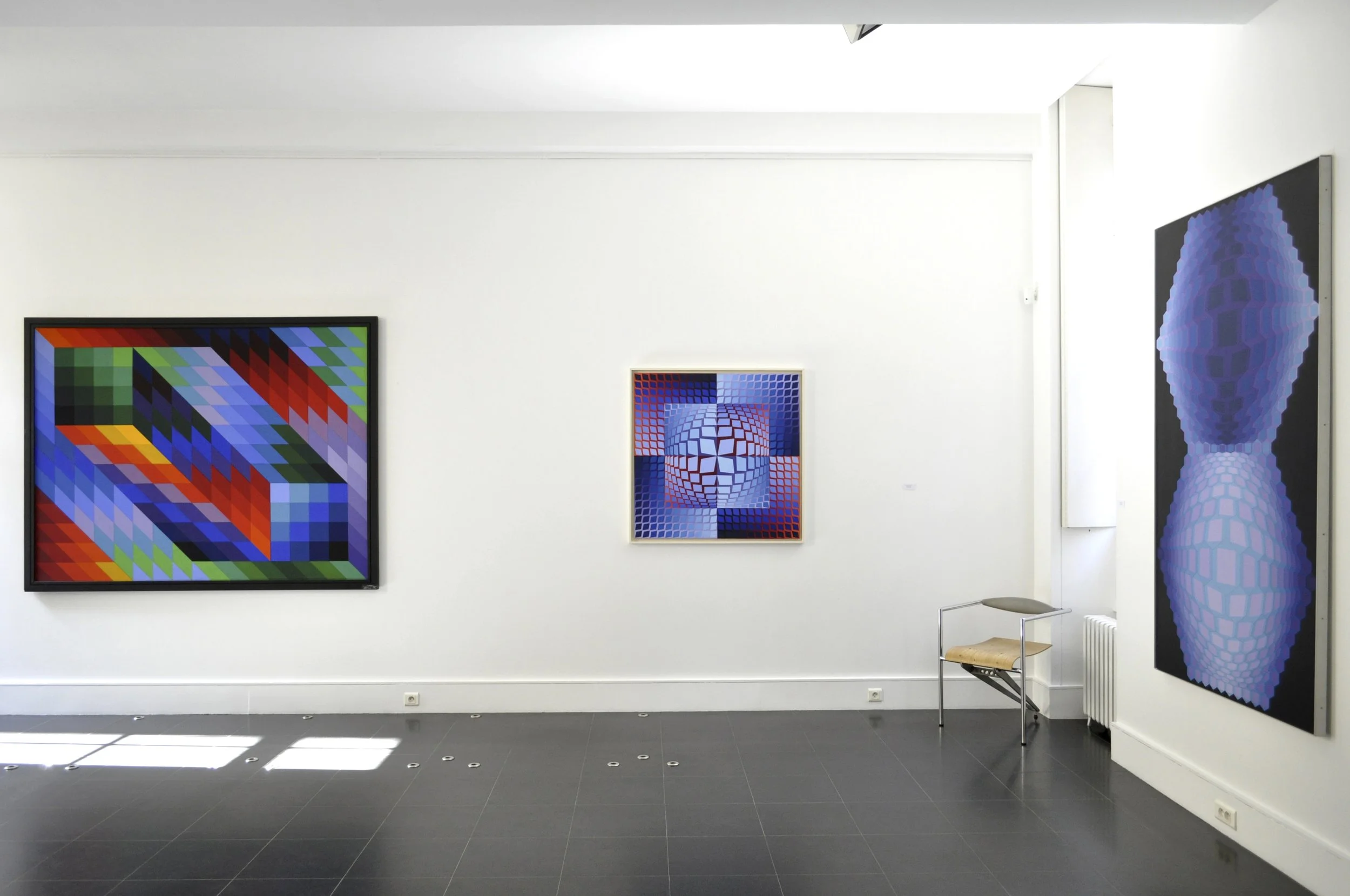
The cosmos, another scale. Vasarely's black and white world confronts this as early as the 1950s: Bellatrix MV (1957-1960) presents a succession of white circles, some of them cut off, against a black background. The stark contrast makes them blink like the star that gives the work its title. As in the previous series, these titles do not indicate any figurative relationship between the work and reality. But they launch the viewer's imagination into a vast network of analogies and correspondences. The chromatic gradient of Quazar-R (1968) emanates a luminous intensity that seeks to transpose the phenomenon of irradiation suggested by its title, the latter referring to a particularly energetic source of cosmic radiation: quasars. In Quazar-Zett (1965-1971), these luminous effects, delivered through a different color range, are enriched by a distortion of the grid underlying the composition: it swells, creating on the surface a bubble comparable to those in the paintings of the Vega series, or to those that form in the masterful Terries II (1973-1975). Famous above all others, this typically Vasarely motif offers a spectacular image of the cosmic genesis and cataclysms that so fascinated the artist: “They seem to breathe heavily, like pulsars born from a gigantic explosion that occurred fifteen billion years ago. I am convinced, for my part, that this birth is continuous, that it is endless, and that it constitutes the very fabric of the universe.”
With Gestalt City (1969), the fourth dimension makes its appearance and completes this panorama of Vasarely's universes. A multiverse, here, a universe crumpled by the spatial illusions generated by these scaffoldings of axonometric cubes which—aided by plays of light—can be read in relief or in projection simultaneously. With them, Vasarely builds Piranesian architectures where the sense of gravity has been lost, where all information, carried by unreliable spatial coordinates, is subject to questioning. Work after work, the artist thus explores all dimensions of a nature not expelled from creation but revisited according to a new axiom, the one suggested to him by the sciences of his time: "Let's put an end to romantic Nature: our Nature is Biochemistry, Astrophysics and Wave Mechanics."
Arnauld Pierre
February 2019