


The space in between
Renaud Jacquier Stajnowicz & Moon-Pil Shim
From May 18 to July 6, 2019
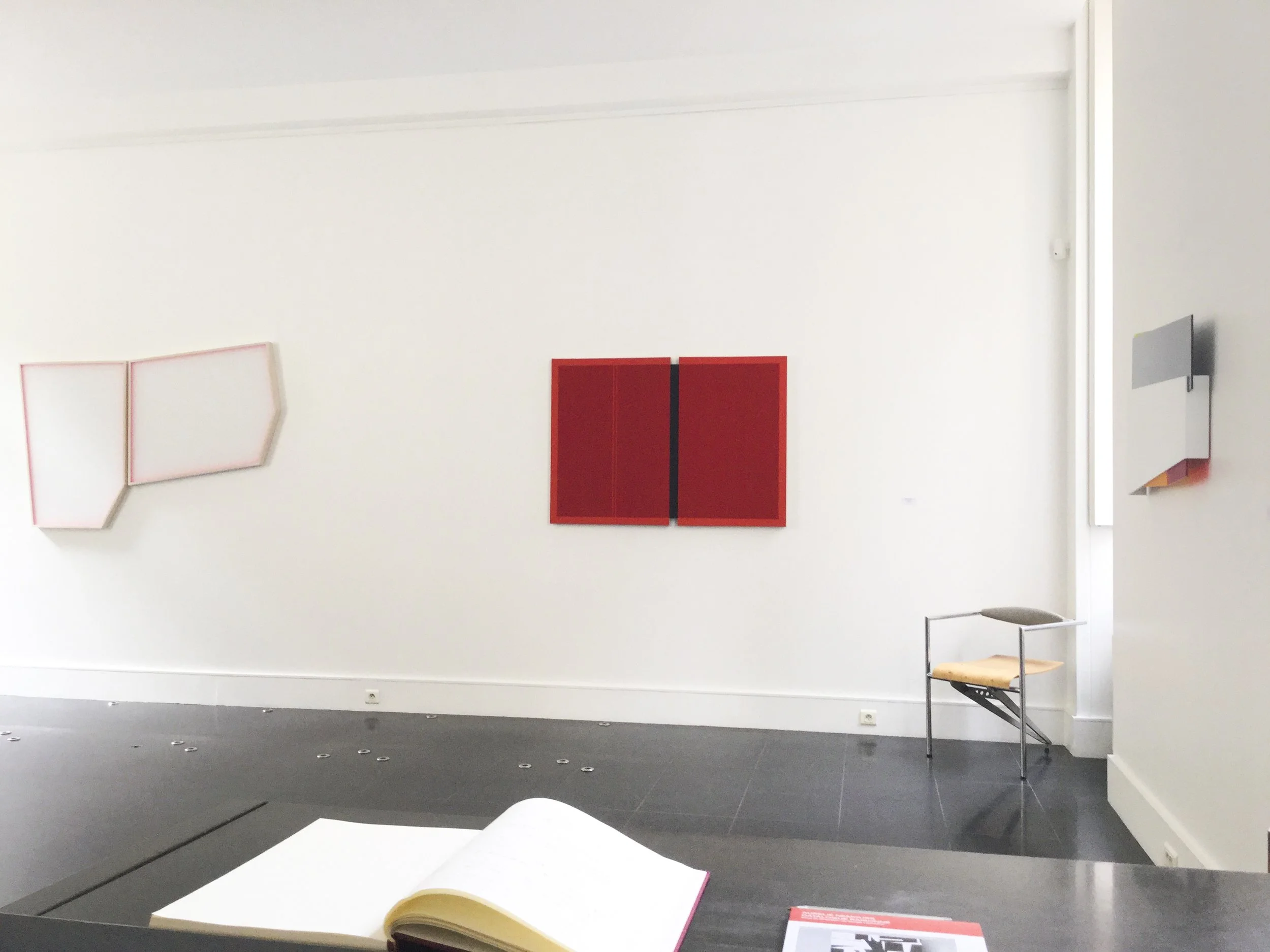
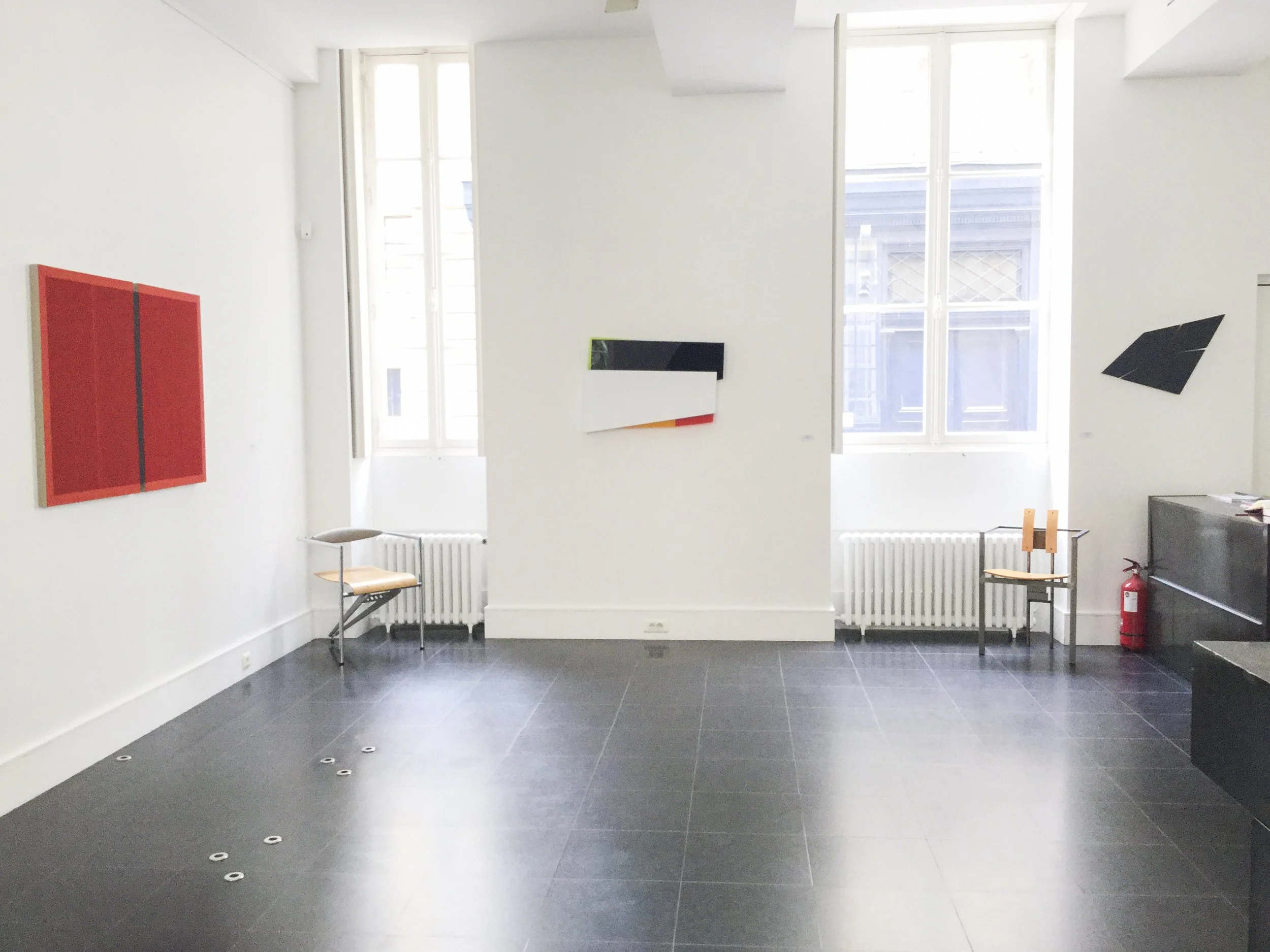
For this exhibition at Galerie Lahumière, Renaud Jacquier Stajnowicz and Moon-Pil Shim draw us into a dialogue exploring space, light, and movement. While their works differ in form, they share a strong focus on the surrounding space—that of the wall or the gallery (both artists have, in fact, completed numerous monumental commissions)—and the intrinsic space of the artwork itself: what happens between the elements, what relationships exist between them? Various means are employed to answer these questions, ultimately prompting us to consider the enduring nature of painting, an eternal window onto the world, and, for abstract artists since its inception, how to use it to make the invisible visible
Renaud Jacquier Stajnowicz is fond of the notion of threshold, and a threshold is a passage to be crossed, a passage that delineates distinct spaces or spaces with different functions: physical spaces, immaterial spaces. Physical space is the materiality of the painting, while the immaterial or invisible becomes the relationship between the elements of the painting or between the paintings that compose the work. It is the assembly of these elements that disrupts our perception; there is a transcendence of the frame, that of easel painting, a painting that becomes an environment into which we enter. Indeed, certain assemblages of paintings cannot help but unsettle us, because they disturb our order and our calm. This leads to a play on open and closed spaces, the solids of the painting, the voids of the wall that compel us to move, and if there is movement, there is movement; movement of the body, but also movement of the gaze, an extension of thought.
The same process occurs with the works of Moon-Pil Shim. His paintings don't appear directly to us, but rather reveal themselves by being presented "veiled" behind one or more translucent Plexiglas panels. The layering of these panels draws us into the work; sometimes the Plexiglas reflects and invites us to become aware of the surrounding space. Moving the panels reveals the work in its entirety, allowing us to see what lies behind. We are not in the realm of Vasarely's optical approach, nor in the participatory experiments of GRAV, but rather in an almost metaphysical thought that questions what lies beyond, what lies behind the surface of things. It is the light that passes through or reflects the painting that allows us to cross the threshold.
In Moon-Pil Shim as in Renaud Jacquier Stajnowicz, we are in the space of the in-between, a back and forth between the above, the below, the inside, the outside, we are at the same time literally in the infra and in the supra, our desire before these works pushes us to seek to see below the surface but also above what is hidden there.
Painting, the starting point for the works of these two artists, is a surge, an impulse. Movement originates from both body and mind. First, the will dictates movement to the body, and then the body is propelled forward. Matter and spirit thus meet at a common point, and it is the artist's role to make us feel this.
In this sense, the works of Renaud Jacquier Stajnowicz and Moon-Pil Shim belong to the realm of the infinitesimal, to the internal vibration of matter, and therefore to painting and the vibration it seeks to evoke within us through space and light.
All the concrete experience we have originates in the world of thought. It is therefore not quite the movement of the body that is at issue, but rather a thread, materializing the flow of thought without necessarily being concerned with words. It is something common to all men, it is what creates the bond, and perhaps it is also the universal language inherent in many non-objective and non-concrete artists. Henri Bergson said:
“What is real is not the simple, instantaneous ‘states’ we take, again, along the way; it is, on the contrary, the flow, the continuity of the transition, the change itself. The essence of real time is to pass; none of its parts is yet visible when another appears.” For me, this is the space of in-betweenness to be lived and experienced in this exhibition.
Céline Berchiche.
April 10, 2019.