

Auguste Herbin
Swirls
From October 10 to December 21, 2019
An exhibition dedicated to Herbin on the theme of volutes? A paradox! Isn't Auguste Herbin one of the most representative painters of geometric abstraction, his paintings composed solely of squares, rectangles, triangles, circles, and semicircles, his figures drawn with a ruler and compass, strictly ordered in the plane within a horizontal-vertical grid? Indeed: this is Herbin from his great period, the one in which, after 1945, he dominated all of European art with the beauty of his compositions and the strength of his ideas.
But this is to see only a part of his work, which was immense, varied and spanned the entire 20th century until 1960. There is Herbin the pointillist, Herbin the Fauvist, Herbin the pioneer of Cubism, Herbin one of the first abstract artists, Herbin of the return to figuration, Herbin returned to abstract art, and then founder in 1931 with Georges Vantongerloo of the association Abstraction Création.
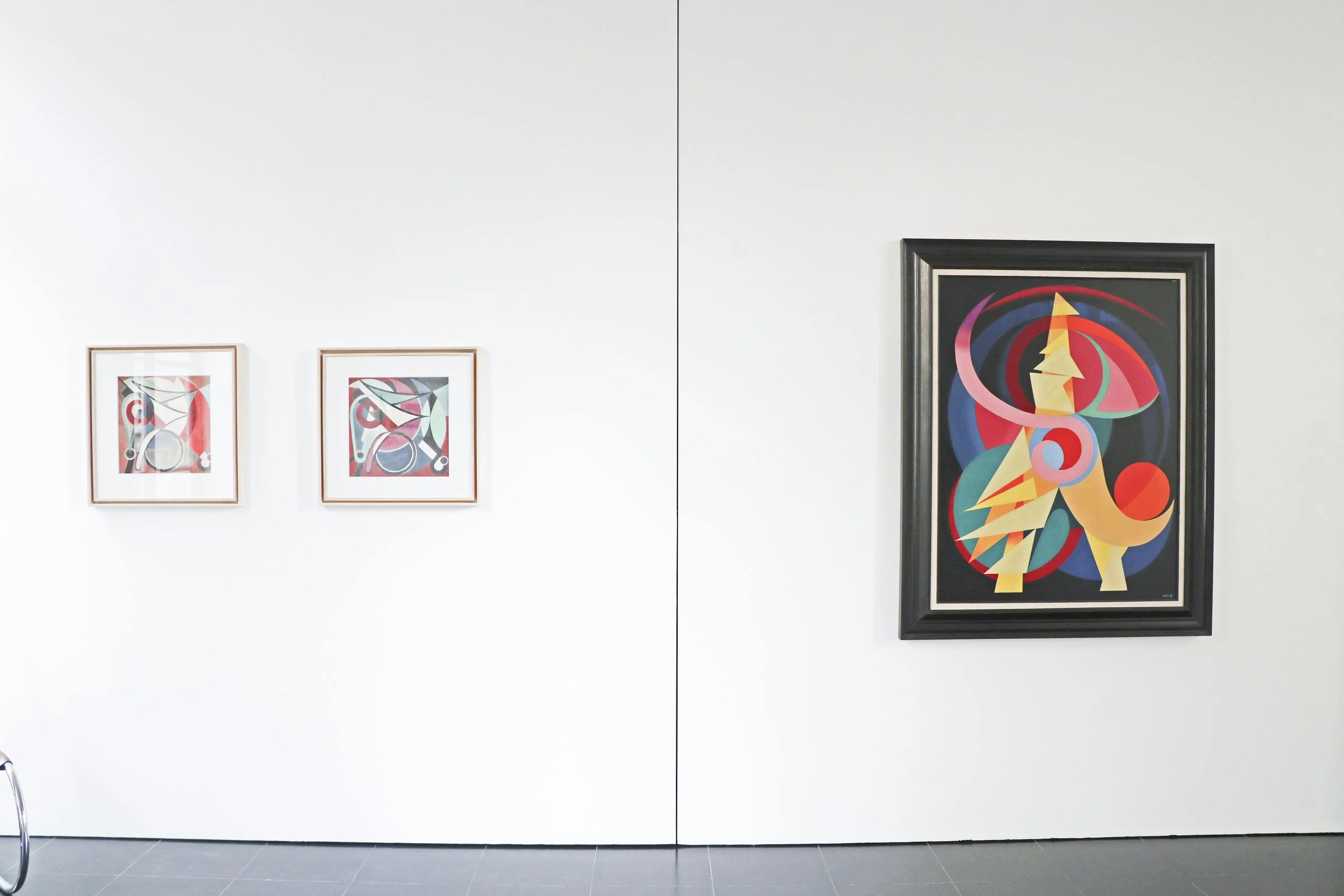
Has it been sufficiently noted that this latter shift occurred from 1925 onwards through subjects drawn from reality, increasingly transposed and stylized to the point of being unrecognizable, as demonstrated by the composition *The Little Man and the Donkey*, dated 1926, where nevertheless all the elements of the original remain present: the animal, its handler, the landscape, the ground, and the sky? It should also be noted that the whole is expressed in a single language: that of curves. Herbin would not abandon this language until 1942, that is, for a period of 17 years, resulting in more than 180 paintings. This is the subject of this new exhibition at the Lahumière Gallery.
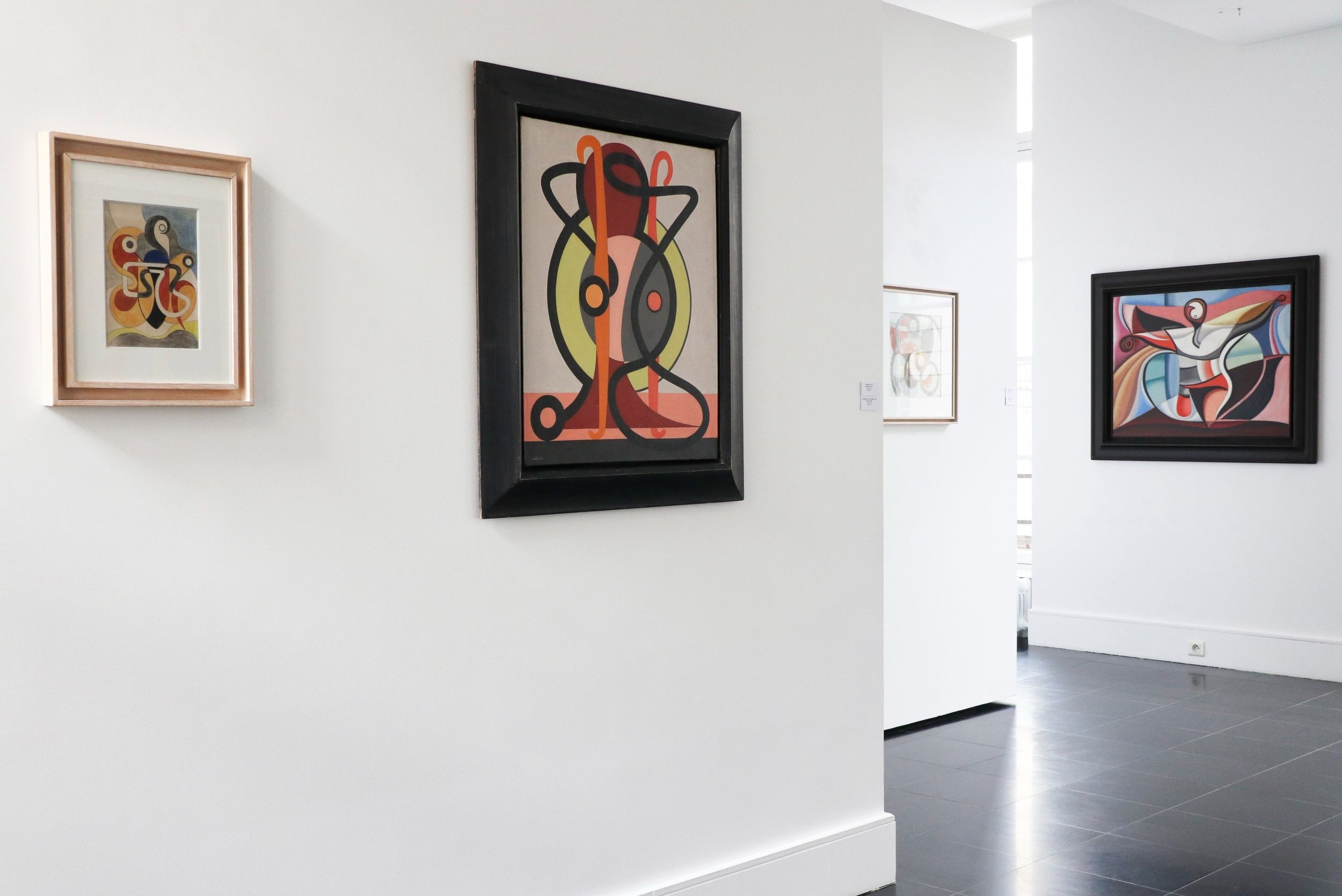
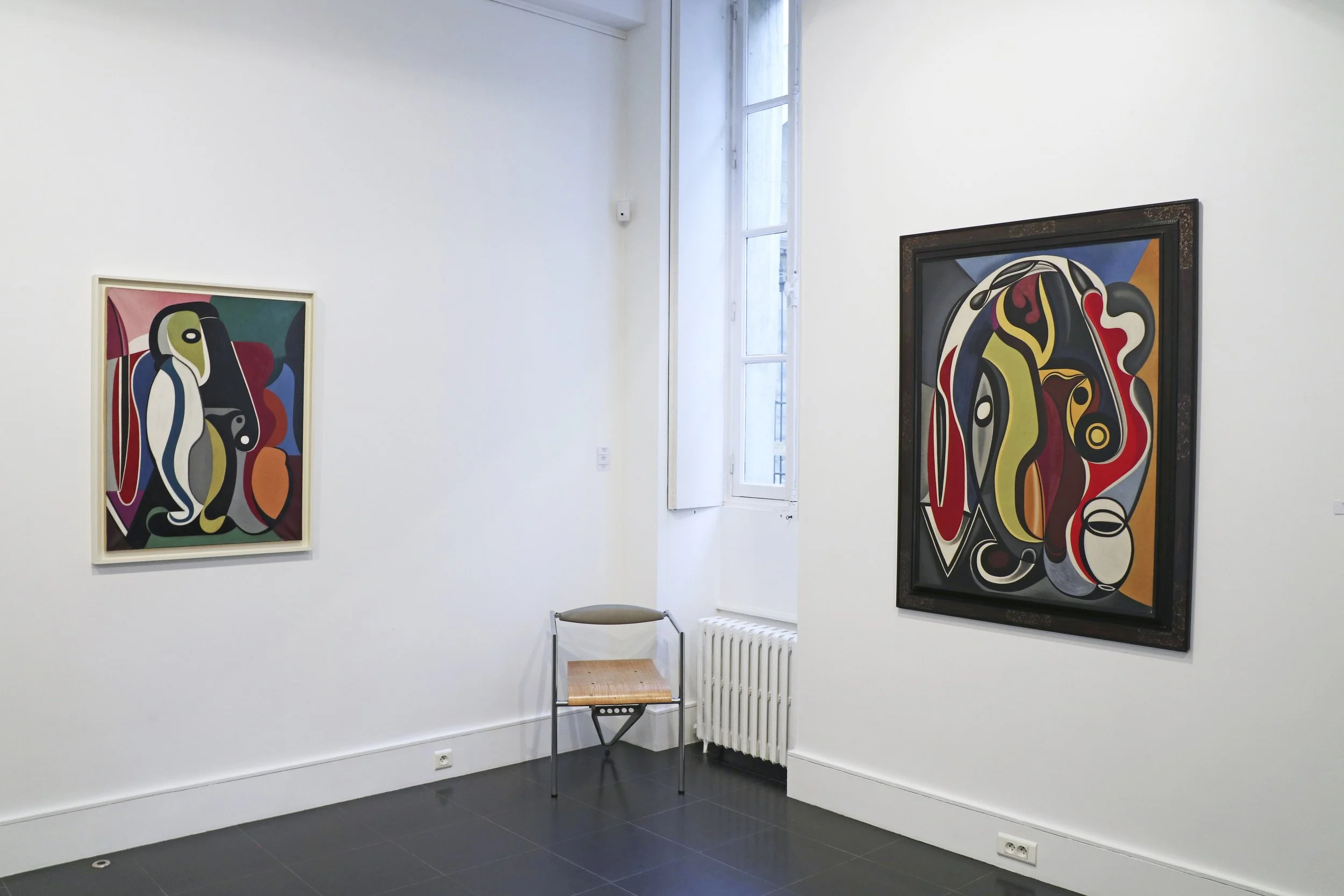
Within this long period, one can observe a clear evolution and a wide variety of styles, all sharing common features such as a respect for the plane in the arrangement of forms, generally vibrant colors applied in flat planes, and a neutrality and precision of execution that would continue to characterize his subsequent works. The compositions are complex and sometimes dense, then move towards simplification in the 1930s, as references to reality fade and the artist adopts a truly abstract approach, as demonstrated by his 1932 painting Composition with Black Line (private collection, Paris), to which several watercolors from 1936 included in this exhibition can be compared. At the same time, Herbin remained committed for a long time to the classical presentation of the motif against a background that complements the centripetal composition; Composition on a White Background of 1932 is a magnificent example of this. The work is powerful, with its interlacing curves contrasting with a family of circles. It is movement that is sought, as seen in many paintings where the artist directly alludes to dance. In this style, Herbin composed the three monumental decorations he executed in 1937 for the cinema of the Railway Pavilion at the International Exposition of Arts and Techniques in Paris.
Curves, spirals, coils, meanders, interlacings, volutes in an infinite variety of arrangements—so many organic forms: drop, amoeba, bean, knucklebone, shell, knot—linking and developing, generated by one another, connect Herbin's art to that particular tendency of non-geometric abstraction called biomorphism. Its principal representatives in the 1920s and thereafter are illustrious: Arp, Kandinsky, Kupka from his early work (for the other half of his oeuvre), Miró, Calder, Moholy-Nagy, Domela, Erni, Béöthy, Vantongerloo, Schwitters, as well as, at the margins of abstraction and at its highest levels, Léger, Baumeister, and Le Corbusier. Herbin is one of the first, most important, and most original of these artists. His 1930 painting, Composition, shown here in the exhibition, finds its equivalent in Le Corbusier's 1938 painting, Embrace III (Geneva, Museum of Art and History). In the late 1930s, he titled one of his works Spiritual Reality, also featured in the exhibition. Still rigorously abstract and continuing his development from organic forms and all that they contain in terms of germination, transformation, and metamorphosis, Herbin added a new dimension to his art, imbuing it with spiritual content.
Serge Lemoine