
To transcend, to reconstruct reality
F. Del Marle, G. Folmer, J. Gorin
From February 6 to July 9, 2021
The current exhibition at the Lahumière Gallery brings together three 20th-century artists, close in their commitments and their plastic and aesthetic concerns, and profoundly original in their own conceptions of geometric abstraction.
First, it's worth noting that Félix Del Marle (1889-1952), Georges Folmer (1895-1977), and Jean Gorin (1899-1981) began their careers in figurative art. And strangely enough, some occasionally returned to it after an abstract period, such as Malevich, Hélion, and Herbin. Del Marle returned to figurative art between 1930 and 1940, Folmer practiced it until 1943 and even occasionally until 1960. Gorin abandoned it completely in 1926.
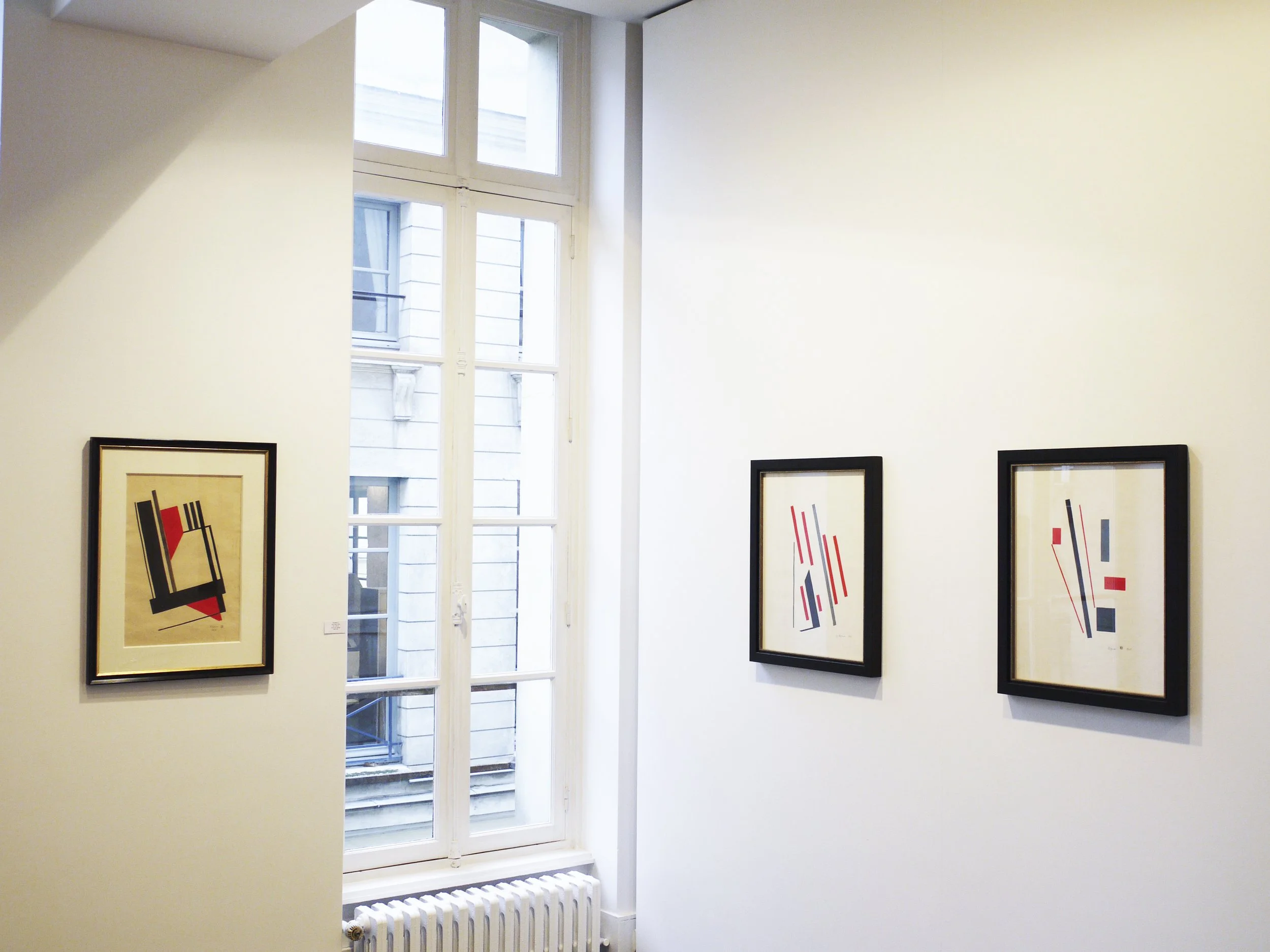
The earliest work here is Del Marle's "Study for Musicalism" (1925). At that time, the artist was influenced by Futurism, had become associated with the German group "Simplicissimus," and with Friedrich Kupka. Most notably, he founded the group and journal "Vouloir" in Lille, a regionalist and moderately avant-garde movement. That same year, he gave a lecture on H. Valensi, the founder of Musicalism, who sought correspondences between painting and music, colors, sounds, etc., without, however, aiming for a total synthesis of the arts, as Kandinsky had envisioned in "Yellow Sound" in 1909.
From 1926 onwards, "Vouloir" and Del Marle turned resolutely towards "De Stijl" and Neo-Plasticism: Mondrian was asked to contribute articles to the magazine, and Del Marle visited him in his Parisian studio. That same year, Del Marle traveled to the Netherlands with C. Domela and met the architects G.T. Rietveld and J.J.P. Oud. This led to several architectural projects: the "L'Esthétique Moderne" bookstore in Lille and Léonce Rosenberg's apartment in Paris. Also in 1926, Del Marle became friends with Jean Gorin, who, in turn, met Georges Folmer that same year.
At this time, J. Gorin appreciated the Purism of Ozenfant and Le Corbusier, an architect who readily practiced sculpture and painting. Purism (which Del Marle vehemently criticized) having degenerated into a kind of decorative system, Gorin discovered Neo-Plasticism through "Vouloir" (in which G. Folmer was now involved) and Del Marle in Lille, and formed a close bond with Mondrian, to whom he remained faithful throughout his life. In 1932, he founded "Abstraction - Création" in Paris, with Herbin, Hélion, and Vantongerloo. He traveled to Moscow and admired the works of Malevich. He was almost certainly aware of the research of the Russian and Soviet avant-garde on art and everyday life, the projects of the architect Melnikov, the porcelain tableware of Kandinsky and Suetin, the works of Malevich, the furniture of Rodchenko... This "utilitarian," social direction of art was already that of Del Marle and his new STUCA group, founded for a few months in 1928 in Lille (with Gorin, Domela, Mondrian...), aiming for a new synthesis of art and industry, parallel to the spirit of the Bauhaus, which Del Marle had visited in 1926...
Here emerges a preoccupation whose meanderings we can trace throughout the 20th century. Geometry underpins a new reading of the world: discovering the true, immutable structures of reality, beyond appearances. Extending the work of Cézanne and then Cubism, geometric abstraction devoted itself to "pure" forms, readily drawing on the Hermetic tradition. Mondrian and Kandinsky were followers of Theosophy, Malevich practiced a blend of aesthetic mysticism and revolutionary faith, Del Marle was a Freemason before converting to Catholicism in 1930, Gorin, in 1977, demanded from the artist "new means of expression based on the universal and eternal laws of the cosmos," Folmer was fascinated by the Golden Ratio and its universal presence... The quest was as much spiritual as it was artistic.
But the link with the public risks being severed forever. Therefore, a way must be found that allows everyone to embrace these new principles and live in a more beautiful, better, and thus more just world (Plato's idealism is not far off).
Two possibilities are then explored:
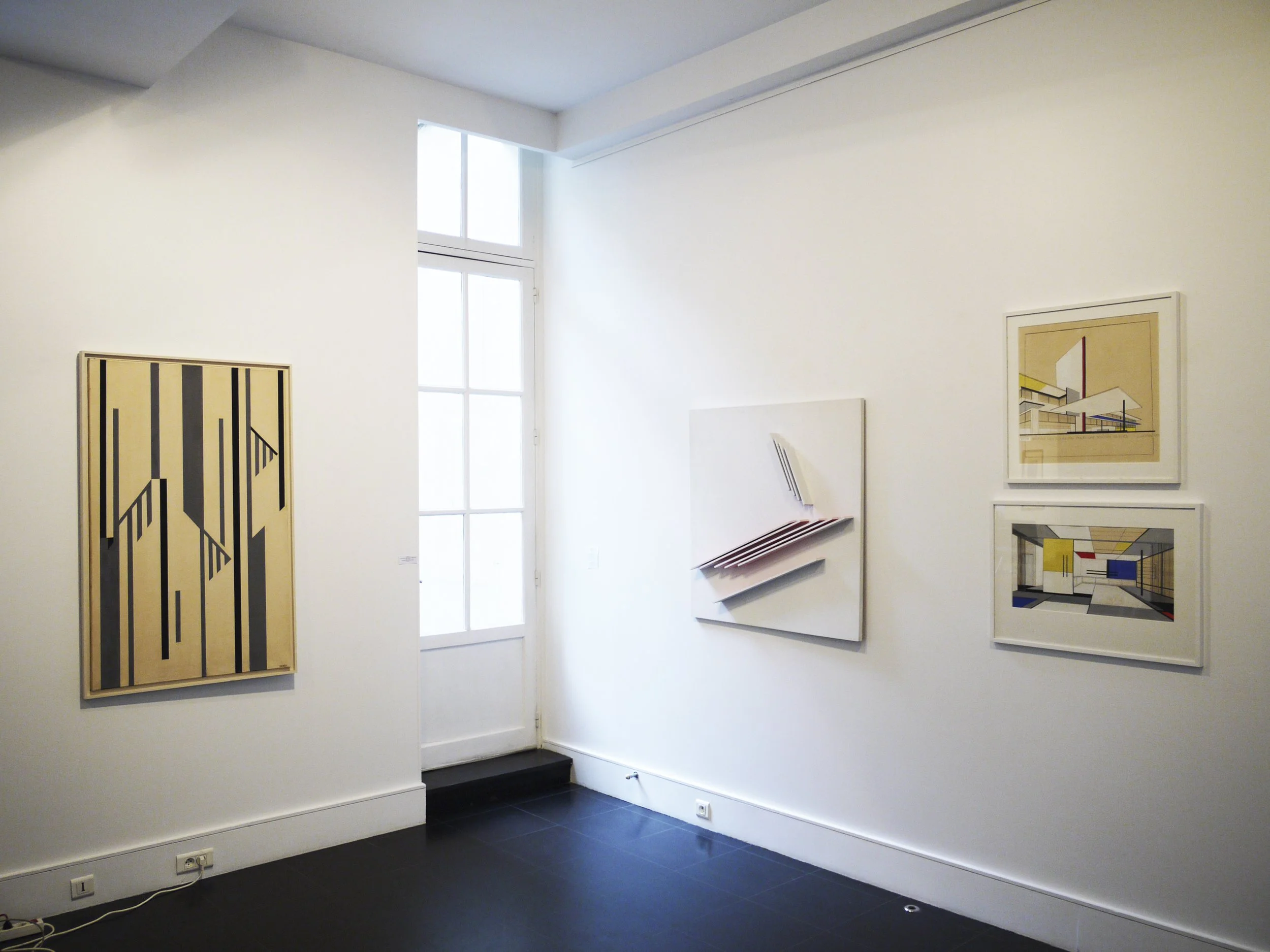
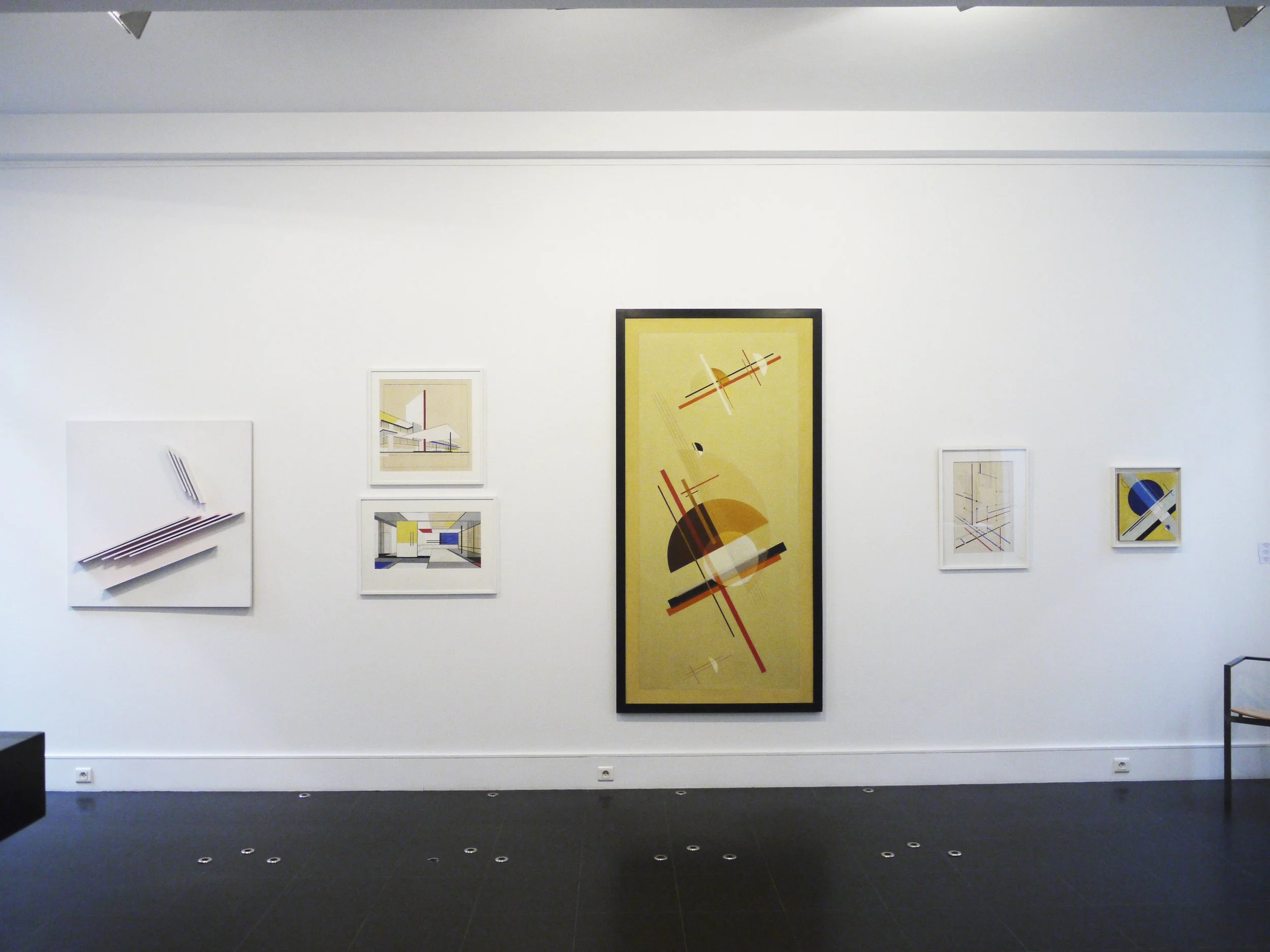
An architecture united with painting, visible to all: a new society, a new man. From this spring these creations embedded in the concrete world: the openly neo-plasticist interior of Del Marle's house in Pont-sur-Sambre (1926), of Gorin's house in Nort-sur-Erdre in 1926-1927, and in Sainte-Pézenne in 1967, two projects—among many others—presented here (1952 and 1964), numerous studies of furniture, architecture, and polychromy. This trajectory is quite parallel to that of Le Corbusier from 1923 onward (in particular, his experiments in "Architectural Polychromy" in 1947 and 1953: the Radiant Cities of Marseille in 1947, and of Rezé in 1953).
To engage with the public, through exhibitions, hence the fundamental role of the Salon des Réalités Nouvelles, of which Gorin was a founding member (with A. Herbin, creator in 1942 of the "Alphabet Plastique," a new essay on the correspondence between the arts), and its first Secretary General. This position was held by Del Marle from 1947 to 1951. Folmer participated in this Salon from 1947 to 1972 and became its Secretary General from 1956 to 1968. This Salon was an essential meeting place, an echo of the many debates and disputes; it brought together and confronted diverse trends, affirming the vitality and necessity of geometry in the face of lyrical abstraction and the very dynamic American avant-garde.
Beyond these visible activities, Folmer, too, sought true reality beyond appearances, and throughout his life, he was passionate about the Golden Ratio, music, the poetry of Mallarmé, and the synthesis, or at least the correspondence, of the arts, during numerous discussions at the Salon des Réalités Nouvelles, or with Gorin, Del Marle, and his collaborator Servanes, among others. The works presented here date from 1949-1959 and demonstrate a fine concern for construction and balanced solidity. Folmer's explorations are perhaps less obvious than those of Del Marle or Gorin, but we can glimpse a clue in the titles: "Through the Blue Incense of Fading Horizons" (1953), "And Suddenly the Sun Strikes Nudity" (1959), besides echoing Mallarmé, may also evoke some architectural facade (cf. Mondrian's 1914). Similarly, the slightly slanted ochre and black planes of "Composition 1950" (1950) seem to echo the fruit of the pylons of Egyptian temples, this Egypt, mother of ancient mysteries, which we find here and there in Folmer, a domain that neither Gorin nor Del Marle explore...
In 1952, Folmer joined the "Espace" group, founded the previous year by F. Del Marle and A. Bloc, to foster collaboration between designers, architects, and artists. In 1951-1952, the group developed various projects involving polychromy (Lille Trade Fair), social housing (Guebwiller, Flins), and rooms at the Cité Universitaire in Paris. In 1956, Folmer resigned from the group, which he considered ineffective. In 1960, he founded "Mesure" (dissolved in 1965) with J. Gorin (vice-president), L. Breuer, A. Nemours, L. Peire, and others, to revisit the question of the synthesis of the arts.
Simultaneously, new artistic concerns emerged. From around 1948, Folmer addressed the problem of polychrome and then mobile volumes, of movement—that is, of time—and that of the transformations of a work of art from 1960 onward. Gorin, in addition to planes, lines, and colors, also suggested time in his paintings, reliefs, and assemblages, such as the "Spatio-Temporal Composition No. 51" (1959) and "No. 60" (1969) presented here. These can be interpreted as distant, possible architectural ideas (perhaps akin to Malevich's "Architectons" of the 1920s, whose works he had admired in Moscow in 1932). In parallel, Gorin produced utopian-tinged design sketches: "Rest Home for a Club" (1952), "Plastic Architecture of Colors in Space-Time" (1964), which extended his neo-plasticist research from the 1920s. Del Marle, for his part, was interested in the notion of space without reference points: "Small Cosmic Space" and "Composition," both from 1948, could they be echoes of Suprematism? And his "Spatial Structure" (1949) seems to foreshadow Gorin's "Spatial Constructions" (1969), both remaining faithful to Mondrian's palette.
As we can see, these decades between 1925 and 1969 demonstrate a remarkable richness in terms of works, ideas, and commitments to the improvement of humanity and society through art: a kind of horizontal dimension. On the other hand, Del Marle, Gorin, and Folmer were determined to transcend appearances, to rebuild a kind of temple for a new Man, to rediscover "true reality," that of lost origins, governed by mathematical rules and immutable structures, dreaming of a new Harmony, a grand unity of all the arts, in a rediscovered Golden Age... This vertical dimension is subtly woven into the thinking of our three artists (and many others as well), who appreciated each other, worked together, separated, exchanged ideas, and reunited in various groups, such as the Salon des Réalités Nouvelles, each nevertheless retaining their individuality. But before their disappearance, Kinetic Art, Op Art, and Pop Art would establish another hegemony...
B. Fauchille,
Honorary Director of Museums,
January 2021