
Panoramas
Jean Dewasne
From November 7 to December 18, 2021
Jean Dewasne:
From Painting to Anti-Sculptures and Architecture -
A Total Work of Art
A major figure in geometric and constructivist abstraction, Jean Dewasne was the first winner of the Kandinsky Prize with Jean Deyrolle in 1946, the year of the creation of the Salon des Réalités Nouvelles, of which he joined the committee at the request of Herbin; his presence alongside him would be decisive.
Born on May 21, 1921 in Hellemmes, near Lille, Jean Dewasne, like Matisse and Herbin, was from the North of France. He was the founder of the Abstraction-Création movement and later of the Salon des Réalités Nouvelles. His career, marked by his research into geometric abstraction, which he embraced immediately at the end of the war, is remarkably coherent.
In 1950, Dewasne, along with Edgard Pillet, opened the Atelier d'Art Abstrait (Abstract Art Workshop), a place for teaching and reflection on the "technology of painting." This short-lived laboratory of abstract art (it closed in 1953) immediately provoked strong reactions following Charles Estienne's pamphlet, "Is Abstract Art Academicism?" (Beaune Publishers, 1950), denouncing a dogmatic and codifying approach. His colleague, the critic Léon Degand, responded in a text entitled "The Scarecrow of Abstract Academicism."
It was in this polemical climate that Jean Dewasne created his first paintings. In 1949, with his Traité de la peinture plane (Treatise on Plane Painting), he had already laid the foundations in his early works. After his first exhibition in 1941 at the Esquisse gallery-bookshop, where he presented subjects influenced by Matisse and Seurat, he showed his first abstract painting at the Salon des Indépendants in 1943, then at the Salon des Surindépendants in 1945, demonstrating his commitment to the Bauhaus tradition. Faced with proponents of lyrical abstraction, he chose his side and established himself as a fervent defender of an aesthetic line: "Abstraction is an ethic, a way of life that adapts." His activism was all-encompassing, even targeting figurative art. He organized numerous events and lectures to convince people of the progressive purpose of abstraction and the urgent need for recognition of a constructive art that participated "in direct action with the human community." His first mural, La Joie de vivre (1948), essentially contained his theories on plane and form, creating optical illusions without relying on perspective. His theories, derived from the work of mathematicians on abstract spaces, draw on non-Euclidean geometry, topology, n-dimensional spaces, and the theory of four colors, offering artists the possibility of "stepping outside" the confines of the flat surface to work in entirely new, curved spaces.
Having become a leading painter at the Denise René gallery alongside Vasarely, Marie Raymond, Poliakoff, Deyrolle, and pioneers like Hartung and Schneider, he exhibited six small Antisculptures in 1953, including The Choirboy (Matisse Museum, Le Cateau-Cambrésis).
He contributed to the rise of geometric abstraction in Scandinavia, Belgium, and especially Denmark, with his friends Robert Jacobsen and Richard Mortensen.
A flat painting. Constructed color.
The Anti-sculptures.
Glycerophthalic lacquer.
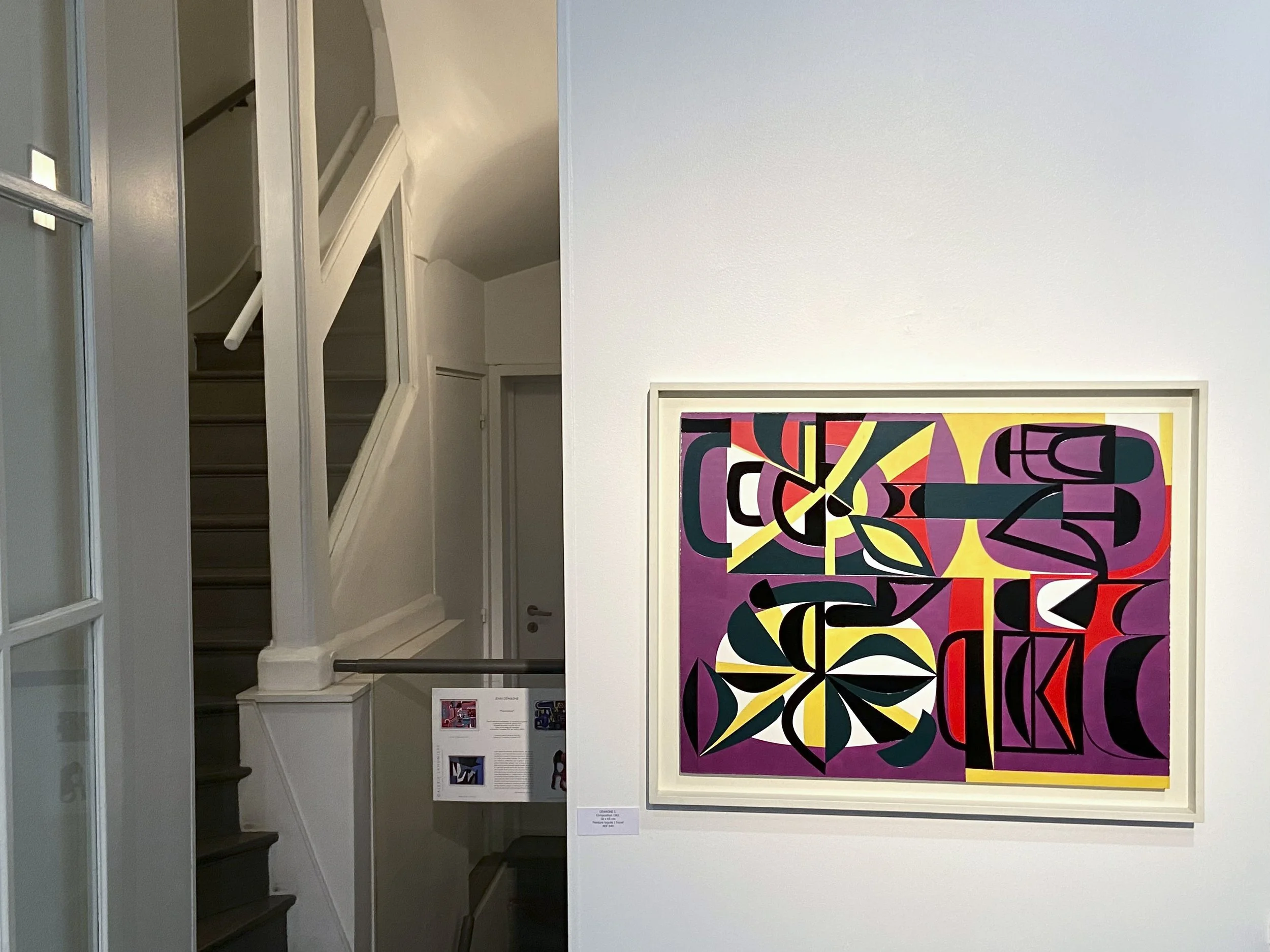
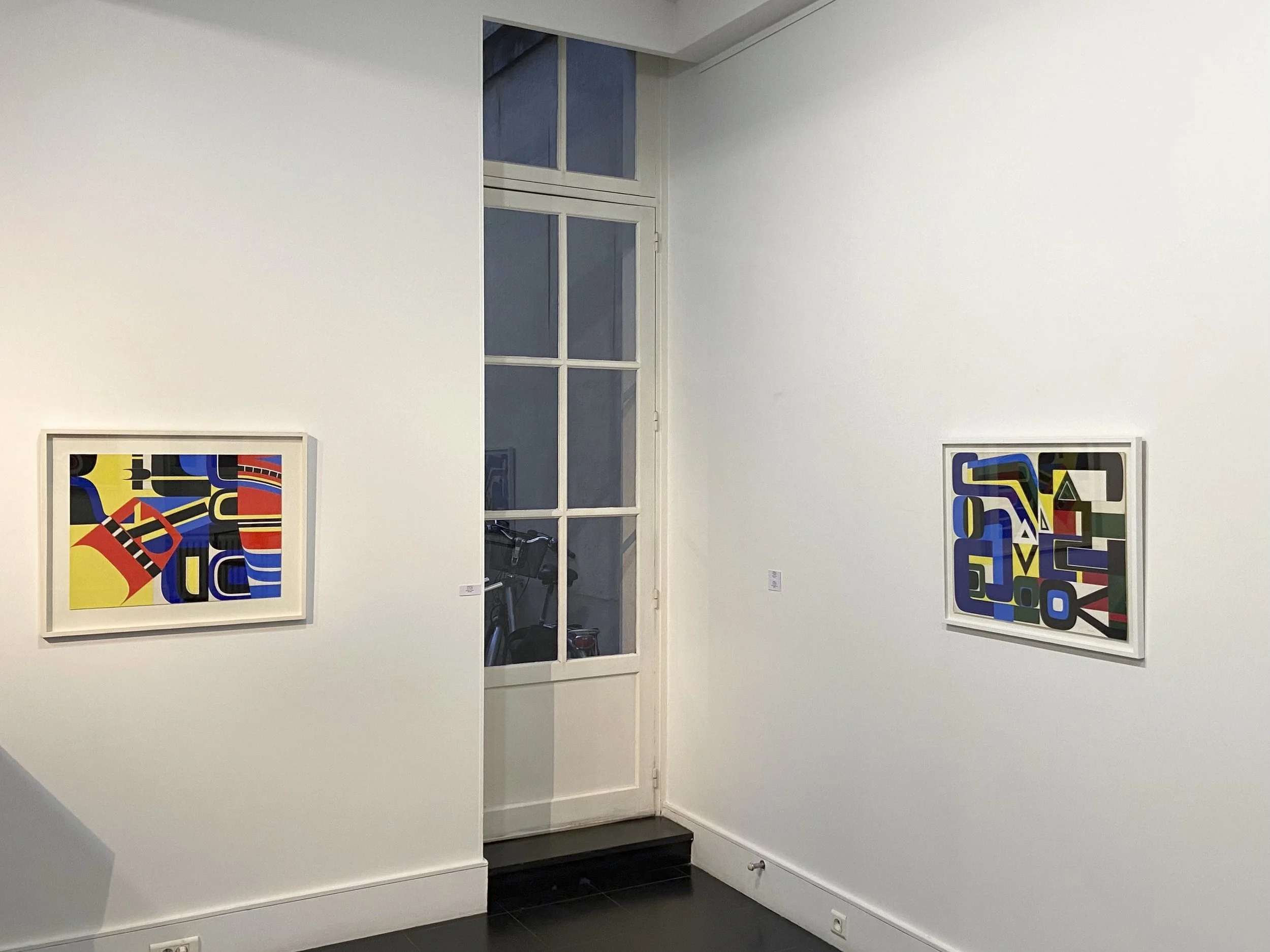
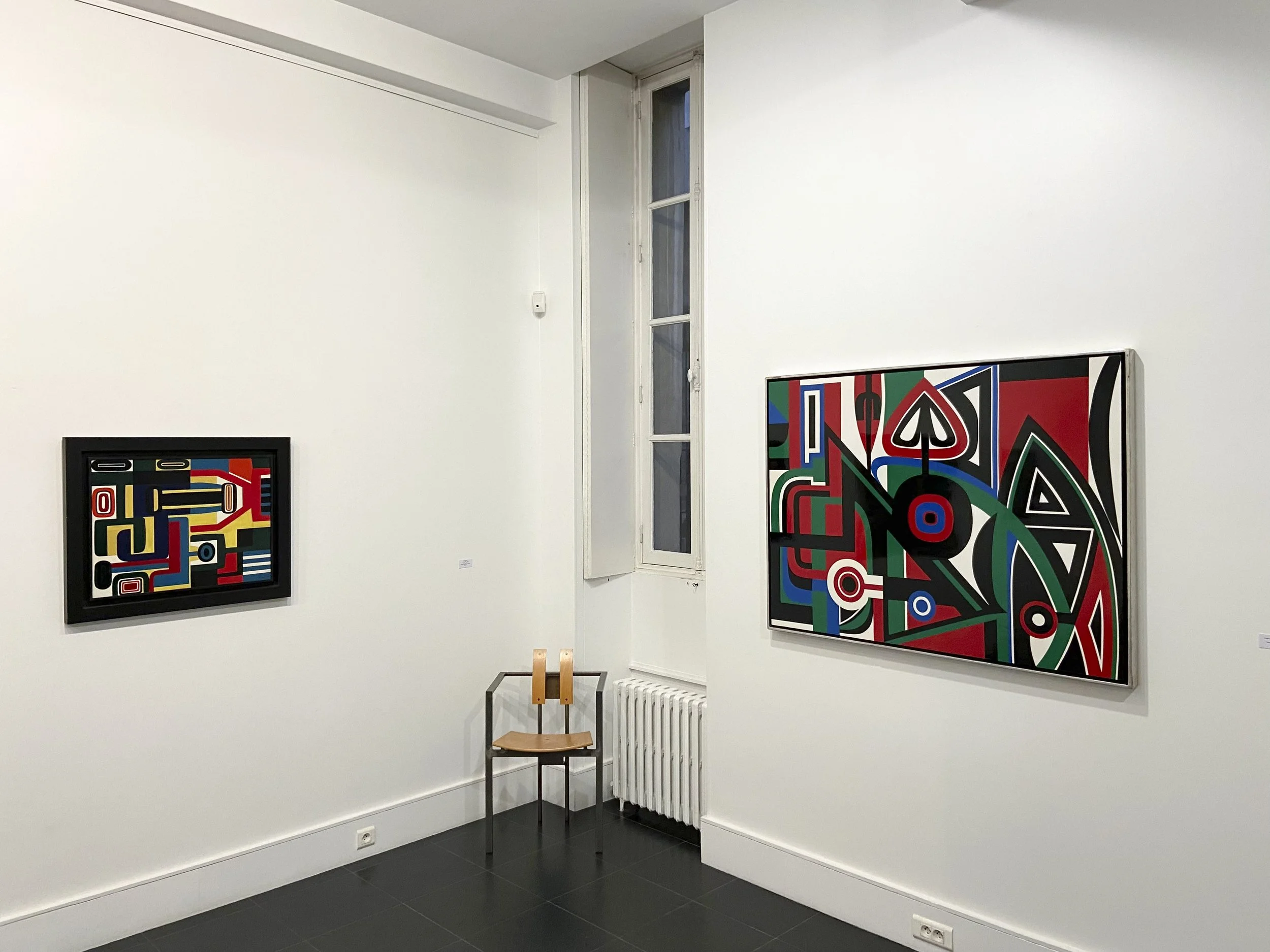
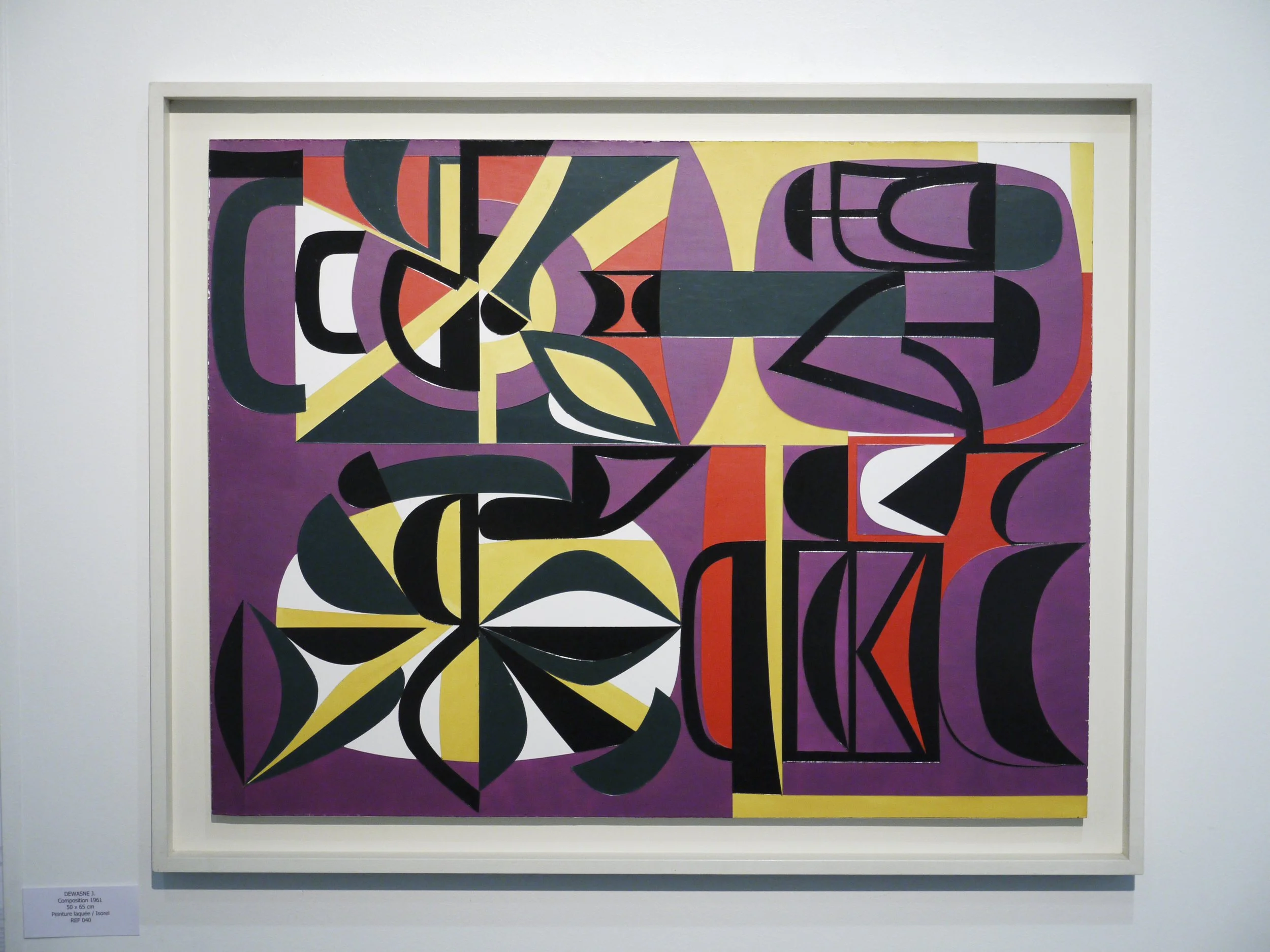
Dewasne developed a vocabulary of simple, evolving forms arranged in complex rhythms within a Baroque style, using flat areas of bright, contrasting colors, without reference to reality.
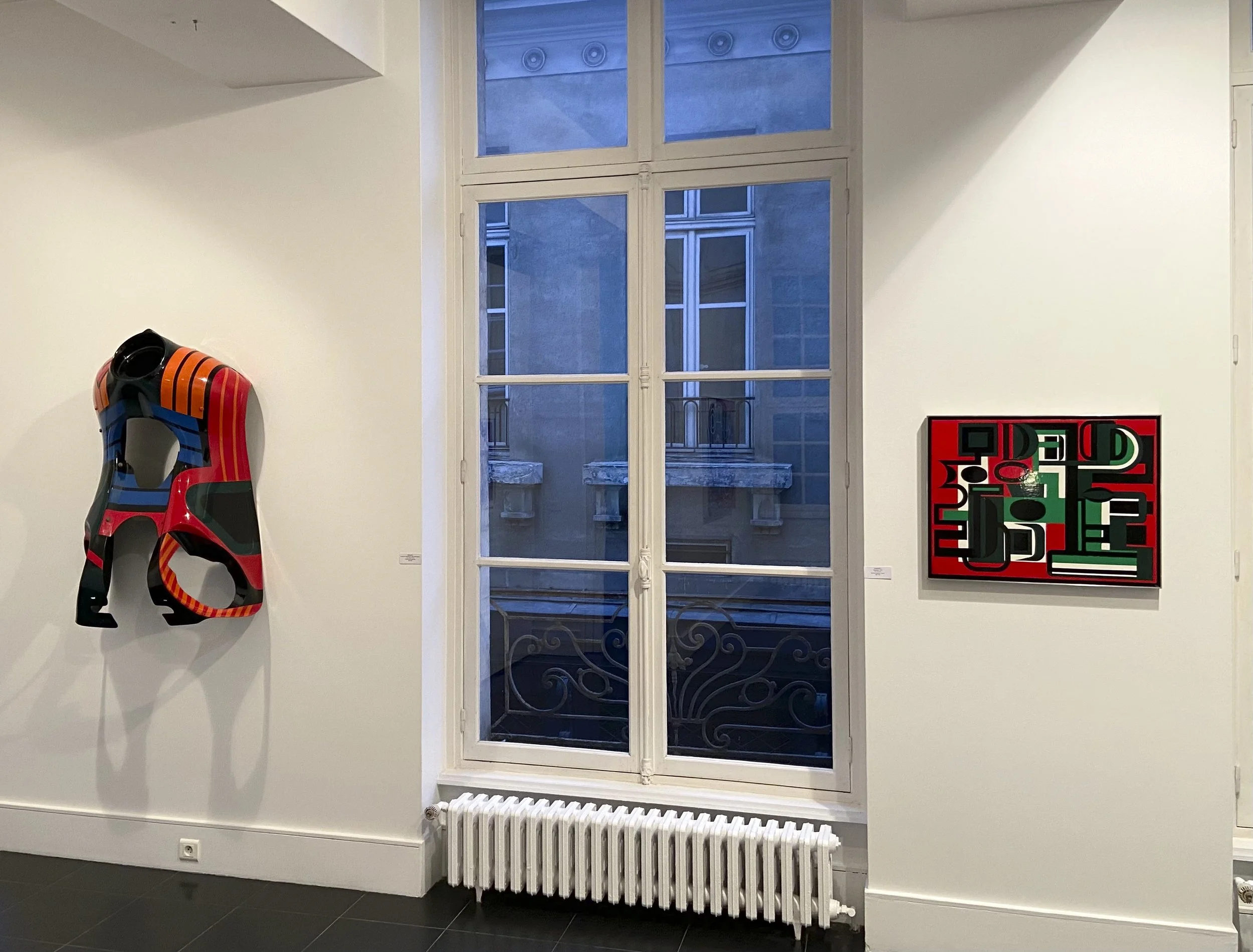
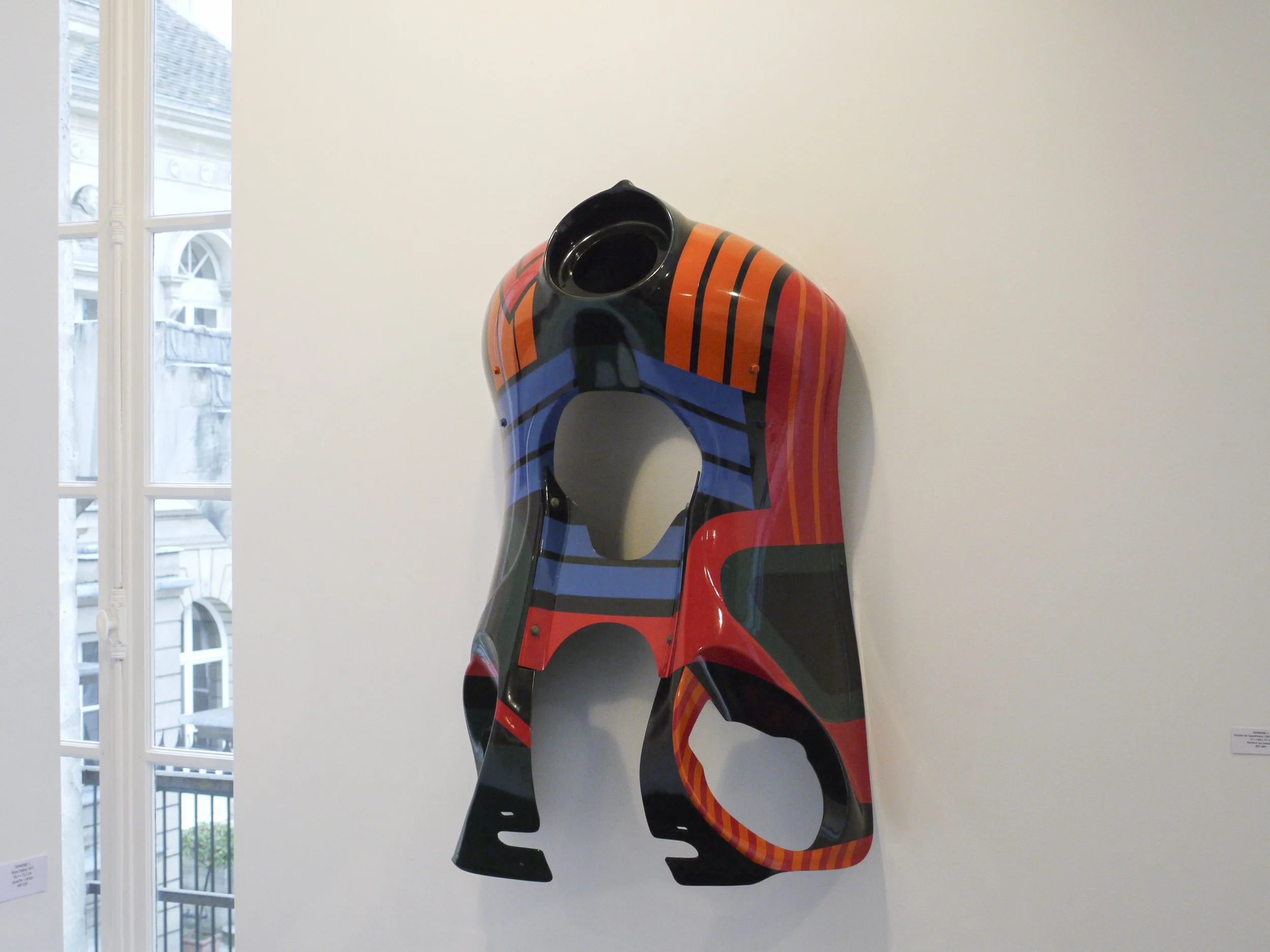
In 1951, he painted *The Apotheosis of Marat*, an immense painting measuring 2.50 meters high x 8.335 meters long (purchased by the French State in 1982 and on loan to the Grenoble Museum, Centre Pompidou, Paris, National Museum of Modern Art/Centre for Industrial Creation). A prototype, painted on metal (1.68 meters x 5.68 meters in eight panels) and dated 1951, preceded it (Derom Collection, Lahumière). Dewasne innovated with the use of glycerophthalic lacquers, an industrial paint that he applied to aluminum, and later to a new, durable material, Isorel, preceding particleboard and plywood. These supports allow us to roughly date his works, which he rarely dated. These industrial techniques resonated with his aesthetic concerns and led him to explore unexpected mediums: car bodies, and rarely motorcycle fairings (Grandeur Moto series), whose volume he painted like a canvas with bumps and hollows. “I found the rear end of a pre-war racing car whose shape intrigued me. I sawed off the base, stood it upright, and realized I could paint both the inside and the outside. It's not a sculpture: it's a painting that, instead of being on a flat surface, is a hollowed or convex surface.”
In 1951, he created his first Antisculpture, The Tomb of Webern (Centre Pompidou), which he painted on the shell of a racing car he bought from a junkyard in Suresnes for
3,000 francs. This shell became, for him, a symbol of modernity. This tribute to the great Viennese dodecaphonist composer, Anton Webern, recalls his passion for music (he was a familiar figure in Pierre Boulez's Domaine Musical) and demonstrates the symbiosis of his plastic and expressive research with mathematics, architecture, and music.
Regarding the term "Antisculptures," Dewasne explains: "It wasn't 'anti,' it was about honesty. Here's the principle of Antisculpture: I started with the visual vocabulary developed on a flat surface, then I asked myself why always do this on flat surfaces, why not on surfaces that evolve in space while preserving the two dimensions of painting? I found ready-made forms in industry that served as my supports, and on which I painted as if they were canvases. I am a painter, not a sculptor." The painter asserts his identity by using the three primary colors in the field of optics, which unify his artistic explorations and form the foundation of his palette: red, green, and blue, with yellow appearing through oscillation. White and black provide harmonies and dissonances within a structuring system that will become increasingly radical.
Industrial colors—the red of fire trucks, the blue of service vehicles—harmonize with a visual language that became his signature. From 1972 onward, the Male Brains series cemented a collaboration with Renault within the framework of the "Research, Art, and Industry" laboratory. He selected chassis parts from Berliet-Saviem trucks, approximately two meters in diameter, from the assembly lines at the Blainville-sur-Orne (Calvados) factory.
Twenty-four Antisculptures were created. With them, Dewasne achieved the synthesis he had been striving for between painting and a support conceived not by a sculptor but by an engineer.
Confronting architecture: a total art form
The Long March 1969
Dewasne lived up to his ambitions when he adapted his
art to the technology of his time. He created photomontages of his "Antisculptures Cerveaux-Mâles" (Anti-sculptures Male Brains), which he integrated into the city (Montparnasse Tower), convinced of the unifying role between abstract art and humanity, thus becoming part of urban architecture.
He shifted scale in his desire to create a total work of art. In 1968, he created murals for the ice rink hosting the Grenoble Olympic Games, followed in 1970 by those for the former library of the Grenoble Museum. This Napoleon III style building, illuminated by vast domes, was transformed by a series of panels measuring 60 meters long by 15 meters wide and 15 meters high. The glossy, lacquered paint trapped the light, creating reflective effects. Created on laminated supports stretched over wooden frames, the Grenoble suite was subsequently rolled up for dismantling, which led to its destruction (as Jean-Claude Lahumière told his daughter Diane).
The Long March, created in 1967, was exhibited in 1969 at the ARC (Centre d'Art Moderne de la Ville de Paris) and in 1981 at the Centre Pompidou. Initially intended for the technical high school in Haubourdin (Nord), it was probably never installed. This masterful work was inspired by Mao's account of the "Long March." Composed like a sonata, presupposing a fragmented journey, interrupted by hardships, which are evoked by the different rhythms and chromatic polyphony, it comprises thirty-six compressed panels, glazed in a kiln, for a total length of 88 meters. During the donations made to the State and presented in 2014, Patrice Deparpe had located only one panel at the Villeurbanne Museum. The others remained untraceable.
Of these two monumental works, only the two editions produced at the time by Jean-Claude and Anne Lahumière following their meeting with Dewasne in 1968 remain. They presented La longue marche at the first Basel fair in 1970.
In his determination to create a total art form in which the viewer enters and experiences the work through interaction, Dewasne, on the advice of Jean-Claude Lahumière, conceived a circular structure: Red Habitacle 1972 (Le Cateau-Cambrésis, Matisse Museum), which echoes the shape of the infinity symbol. The red enamel motifs embrace volumes and concave and convex curves, reflected in the black lacquered ceiling. The culmination of his work on Antisculptures, this penetrable aluminum tube structure houses a circular fresco that "draws us into a whirlwind of highly geometric plastic magic." This monumental, penetrable Antisculpture was exhibited in numerous museums until its final public presentation at the inauguration of the new wing of the Carnegie Institute in Pittsburgh.
In 1975, Dewasne continued his work integrating architectural elements into Renault's headquarters as part of a collaboration with contemporary artists (Arman, Vasarely, Dubuffet, Soto, etc.) initiated by Claude-Louis Renard, the car manufacturer. Dewasne created 40 meters of paintings and alkyd lacquers on wood in the computer room. That same year, he received a commission for the Hanover metro. The destroyed city where Leibniz had lived provided him with a vivid source of inspiration.
Dewasne painted an Antisculpture in situ in 1979, at the invitation of Gori Vaerk, the director of a chemical plant in Koldong, Denmark. It consists of twenty cubic tanks with concentric patterns arranged in three rows of vats and the 7 km of pipes that run through the plant. Also dating from 1979 is a mural, still visible in situ, at the Jean Vigo high school in Millau, of which the town is very proud.
The meeting of painting and architecture: the Grande Arche de la Défense 1986-1989
These monumental achievements in which forms and colors interact in space and allow the "communication of the spirit" convinced the architect Johan Otto Von Spreckelsen, in charge of the design of the Grande Arche de la Défense, to entrust Dewasne, whose Antisculptures he knew, with the creation of the largest painting in the world. Only two sides will be created, measuring 100 meters high and 70 meters wide, covering an area of 15,280 square meters of enamel paint baked at 1200°C on a steel plate. "To fulfill the architect's wish and express the connections that unite thought and human beings, I started with graph theory and imagined tree-like combinations that represent the complexity of the relationships between ideas," he wrote in 1996.
Another monumental Antisculpture in Zeevenaar (Netherlands) for the Stuyvesant tobacco factory became a Homage to Spinoza in a 7-meter-high machine room.
The theme of gigantism continued with an impressive work for the newspaper Politiken in Copenhagen, Denmark, in 1995.
Motifs unfold from the 800 square meters of ceiling, overlooking all the workspaces.
Paintings, Gouaches and Serigraphs
The monumental scale of the painted works integrated into the architecture similarly permeates his paintings, which are always prepared through drawings and sketches focusing on structure and color. These works constitute a parallel activity to which Dewasne devoted considerable attention. They can be described as easel paintings: The Key or the Architect, 1959, lacquered paint on hardboard, Lahumière Collection, Paris; Prometheus I, 1952, oil on hardboard (Daniel Cordier Donation, Centre Pompidou); Big Dipper, 1958 (Daniel Cordier Donation, Centre Pompidou).
Some paintings retain a monumental quality, such as Badia La Grande, 1953 (Jean Dewasne Donation, on loan from the French State to the Cambrai Museum); Aurora (on loan from the Postal Museum, Paris), which relates to the postage stamp issued in 1983.
Numerous screen prints reproduce his monumental works: La Grande Marche, Grenoble 72…
Dewasne, a visionary creator
, opened art to life.
A champion of color and joy.
With his Antisculptures, the need to find ever-larger spaces to be at the heart of the city and its people, and to make society better, became clear. To respond to this utopia, he once again turned to technology. He anticipated graphic software by using a process of montage and collage of images and photographs, which he integrated into the urban environment. Dewasne triggers playful visual surprises within the realm of reality. By liberating color, he creates random spaces based on non-Euclidean geometry, resulting in spatial deformations through continuous transformations following the well-known Möbius strip model defined by topology. Order is supplanted by dreams.
Colorful Anti-sculptures at the Pompidou Centre
In 1970, after discovering the construction model of the Centre Georges Pompidou by architects Renzo Piano and Richard Rogers, Dewasne invited them to his studio, where the heating pipes were painted and surrounded by his Antisculptures. The effect was striking. They were immediately convinced: the gray color initially planned for the Centre was abandoned. "They decided to take this as their model because the problem suddenly seemed obvious to them: the Centre Pompidou would be colorful," Dewasne explained.
In 1956, Dewasne joined the Daniel Cordier gallery, one of his first collectors. For the former secretary of Jean Moulin, who had opened a gallery on rue de Miromesnil that would close in 1964, Dewasne had managed to introduce into abstract painting "the tormented dreams of a Piranesi and maintain an exuberant sensitivity within the most severe of constraints. Geometric painting was cold. He baroqueized it.".
Then the Lahumière gallery will exhibit it in its gallery in Paris and at international fairs (Art Basel)
Institutional recognition
In 1966, the first retrospective of his works took place at the Kunsthalle in Bern.
He represented France at the Venice Biennale in 1968.
In 1993 he was elected a member of the Institute, Academy of Fine Arts, to the seat of Hartung, his friend.
Between 1973 and 1989, successive donations from Daniel Cordier brought Jean Dewasne's works into national and institutional collections: Centre Pompidou, Musée d'Art Moderne de la Ville de Paris, CNAP-FNAC, MACVAL, Statens Museum Copenhagen, Postal Museums, Paris, Villeneuve-d'Ascq, Cambrai, Dunkirk, Abattoirs Toulouse, and others.
In 2012, Mythia Kolesartova Dewasne, the artist's widow, made a significant donation to the French State of the majority of Jean Dewasne's works and archives, of which she was the heir.
This substantial donation, covering the years 1940 to 1990, complements a pre-existing Dewasne collection, thanks to the artist's generosity. The works have been distributed among museums in France: Amiens, Caen, the LAAC Dunkerque, Le Cateau-Cambrésis, Les Sables d'Olonne abbaye Sainte-Croix, Nantes, Pontoise, Rennes, Saint-Etienne, Strasbourg, Villeneuve-d'Ascq, MacVal, museum of modern art Ville de Paris, Centre Pompidou.
In 2014 a major Jean Dewasne exhibition was organised at the Matisse museum in Cateau-Cambrésis, based on the Mythia Dewasne donation.
Jean Dewasne died on July 23, 1999
Lydia Harambourg,
Historian, Art Critic,
Correspondent of the Institute, Academy of Fine Arts