
Auguste Herbin, the majesty of painting
From October 13 to December 17, 2022
Auguste Herbin was the great master of geometric abstraction in Europe from 1945, in the aftermath of the Liberation, until 1960, the year of his death. This period was the most accomplished of his entire body of work, which began at the start of the 20th century following pointillism, continued with fauvism and then cubism, of which he was
one of the major representatives before 1914.
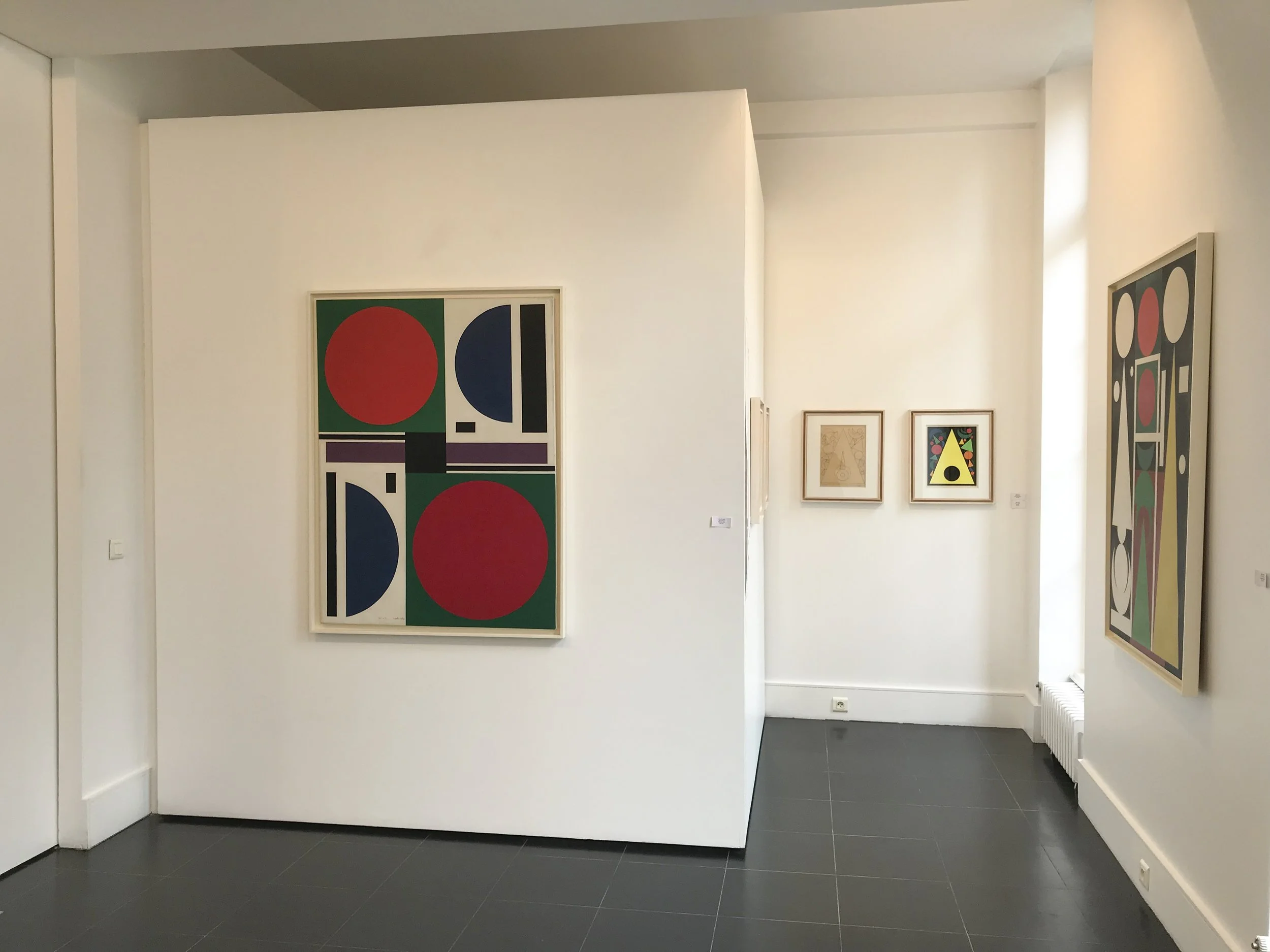
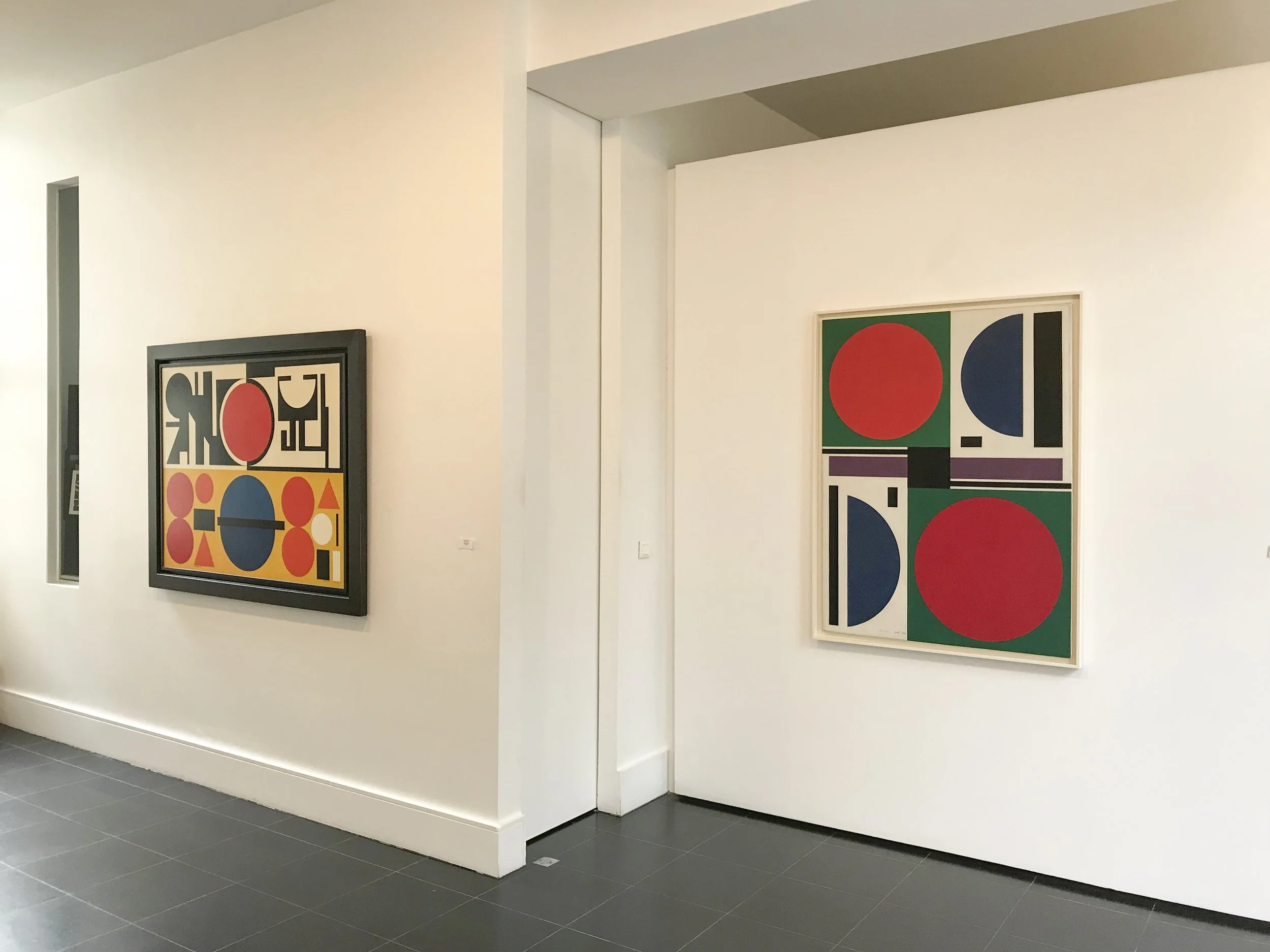
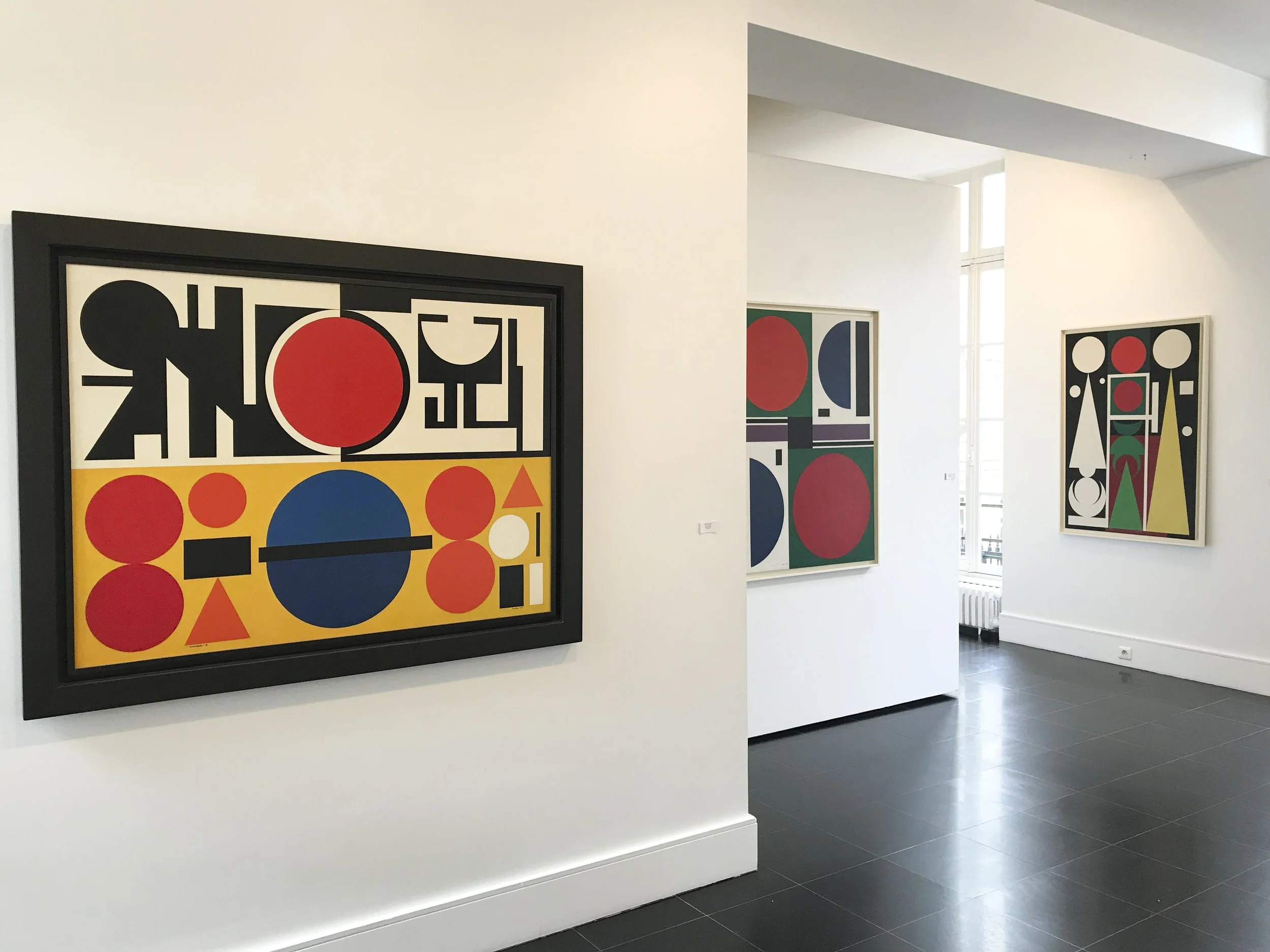
The paintings that Herbin then painted, strictly abstract, composed of simple and vividly colored geometric shapes, which are arranged in the plane and distributed within an orthogonal grid, stand out for the balance given in their structure, the rhythm of their composition, the relationships between their shapes
and their colors, their perfect execution and, what is important, their frontality.
It is the privilege of the Lahumière gallery to be able to offer in this exhibition a selection of 10 paintings from 1948 to 1957 among the most representative of this period, including the famous composition Friday II of 1951, which was seen all over the world after its first presentation that same year at the Salon des
Réalités nouvelles in Paris, then reproduced in many books as an
example of his art.
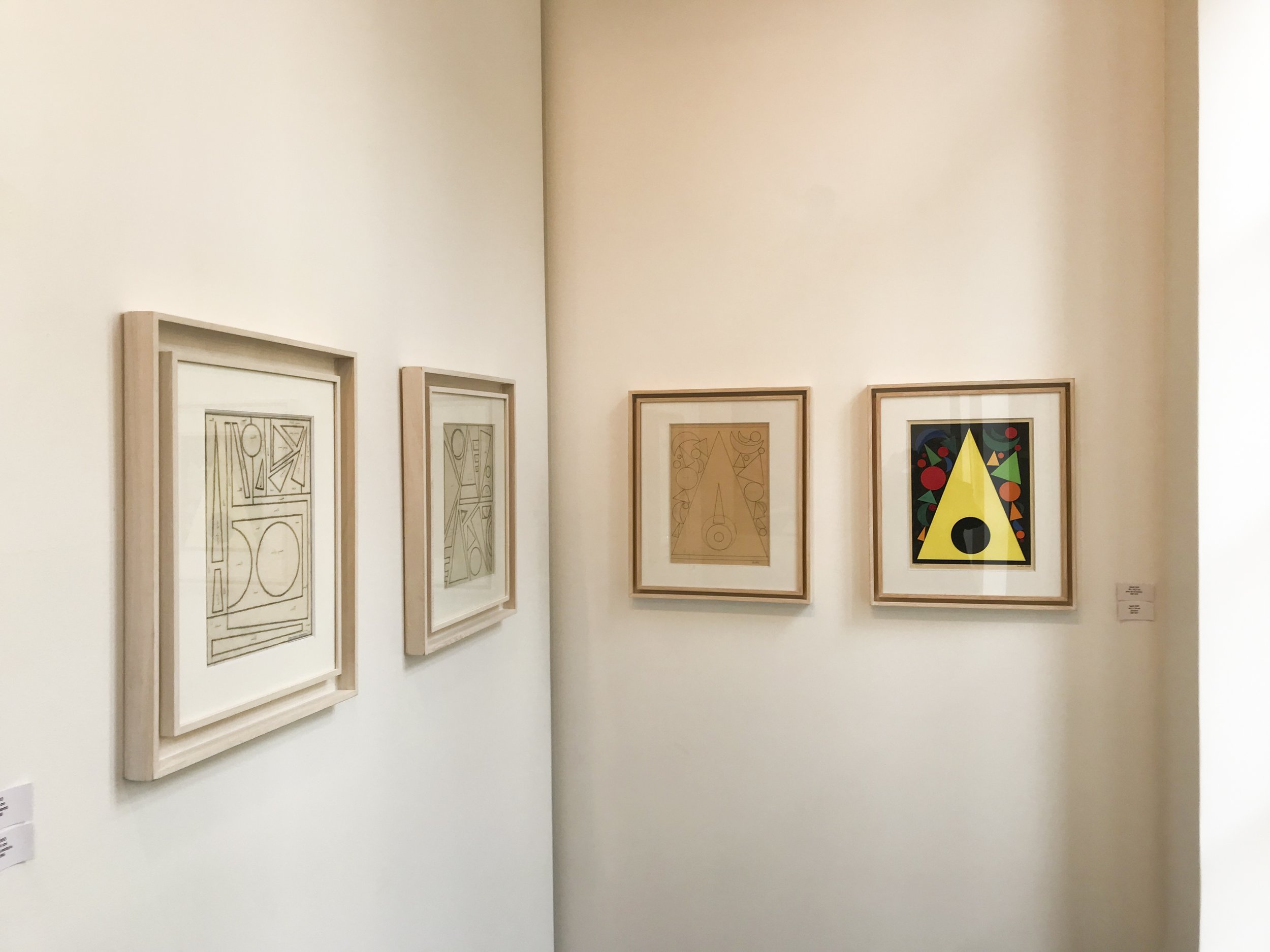
Auguste Herbin then codified his language, though it cannot be described as a system: he defined a vocabulary associating forms and colors and developed a grammar, that is, a way of assembling them, which he called the "Plastic Alphabet," the principles of which he published in 1948 in his book *L'art non figuratif - non objectif* (Paris, Édition Lydia Conti). Starting with a theme, a name, a letter, or a number, he composed his paintings based on his theory: largely founded on the search for a universal language, it was intended, according to him, to be understood and usable by everyone. His compositions were meticulously studied, beginning with a drawing drawn with a ruler and compass, precisely annotated for the choice of colors, before being translated into gouache in a small format, and then executed in oil paint on the canvas,
generally in a large format.
This is what the Lahumière Gallery demonstrates in its presentation, where the final painting is displayed alongside its preparatory drawing and gouache study. This juxtaposition is highly instructive, clearly revealing the element of improvisation that remains within the rigorous calculation governing each work: everything is ordered, yet everything can be changed according to the artist's sensibility, their eye, and, one might say, their inspiration, if such a word were not inappropriate in this context. The placement of circles, crescents, triangles, and squares, their proportions, and their colors can all be modified, from the drawing to the gouache and then to the finished painting. These changes range from a vertical to a horizontal format for the 1955 painting "A"; they focus on specific points for the 1949 painting "Noël," where the elements shift from left to right, are stretched vertically, and their proportions are altered. There are few variations, however, for the painting Summer of 1952. As for the magnificent painting Perfume II of 1954, its composition has gained in clarity, all the forms being well separated in relation to the gouache which ultimately appears more confused.
Where we see a thought at work. Where we witness the creative process. Where we discover that even in the most constrained art, there is room for change.
Auguste Herbin exerted a considerable influence during this period so rich in artistic events worldwide: his paintings, with their majestic presence, were the driving force behind it. The artist's theories also played a significant role, and his book was widely read, discussed, and its contents interpreted. Finally, his personality
undeniably played a significant part, particularly within the Salon des Réalités Nouvelles, which he led, as did the warm welcome he extended to young artists who came to visit him.
More than just his disciples like Henri Lhotellier, numerous artists, inspired by his work, have found their own path and become great creators in France, Belgium, Germany, Scandinavia, and even Iceland. Aurélie Nemours, Jean Dewasne, Carlos Cairoli, Georges Folmer, Vera Molnar, and Nicolas Schöffer, to name just a few of the leading French artists, will be among them, starting in 1960, Victor Vasarely himself, when he created his own "Plastic Alphabet." Geneviève Claisse, his niece and assistant during the last year of his life, would later develop his art in a personal and highly varied way. In Belgium Jo Delahaut, in Germany Günter Fruhtrunk, in Sweden Olle Baertling, in Finland Lars-Gunnar Nordström, in Iceland Erikur Smith are the names that stand out among the great artists of the time, Baertling's painting for example representing well the European equivalent of that of contemporary North American artists among whom we must mention - finally! - the name of Carmen Herrera.
The list is impressive and it doesn't stop: in the next generation, Alejandro Otero, Jean Tinguely, Pol Bury, Yaacov Agam, the members of Equipo 57 must be mentioned and will become the leaders of kinetic art.
Can we ignore Auguste Herbin, one of the glories of French art?
Serge Lemoine,
August 3, 2022