
Aurélie Nemours among friends
Ode Bertrand, Charles Bézie, Jean-François Dubreuil, Gottfried Honegger, Jean Leppien and Henri Prosi
From March 17 to April 29, 2023
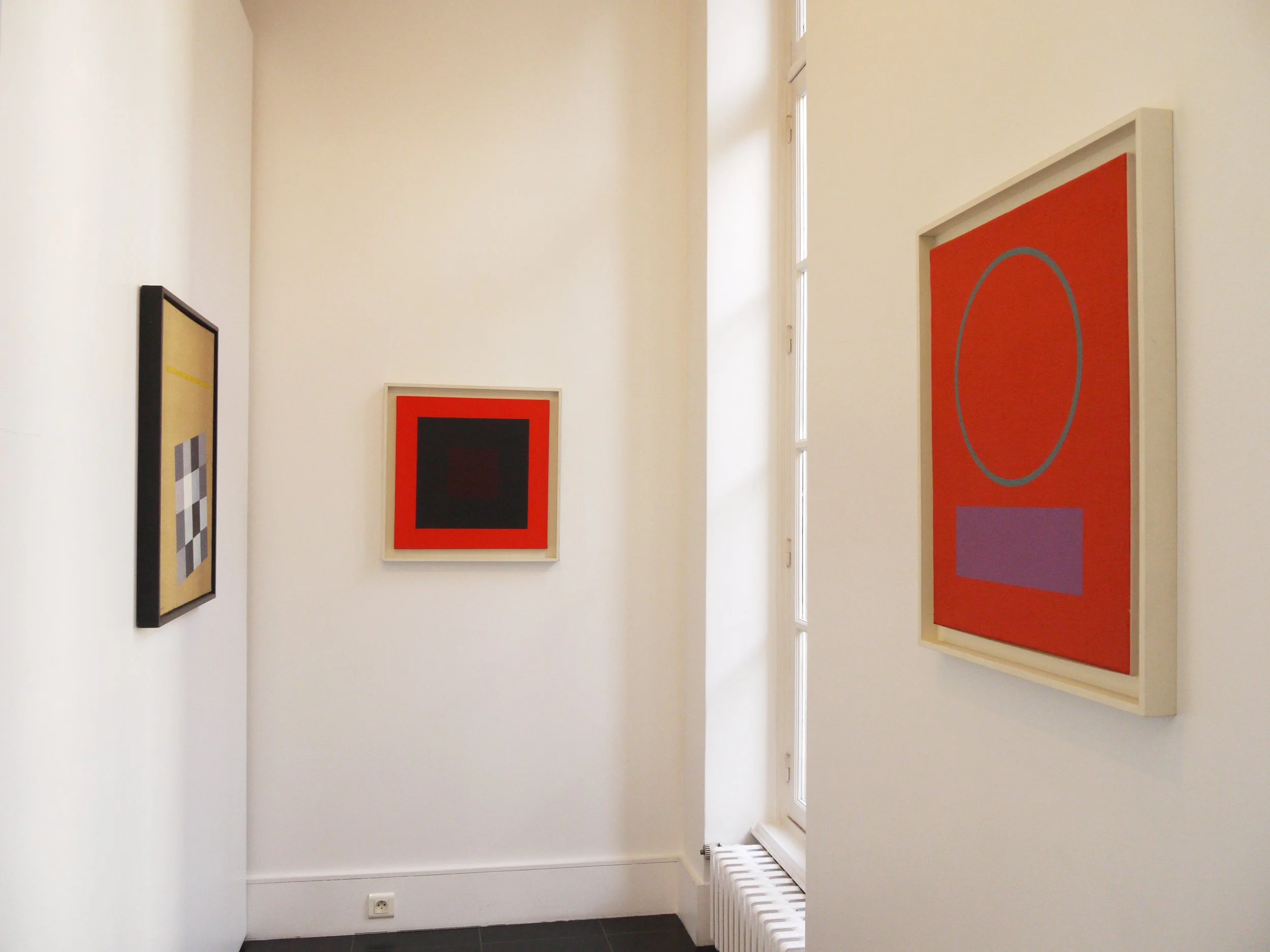
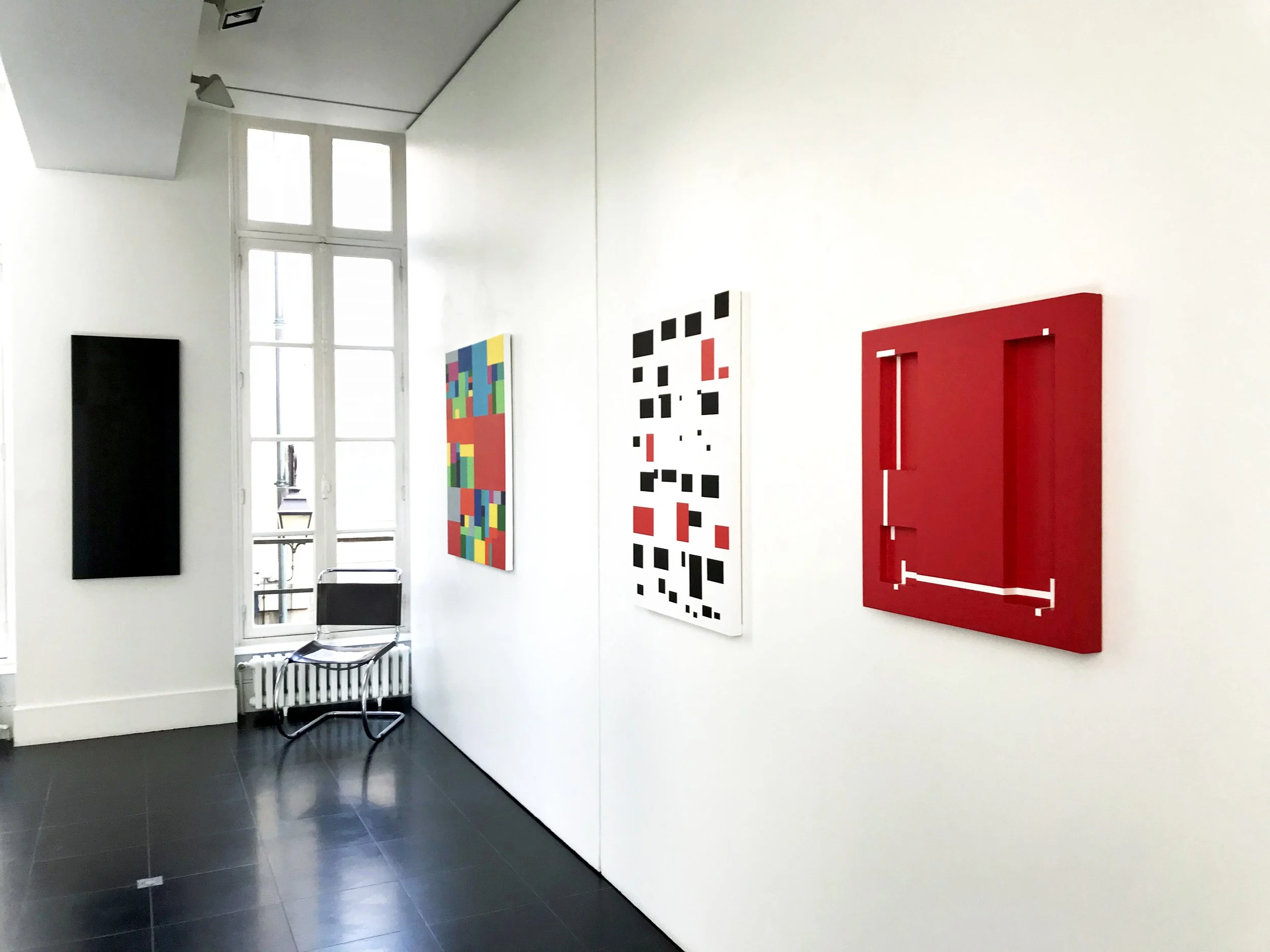
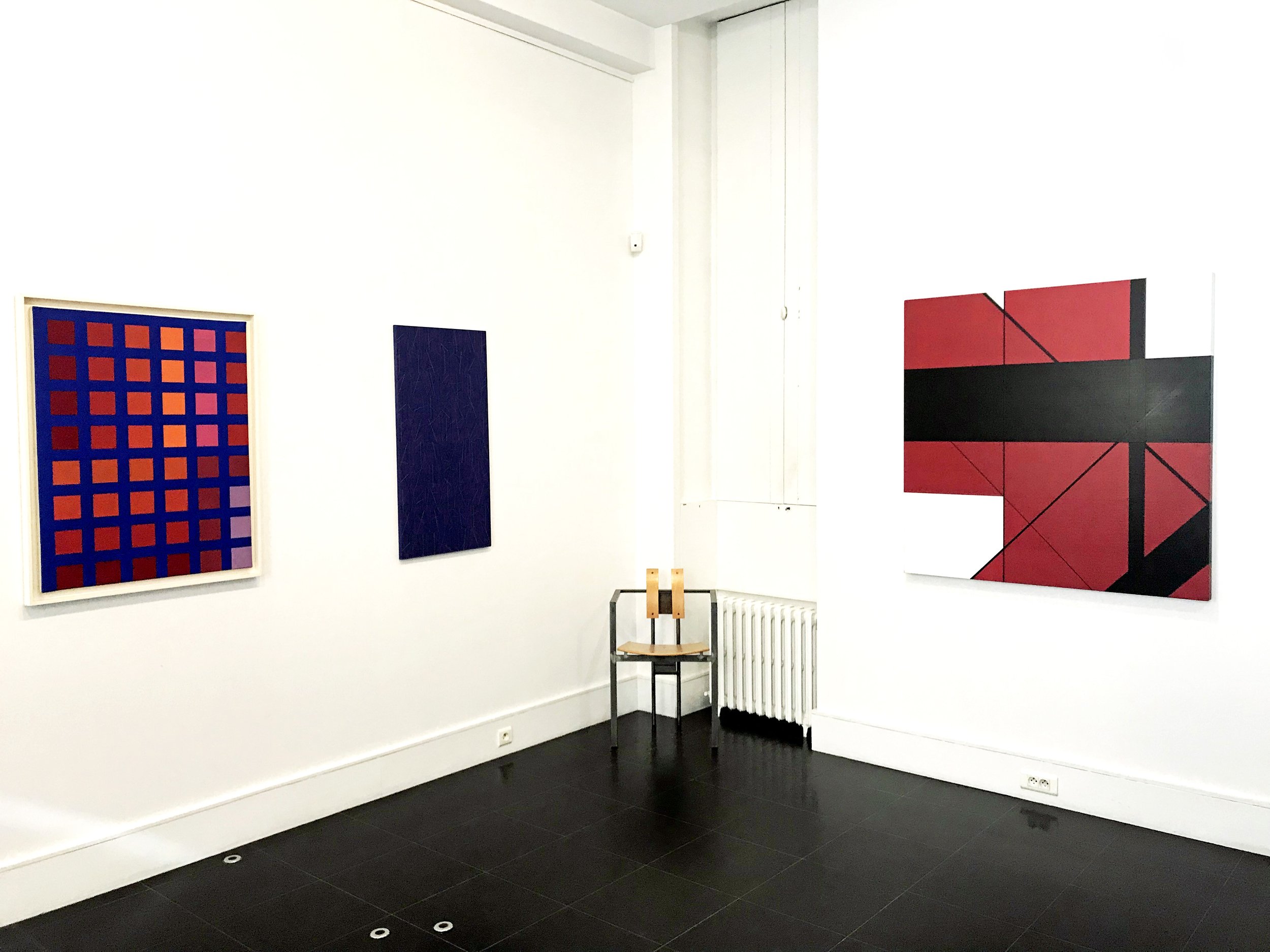
This exhibition brings together, alongside the works of Aurélie Nemours, the works of some of her friends. A major abstract and geometric artist of the second half of the 20th century, Aurélie Nemours (1910-2005) attracted a large number of artists with whom she engaged in many lively discussions about art. Indeed, in her quest for the absolute, she encountered contemporaries such as Jean Leppien (1910-1991), with whom the debates on crosses were endless, and Gottfried Honegger (1917-2016), who greatly supported her and championed constructive art above all else, with strength and conviction.
Among the following generation, impressed by her tenacity and commitment to abstraction, we find Ode Bertrand, Charles Bézie, Jean-François Dubreuil, and Henri Prosi (1936-2010).
Aurélie Nemours, a painter who captures the essence of the moment, has worked in themes and series throughout her career, sometimes moving between color and black and white, creating a body of work she herself prefers to describe as constructed.
Clearly, she touches the hearts of those she and her paintings encounter; few collectors part with her works, and she graces many private homes. Her creations, achieved with tiny brushstrokes, preferably in oil, which she considers a living medium, give her canvases a vibrant quality, reinforcing the mystery, even the mystical quality, of her art.
Jean Leppien, a student of Kandinsky and Albers at the Bauhaus, gradually distanced himself from these influences, embracing a theme of crosses, a path shared with Aurélie Nemours, and especially leading to his famous circles, which he called UFOs (unidentified flying objects). From the outset, his choice of palette was heavily influenced by his surroundings. His numerous stays in the South of France dazzled him; the blue skies and the luminous landscapes—red, green, yellow—ultimately anchored him in Roquebrune, where he found a studio. There is no systematic approach to his compositions, nor to his choice of palette. Even as his work becomes more minimalist, it is no longer Albers's teaching that predominates, but simply his own sensitivity and his Mediterranean environment. His humor and keen eye led him to remark that a painting he had created needed to remain on the wall long enough for him to determine if what he had just painted was truly a painting.
Gottfried Honegger, painter-sculptor, inveterate utopian, and early activist, dedicated his life to defending Constructivist art. Here is what he wrote about his project for a museum of Concrete Art and Aurélie Nemours:
“You too wanted a place where Constructivist art is preserved, experienced by the public.
[…] In the spring of 2004, a utopia will be realized. The art of creators from all backgrounds will unite to act, to serve. At the heart of this building will be a room in which your work will be exhibited.
The Concrete Art space in Mouans-Sartoux—this project, you participated in it, you hoped for it, you inspired it.” "Excerpt from Gottfried Honegger, Homo Scriptor - Les presses du réel - 2004.
From his relief paintings, his reliefs and his sculptures, emerges a unity of purity and emotion, the delicacy of movement and the simplicity of form. Since the 1950s, aleatory geometry has been the essential foundation of his work."
Ode Bertrand, a remarkable painter and keen observer, always eager for a conversation about art and its latest developments, plunged directly into geometric abstraction, bypassing representational art altogether. Having learned from her aunt, Aurélie Nemours, whom she mentored for many years, she was then able to take the plunge. It takes unwavering dedication to create these graphic, magical works using only a ruling pen. As one painting leads to another, and despite claiming to be uncomfortable with color, she eventually embraces it, creating muted tones that contrast sharply with primary colors. But form ultimately prevails, and the series of randomly scattered ribbons, their folds, brings her back to black and white.
Charles Bézie, a lover of numbers, from the golden ratio to the Fibonacci sequence, constantly sought the numerical sequence, like a treasure, that best suited his works. Black predominated in his creations, reminiscent of Nemours in his use of successive layers, but in acrylic, it also demonstrates a technical prowess. He was convinced, for more than one reason, that geometric abstraction was a source of harmony and fulfillment.
Jean-François Dubreuil is still surprised to find himself described as a painter. Yet he follows and discovers with great enthusiasm the works of Aurélie Nemours and Gottfried Honegger, with whom he forges strong friendships. The members of Oulipo would likely have welcomed him into their ranks, given his quantitative analyses of information media. These analyses result in beautiful, existing constructions (the newspaper grid), often saturated with color.
Dear Henri Prosi, after your cut-out canvases reassembled and reconstructed on the painting, you command the line to become more present, the grid finer and more legible. You thicken its stroke, which becomes a band of color, but you prefer the accidental appearance that emerges in your later works. The work in relief, always the line appearing and disappearing in a journey full of volume—what a marvelous journey that was! You left us far too soon to share it with us longer.