
Dialogues
Karina Bisch - Alberto Magnelli
From October 14th to December 16th
For the exhibition "Dialogues: Karina Bisch / Alberto Magnelli," the Lahumière gallery invited contemporary artist Karina Bisch to offer a fresh perspective on the work of Alberto Magnelli, an Italian painter who lived the last forty years of his life in Paris (from 1931 to 1971). The aim? To restore visibility to this major figure of abstraction, whose influence was particularly decisive in the post-World War II period on such important artists as Victor Vasarely, Jean Dewasne, and Piero Dorazio.
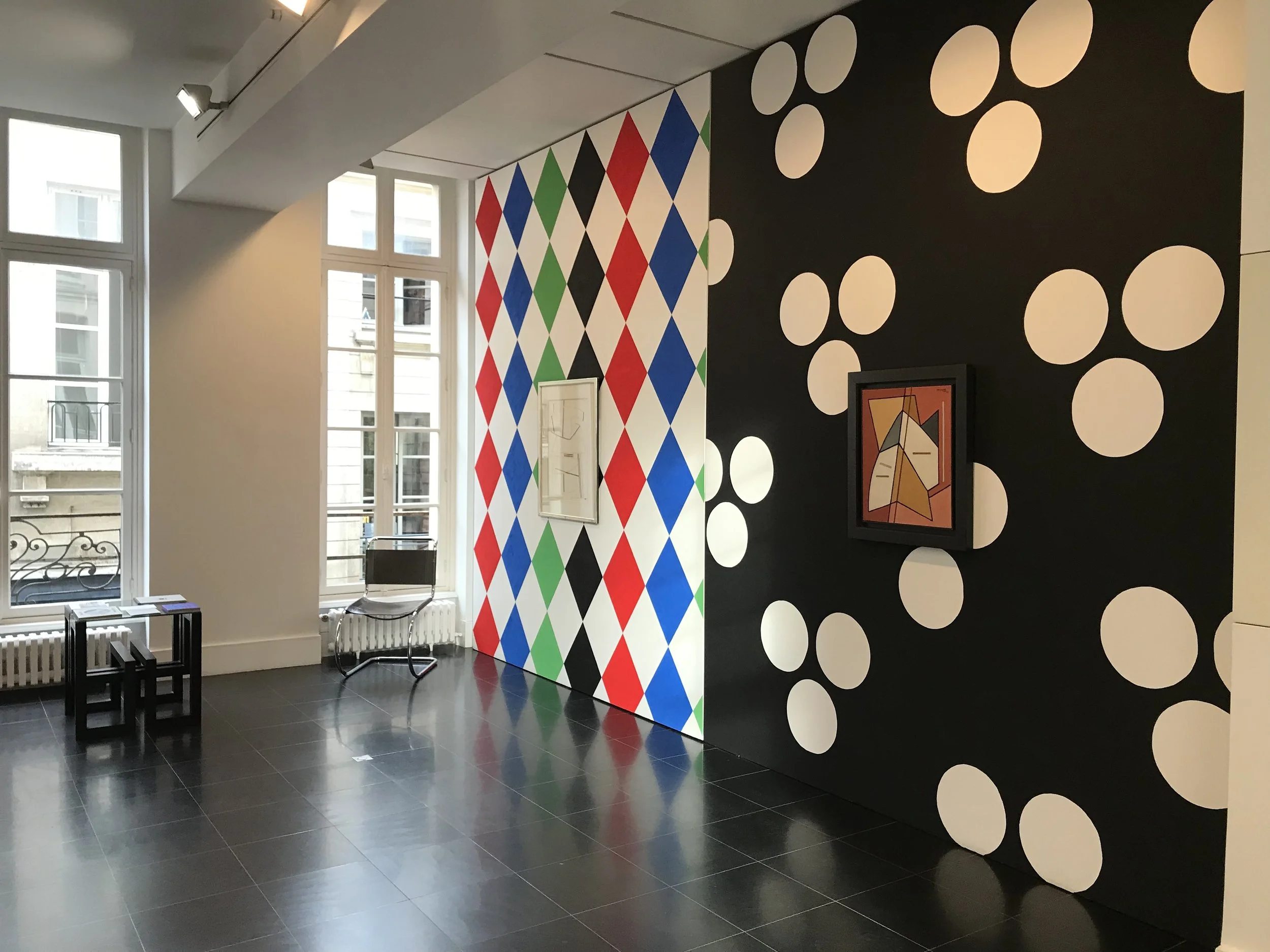
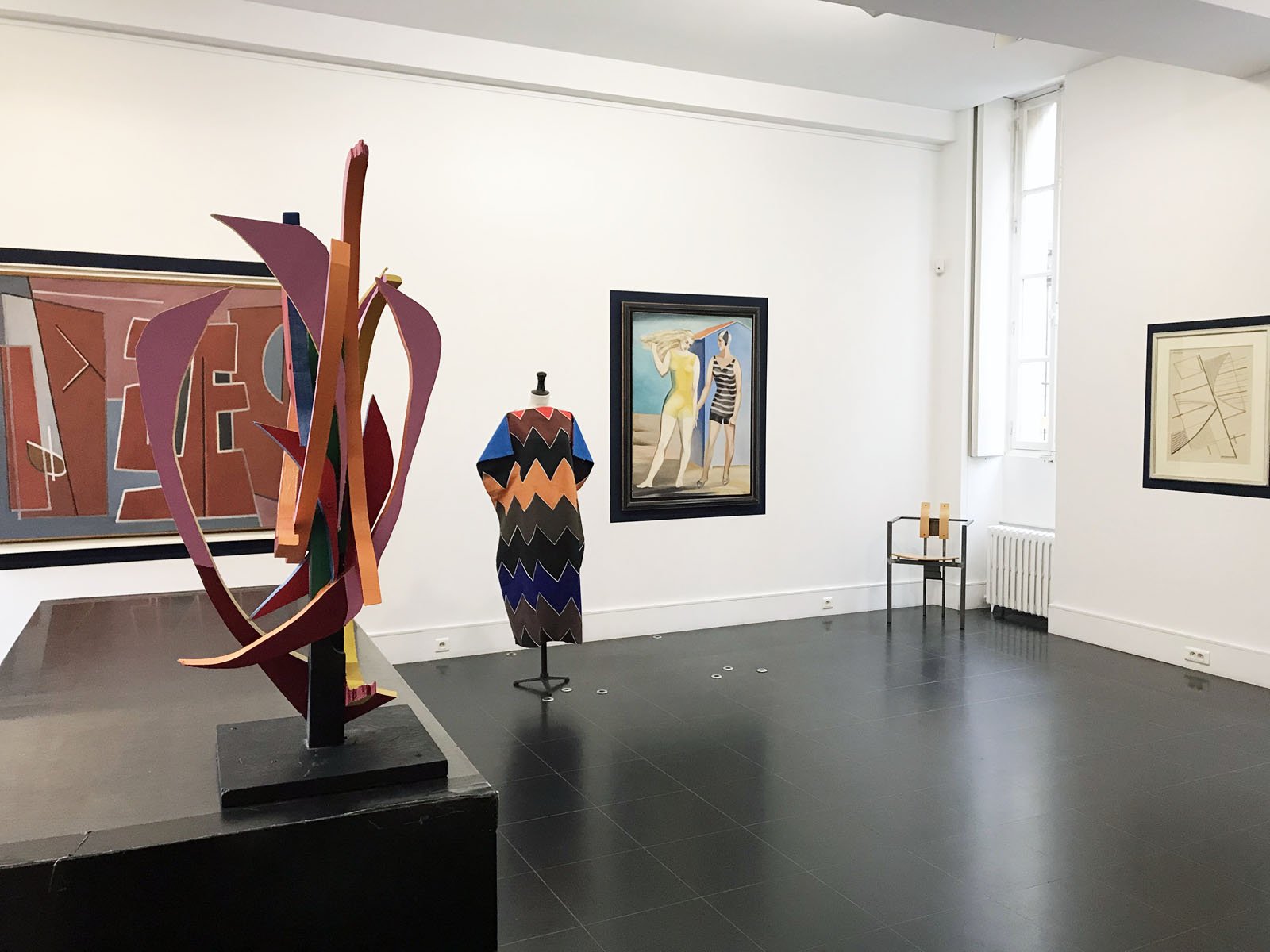
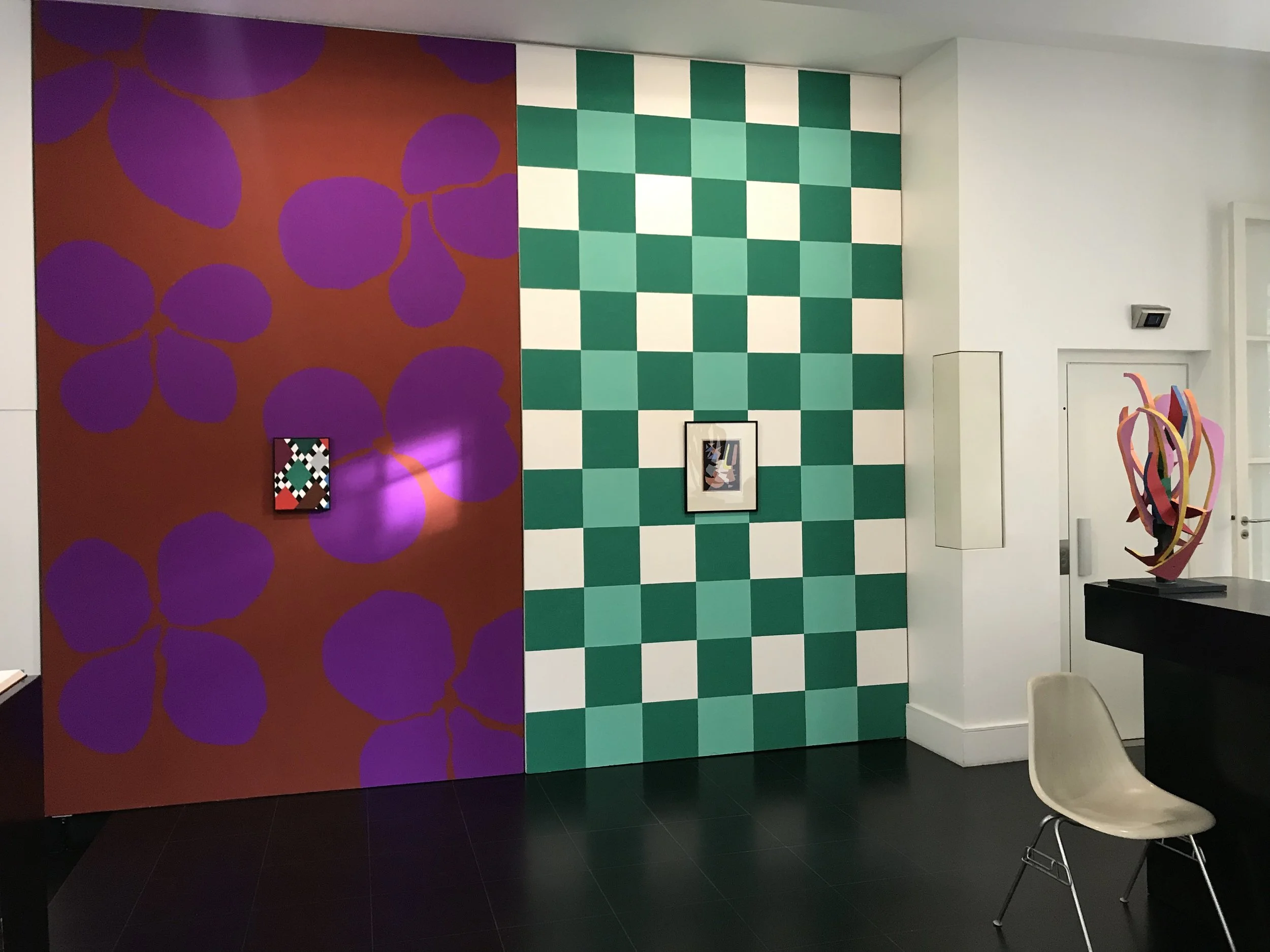
Karina Bisch's intervention, informed by her profound knowledge of the history of the avant-garde and modernism, consisted of juxtaposing her visual world with that of the Italian painter. She initially selected a series of Magnelli's works, most of which date from the 1950s and 60s: oil paintings, gouaches, collages, watercolors, felt-tip pen drawings, as well as a figurative painting from the 1920s. Distributed across the gallery's two floors, some of these works are presented against a backdrop of murals that Karina Bisch created specifically for the exhibition. Working in pairs, they symbolically occupy only the gallery's movable architectural elements and are distinguished by their colorful and unrestrained geometry (green and white squares arranged in a grid, sequences of diamonds or multicolored chevron patterns, large white dots, or brightly colored floral motifs painted on a black background) which evokes the Bauhaus, Russian Constructivism, De Stijl, Matisse, as well as the applied arts and Russian folklore. Karina Bisch thus creates intersections, exchanges, and visual rhymes in a subtle interplay of balance and tension that perfectly reflects the spirit of precision governing Magnelli's painting.
From this plastic richness, resulting from both appropriation and recycling, emanates a creative energy that engages in a stimulating dialogue with the work of Alberto Magnelli, a dialogue that never reaches excess or immoderation. One is then reminded of the beautiful lines that the critic Jean Clay dedicated to the Italian painter: “He is for both the curve and the straight line, for subjective form and for discipline. His forms are simple and massive without being cold or impersonal; dynamic but set against a background that stabilizes them; slender but endowed with a certain static weight (…). ”
Karina Bisch chose to highlight two major works by Magnelli, Tranquil Attitude (1945) and Variation (1959), by displaying them on a large wall deliberately left white, not far from one of his famous Wearable Paints, a textile creation reminiscent of Sonia Delaunay's simultaneous dresses. This work, through which Karina Bisch prompts reflection on the place of women artists in the history of abstraction, is echoed by another painting by Magnelli, executed in 1924, depicting two bathers. Illustrating, through their melancholic elegance, the painter's temporary shift towards a "return to order," this painting serves as a reminder that he was also a very accomplished figurative artist and that the practice of two seemingly antagonistic modes of expression was not necessarily incompatible. Moreover, the Italian painter, at the end of his life, wrote that abstraction "bears the traces of signs that come from very far away." As for the work of Karina Bisch, as Julien Fronsacq pointed out, it: “is well known that it does not seek to break with modernist schemes by developing a third allegorical way as a transcendence of the so-called duality of abstraction - figuration. iii” In addition, the exhibition also reflects the latter’s protean talents, showing two geometric paintings, a polychrome wooden cubist sculpture representing a bouquet of flowers, but also a small embroidery made last summer during her residency in Marfa, thus recalling, in the pure Bauhaus tradition, her attachment to artisanal know-how.
Karina Bisch's unusual and invigorating reinterpretation of Magnelli's work, based on a great freedom of medium, style, and genre, raises questions about the Italian painter's legacy and, more broadly, about post-World War II abstraction. This shift in focus, with its multiple resonances, encourages us to rethink the relationship between the artwork, the exhibition space, and its reception by the public.
Domitille d'Orgeval
i Jean Clay, “Magnelli at home”, Connaissance des arts, March 1968.
ii Quoted by Dore Ashton, “The last works of Magnelli”, in cat. exp. Magnelli, Centre Georges Pompidou, Paris, 1989.
iii Excerpt from the text by Julien Fronsacq “Karina Bisch”, KB, co-published by CNAP, Galerie Les filles du calvaire, ENSBA and Cassochrome, Paris, 2003.