
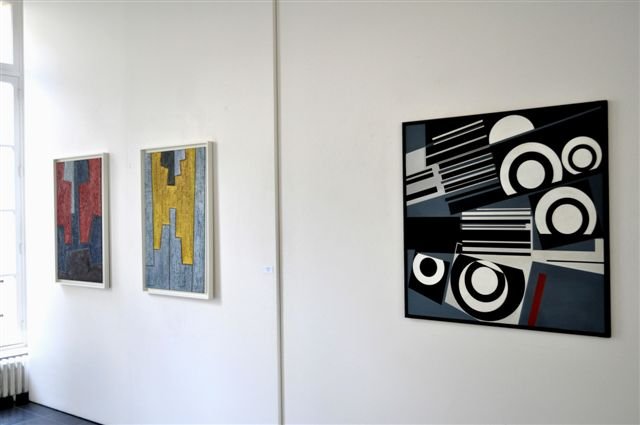
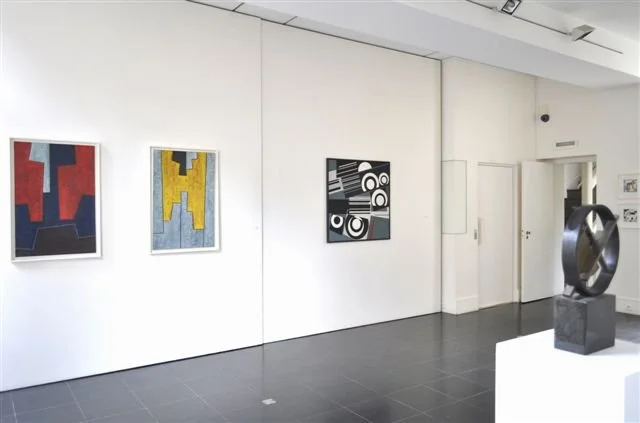
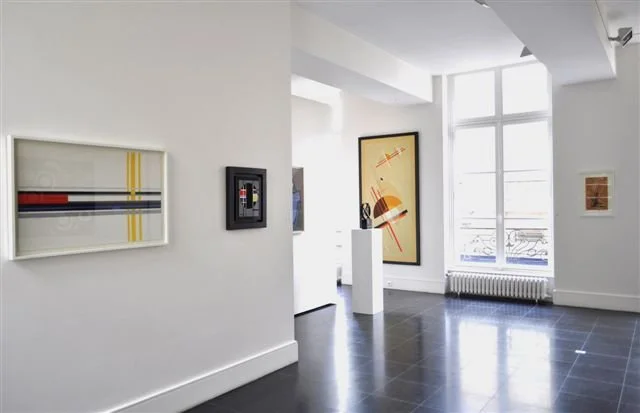
To express, to resonate, to build
Olle Baertling, Marcelle Cahn, Félix del Marle, Jean Dewasne, Georges Folmer, Günter Fruhtrunk, Emile Gilioli, Jean Gorin, Robert Jacobsen, Jean Leppien, Alberto Magnelli, Edgard PIllet, Victor Vasarely
From October 14 to December 17, 2016
For this exhibition, art historian Céline Berchiche has written a text for us. She will also give a lecture as part of the "A Sunday at the Gallery" event, organized by the Professional Committee of Art Galleries on November 27th.
It might seem surprising for a gallery dedicated to constructed and concrete art to inaugurate its fall exhibition with a title containing three verbs, the first of which, "to express," is admittedly rarely used when discussing geometric abstract art. Yet, one cannot ignore the expressive aspect intended by the artists themselves; "creation is the expression of all things within us," wrote Auguste Herbin.
After the Second World War in France, the history of abstract art was written primarily in the press, through a barrage of diatribes for and against, manifestos, and partisan opinion pieces. During the 1950s, abstract art split into two camps: the lyrical and the geometric, the latter being labeled "cold" in contrast to the former—a pejorative term for a convenient division easily assimilated with its own explicit vocabulary: the lyrical express, the geometric construct.
Now, with the historical and critical perspective we possess, coupled with the multitude of resources at our disposal, particularly the archives and writings of these artists, we are able to understand this movement differently. In light of this, it no longer seems scandalous to say of an artist who has chosen geometry as their language that they are expressing their individuality or that they want their art to resonate with the rhythm of the universe. This is no longer scandalous, since that is what these artists themselves say. The cosmic aspect of Victor Vasarely, the naturalism of Jean Leppien, the vibrancy of Olle Baertling, the Florentine style of Alberto Magnelli, or the baroque of Jean Dewasne cannot be ignored.
One can be a builder, a pure geometrician, and still want to express oneself; this is not contradictory. To verify this, one need only look at the works and read these artists. This exhibition, which presents works by nine artists of different styles and generations, demonstrates this, offering a broad panorama of the history of geometric abstract art. Neo-plasticism, very well represented in the exhibition by the key figures of Felix Delmarle and Jean Gorin, but also Concrete Art, Abstraction Création, Salon des Réalités Nouvelles, the Atelier d'Art Abstrait created by Jean Dewasne and Edgard Pillet, Groupe Espace, Groupe Mesure with Georges Folmer—the nine exhibiting artists all actively participated in one or more of these movements, united by a common goal: to contribute, through their works, to a modernity in the making.
Olle Baertling in the new center of Stockholm, Edgard Pillet in Tours and in numerous public buildings in France and Africa, Vasarely in Montparnasse, Tel Aviv, and Caracas, Jean Dewasne in La Défense, Hanover, Copenhagen, and Rome, Emile Gilioli in Grenoble, on the Glières plateau, and elsewhere—these artists inscribed their works in space and territory, transcending the individual for the greater good.
This exhibition sheds light on a historical period that allows us to reflect on what remains of this spirit, for behind it lies the idea of a synthesis of the arts. Beyond the paintings and reliefs on display, the various architectural integrations created by these artists throughout their careers testify to their engagement with reality and society. One can simultaneously express, feel, and build. It is fortunate that the Galerie Lahumière has brought them together around this theme.
Céline Berchiche