

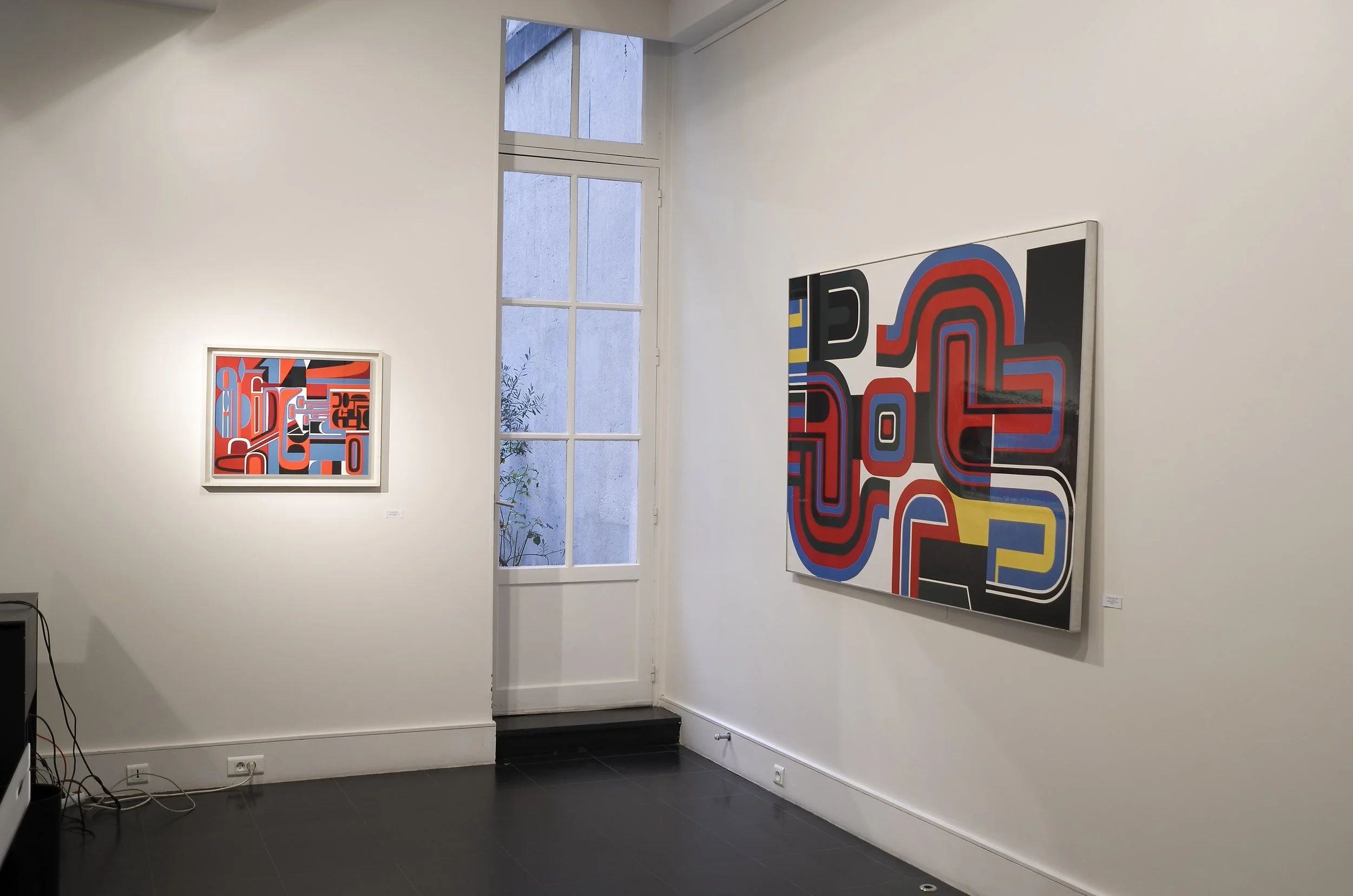


Revisit Dewasne
From October 17 to December 20, 2014
From the early 1950s, Jean Dewasne opted for glycerophthalic lacquers on hardboard or metal supports, which offered superior qualities of brilliance and intensity, reflecting the splendor of a mechanized world. The great attention he paid to the materials of his work is characteristic of his concern "not to waste time." In his Treatise on Flat Painting, he recommended consulting treatises on colorimetry, photometry, and the physiology of vision. This materialist approach justified the path of abstraction, the rejection of imitation in favor of the plastic possibilities of the work. The artist's interaction with his material anchors abstract painting in a concrete relationship to reality: "Nature in its totality is present both in the painter, in the material used, in the laws that govern both, and in the phenomena that animate them."
*: Excerpt from the Treatise on Plane Painting, Jean Dewasne - Introduction by Gérard Denizeau, Minerve Editions, Paris, 2007
Text by Ariane Coulondre, taken from the catalogue Jean Dewasne - Matisse Museums of Le Cateau-Cambrésis, LAAC, Dunkirk and Cambrai. Somogy Editions 2014